The Chemistry of Survival
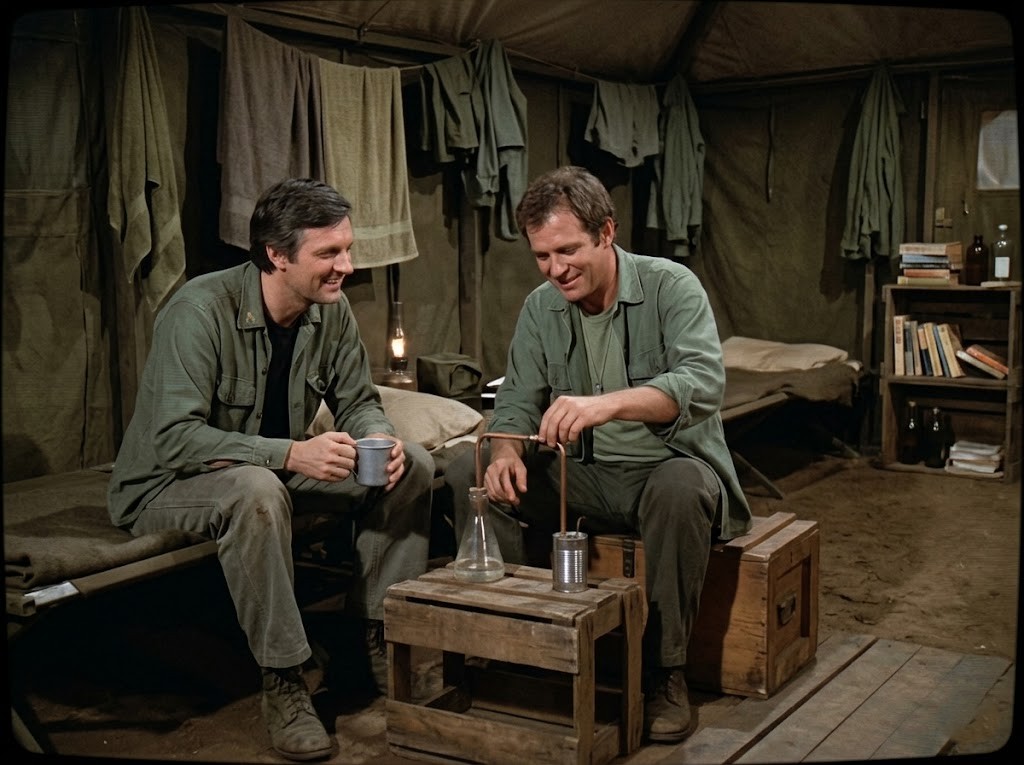
The mud outside was deep enough to swallow a jeep, and the sound of distant artillery never really stopped. But inside the Swamp, the world shrank down to the size of a single wooden crate, a dented tin can, and the steady, rhythmic drip of homemade gin.
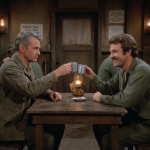
Hawkeye Pierce sat on the edge of his cot, cradling a battered metal cup like it held the secrets to the universe. Across from him, B.J. Hunnicutt leaned over their makeshift laboratory, his fingers gently adjusting the copper tubing that ran from a glass flask into a tin condensation can.
They were exhausted, the kind of bone-deep tired that seeps into your teeth after thirty-six straight hours in O.R. Their olive-drab shirts were rumpled, their boots caked with the red Korean clay, and their eyes bore the heavy shadows of a war that refused to take a break. Yet, looking at the slow assembly of their latest batch of “Swamp water,” both men were smiling.
It wasn’t about the alcohol, not really. It was about proving that in a place designed to tear human beings apart, they could still build something.
“You know, Beej,” Hawkeye said, his voice a low, raspy drawl as he watched B.J. tinker with the copper pipe. “If my chemistry professor from Ohio State could see me now, he’d probably award me a doctorate. Or have me arrested. Honestly, it’s a coin toss.”
B.J. didn’t look up, his focus entirely dedicated to ensuring the seal on the tube was airtight. “Your professor never had to operate on a shifting timeline while a North Korean mortar crew practiced their aim on the nearby ridge, Hawk. This isn’t bootlegging. It’s medical necessity.”
“Exactly,” Hawkeye agreed, tapping his metal cup against his knee. “Sanity in a glass. Or at least, sanity adjacent. How’s the pressure looking on that contraption?”
“Delicate,” B.J. murmured, giving the copper pipe a final, meticulous nudge. “One wrong move and we don’t get gin; we get a small explosion that takes out our laundry line. And frankly, I only have two clean pairs of socks left.”
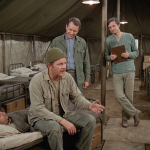
They laughed, a quiet, shared sound that stayed low under the canvas roof. Around them, the Swamp was a testament to temporary living: towels hung on strings to dry, crates served as tables, and a single lantern cast a warm, amber glow over the dusty floorboards. It was a fragile sanctuary, but it was theirs.
B.J. sat back on his wooden box, satisfied with his engineering. He looked at Hawkeye, the humor in his eyes softening into something more grounded, more human. “It’s coming through clear this time. No rust color.”
“A vintage year,” Hawkeye joked, though his smile faded just a fraction around the edges. He looked down at his empty cup. “We needed this tonight. After that kid from Omaha… I didn’t think my hands would stop shaking.”
B.J. reached out, resting a hand briefly on the wooden crate between them. “They stopped, Hawk. You did good out there. We both did.”
The silence that followed wasn’t heavy, but it was thick with the memory of the operating room—the smell of ether, the bright, harsh lights, and the relentless ticking of the clock. They sat there, two doctors thousands of miles from home, waiting for a drop of liquid comfort to break the spell of the evening.
Then, the tent flap rustled.
Both men froze. It wasn’t the frantic entrance of Radar announcing incoming wounded, nor was it the booming authority of Colonel Potter. The silhouette standing in the dim entryway was sharp, rigid, and carried an unmistakable air of New Boston aristocracy.
Charles Emerson Winchester III stepped into the warm glow of the lantern, his nose wrinkled in immediate distaste as his eyes fell upon the copper still.
“An absolute circus,” Charles declared, his voice dripping with refined scorn as he crossed his arms. “I leave the tent for twenty minutes to seek a moment of cultured solace, and I return to find the local hillbillies operating an illicit distillery in our quarters.”
Hawkeye didn’t flinch. He merely raised his metal cup in a mock toast. “Come on in, Charles. Pull up a crate. B.J. here has just mastered the delicate art of the copper drip. We’re thinking of franchising.”
“I would rather ingest battery acid,” Charles snapped, though he didn’t leave. Instead, he stepped closer, his eyes tracking the slow, agonizingly deliberate path of a single drop of clear liquid forming at the end of the copper pipe.
B.J. watched Charles with a quiet, knowing grin. He knew the arrogance was just Charles’s version of a lightning rod—a way to channel the pressure of the 4077th away from his heart. “Don’t knock it until you’ve tried it, Charles. It’s got notes of pine, tin, and just a hint of desperation.”
“What it has,” Charles said, stepping up to the wooden crate and peering intently at the glass flask, “is a glaring flaw in its thermal distribution. You fools are cooling the vapor far too quickly. The condensation will be erratic.”
Hawkeye and B.J. exchanged a quick, amused glance.
“Oh, really?” Hawkeye asked, leaning forward, his wit sharpening. “Pray tell, Dr. Winchester, how does one properly refine the nectar of the swamp?”
Charles sighed, a deeply dramatic sound of a man burdened by the ignorance of his peers. He reached out, his manicured fingers surprisingly precise as he adjusted the angle of the tin can, shifting it barely a fraction of an inch to better catch the flow.
“The angle must be true,” Charles muttered, almost to himself, his defensive posture melting away for a brief second. “If you do not respect the process, the result is nothing short of barbaric.”
For a minute, the three of them just stood there, gathered around a crude pile of junk on a wooden box. The resentment, the class differences, and the arguments about classical music versus loud jokes vanished. They were just three tired men looking for a distraction from the reality waiting outside the canvas walls.
The first full drop fell into B.J.’s cup with a sharp *clink*.
B.J. lifted the cup, took a microscopic sip, and swirled it around with the air of a sommelier. He smiled, a warm, genuine expression that reached his eyes. “Perfect. Tastes like home. Well, if home was a garage.”
He passed the cup to Hawkeye, who took a drink, closed his eyes, and let out a long, appreciative breath. The tension in Hawkeye’s shoulders visibly dropped, the ghost of the O.R. finally fading into the background. He extended the cup toward Charles.
Charles looked at the battered metal, then at Hawkeye, and finally at B.J. He hesitated, his pride warring with the collective fatigue that spared no one in this camp. Slowly, with all the dignity he could muster, Charles took the cup.
He took a sip. His face contorted slightly, but he didn’t spit it out. He swallowed, cleared his throat, and looked at the two of them.
“Adequate,” Charles pronounced stiffly, though he didn’t immediately hand the cup back. “Slightly unrefined, but… adequate.”
“That’s the highest praise we’ve ever received,” B.J. laughed, leaning back against his cot.
Outside, the heavy thud of a distant shell echoed through the hills, a reminder of where they were and what tomorrow would bring. But inside the tent, under the warm light of a single lantern, the drop kept dripping, the cup kept moving, and three friends found a way to survive another night.
In a place where everything felt temporary, the bonds forged over a tin can and a shared cup were the only things that stayed permanent.