The Longest Two Seconds in Korea
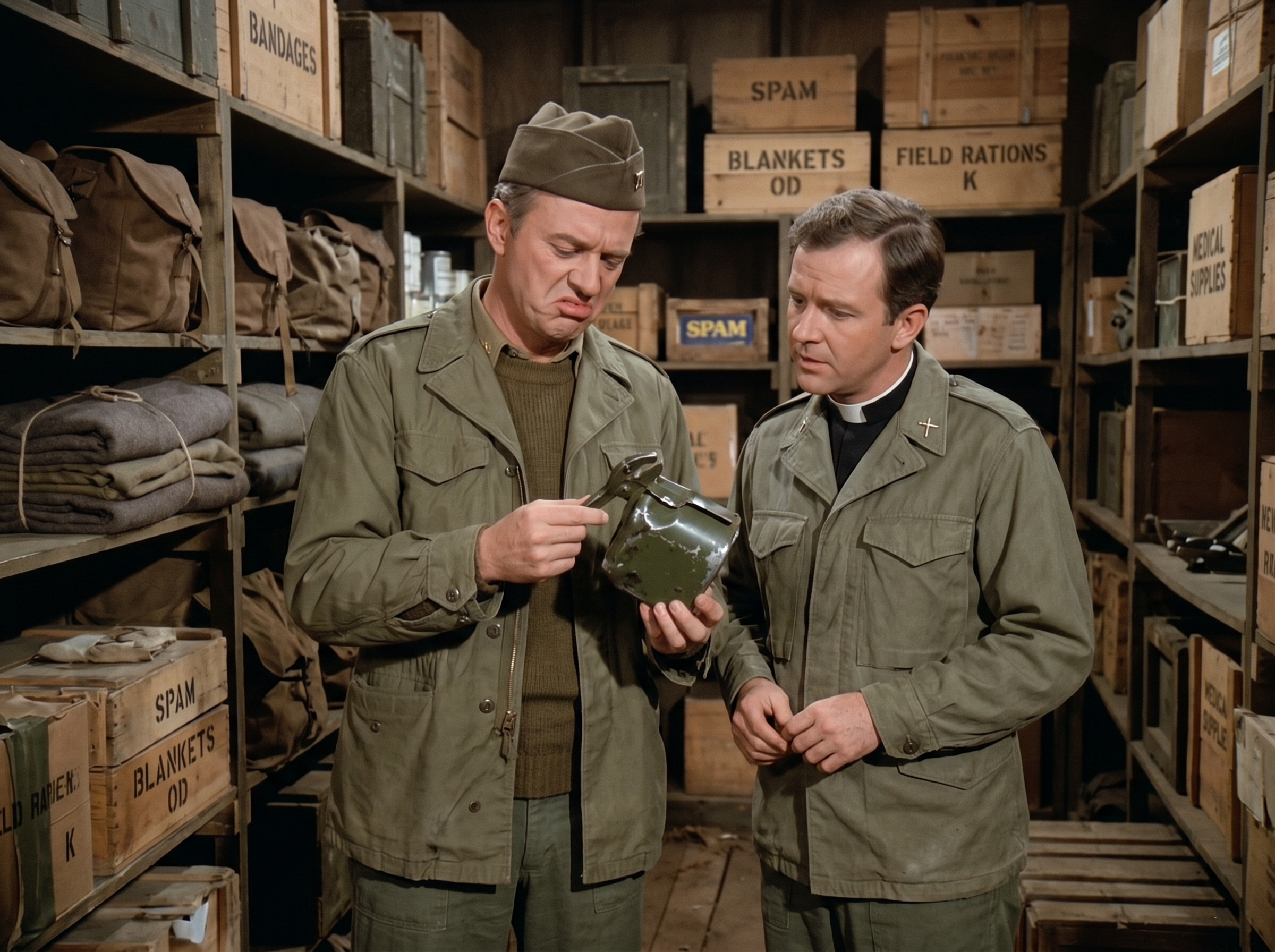
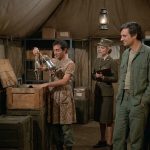
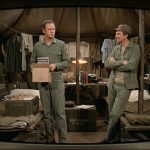
Sometimes, in the endless routine of the 4077th, time didn’t just drag—it came to a grinding, agonizing halt over the smallest things. Like right now. In the cramped chaos of the Supply Tent, framed by stacks of ‘SPAM’ and ‘BLANKETS OD,’ two men were frozen, staring with equal parts horror and fascination at the dented green artifact in their hands.
It wasn’t a bomb. It wasn’t a lost supply list. It was much worse.
It was the very last can opener in camp. The good one. The one that actually worked, the sturdy, crank-handled P-38 type that *didn’t* turn every opening into an act of industrial sabotage.
Major Charles Emerson Winchester III, with his garrison cap tilted back on his refined head and a look of profound, high-society distress that could peel the paint off a surgical lamp, held the offending item. He was holding it the way a master chef might hold a single, overcooked soufflé—with a grimace that mixed aristocratic outrage and genuine despair.
Beside him stood Father John Mulcahy, his kind, observant face etched with a parallel, softer concern. The Father always saw the deeper ripples of trouble, and he saw them now. A broken can opener, when the whole camp was subsisting on canned rations waiting for the supply train to crawl past the frontline? This was a crisis of morale disguised as kitchen grease.
“It is,” Charles muttered, his voice dropping into that rich, sarcastic baritone that usually announced a coming storm, “the absolute zenith of Army engineering. This is what we are reduced to, Father.”
His gaze never left the twisted, greasy piece of metal. He was practically vibrating with the urge to find Colonel Potter and demand a helicopter escort to Seoul for a new one. “It doesn’t just not *open* the can, John. It actively *assaults* it. Have you seen the jagged metal left on the Field Rations K? A surgical hazard, that’s what it is.”
Father Mulcahy, ever the gentle peacemaker, tried for optimism. He shifted his stance, but his worry mirrored Charles’s distress. “Well, perhaps we can, um, just gently coax it back into shape? A little ingenuity? The men are quite resourceful, and…” He trailed off, his voice softening as Charles’s face twisted into an even tighter expression of utter, theatrical disdain. Ingenuity wasn’t his strong suit; proper, high-quality, non-exploding tools were.
The tension in the tiny, cluttered space was thick enough to require its own SPAM ration card. Stacks of canvas bags and more wooden crates labeled ‘MEDICAL SUPPLIES’ watched them silently. The weight of that broken little tool felt immense. Without it, the precarious ecosystem of camp meals, already stressed to the max, would collapse into a landscape of frustrated grunts and jagged tin. Every eye that would later look to Charles for leadership in the OR would now look to him with accusation over cold, impenetrable ration tins.
That was the high point of the tension. The profound silence that followed. Two intelligent, capable men, reduced to a frozen state of helpless disgust and worry by two ounces of twisted metal, while the entire chain of command and digestion hung in the balance.
Charles continued to glare at the can opener as if he expected it to spontaneously repair itself through the sheer force of his patrician disapproval. He didn’t drop it; he held it precisely, like a defused grenade that might still go off at any second. Father Mulcahy simply waited, knowing that arguing against Charles’s theatrics was futile, and hoping for that moment of pragmatic resignation that always followed the initial, operatic outburst.
It was in that silence that the tent flap rustled, and the sound of someone whistling a cheerful, entirely-out-of-place tune cut through the gloom. It wasn’t a melody of war or distress; it was more like something heard at a 1930s seaside resort.
Corporal Radar O’Reilly bounced in, a stack of mail clipped under his arm and a pencil tucked neatly behind his ear. He saw them instantly. He saw the grimace. He saw the posture. And then his gaze dropped to the object Charles held with such delicate revulsion.
He stopped, his cheerful whistle evaporating into a tiny gasp. “Golly, Major Winchester.”
“Corporal,” Charles boomed, not breaking his stare. “Your timing, as always, is impeccably disastrous. Perhaps *you* can explain why the United States Army can produce nuclear bombs but cannot supply a single functioning, metal-biting utensil to its front-line surgeons?”
Radar’s eyes, magnified by his glasses, darted from Charles to the can opener, and back again. He didn’t seem panicked. In fact, a small, subtle knowing smile began to form on his lips, the kind that came from a lifetime of being underestimated in a world full of big ranks and bigger crises.
“Oh, *that*,” Radar said, his voice quiet but assured. “Yeah, I heard that one was, uh, acting up.”
Father Mulcahy leaned forward slightly. “We are quite desperate, Corporal. The whole camp’s sustenance…”
“It just needs a trick,” Radar said. He didn’t ask permission. He just reached out, very carefully, and with a surprisingly tender, nimble touch, took the broken object from Charles’s stiff fingers.
Charles didn’t resist; he was too stunned by the audacity. The Father watched with bated breath.
Radar held the opener, not in his fist like a weapon, but cupped in his palms like a small, injured bird. “It’s not broken-broken,” he said, turning it over. “It’s just… the crank gear is jumped.” He gave a little, delicate *snick* to the mechanism, a move that looked like magic and smelled like grease.
“Look, you just gotta, sort of, *coax* it,” Radar explained, holding it up so they could see the small adjustment. He made a gentle, confident motion, and the mechanism clicked back into its correct, aligned groove with a satisfying, functional sound that seemed to echo in the packed tent.
He smiled, a genuine, simple grin that had no rank, no sarcasm, and no pretense. “She just needed a gentle hand, that’s all. I’ll make sure the mess tent knows the ‘trick’.” He looked at Father Mulcahy and then, very calmly, handed the now-functional can opener back to Major Winchester. “Sir.”
There was another silence. A completely different kind of silence. The tension hadn’t just resolved; it had evaporated, replaced by a quiet, warm sense of awe and humanity. Charles looked at the opener in his hand, then at the young Corporal, and back at the opener. He didn’t glare. His face softened, just for a fleeting second, into an expression that wasn’t quite a smile but was definitely respect. It was the same look of genuine, grudging appreciation he’d occasionally give Hawkeye for a clever surgical innovation.
Father Mulcahy simply beamed, a soft, profound chuckle bubbling up from his chest. “Bless you, Walter. In a world of chaos, it’s often the simplest touch that restores order.”
Charles cleared his throat, adjusting his garrison cap and returning his face to its usual composed, slightly detached mask. “Indeed,” he mumbled, his baritone a little less booming, a little warmer. He looked at Radar. “And Corporal… your, um… your ‘trick’… was most satisfactory. Most satisfactory indeed.”
Radar blushed a deep crimson. “Thank you, sir. I’ll go deliver the mail. I think you got something from Boston, Major. Looks bulky.” He nodded, then skipped back out of the tent, whistling that same happy tune.
The tent was quiet again, but the light filtering through the canvas seemed softer, and the air was less heavy. Charles handed the operational tool to Father Mulcahy with a touch that was no longer delicate revulsion, but quiet gratitude. “Perhaps you should return this to its rightful, and *operable* place, John. And perhaps we should find out what sort of edible contraband has arrived from the civilized world.”
Father Mulcahy took the tool, his heart lighter. As Charles turned to sort through the crates with renewed energy, the Father paused, looking at the dented green can opener and the tent flap where the innocent hero had just vanished. It wasn’t the biggest problem they would face, not by a mile, but it was the one that reminded him why they were there—not just for the surgery, but for the moments of simple, profound human connection that kept everyone whole.
He tucked the opener safely into his pocket, thinking of Radar’s gentle, unassuming power to fix things, and stepped out into the dusty camp, feeling the warm nostalgia of a shared crisis averted, and the bittersweet comfort of knowing that even in war, ingenuity and kind hearts always found a way.
In a land defined by breakage, sometimes the best miracles were the ones that just needed a gentle hand.