The Weight of an Infield Fly
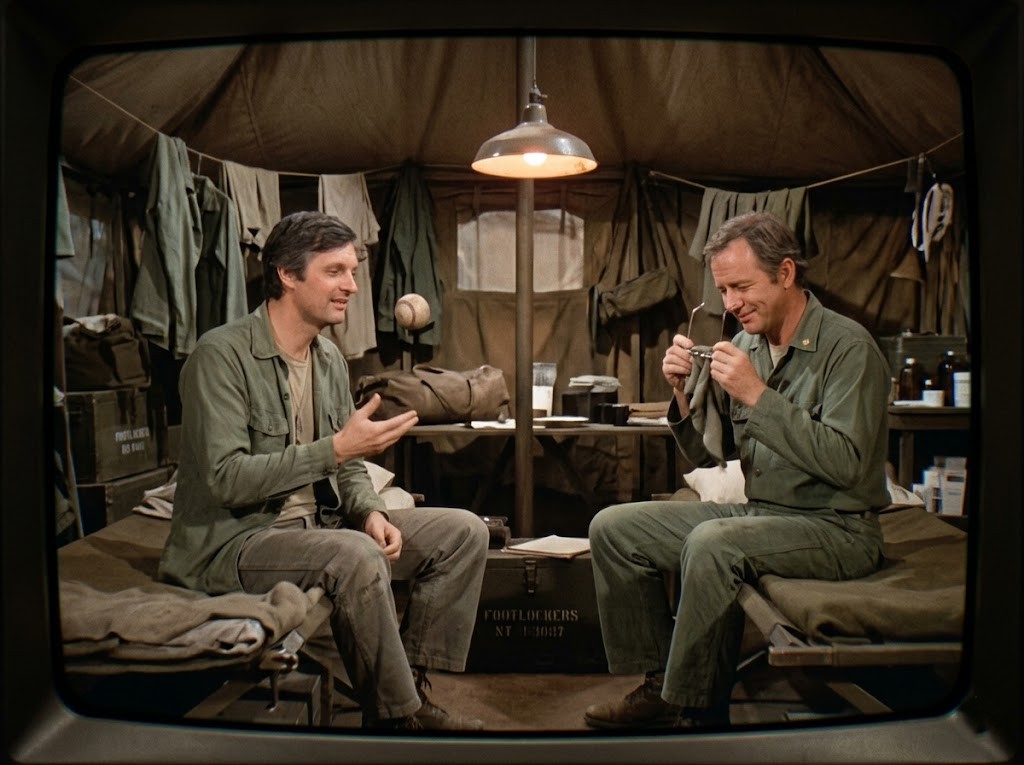
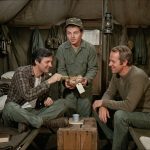
The overhead lamp in the Swamp didn’t so much light the tent as it did partition the shadows. It cast a warm, amber circle over two unmade cots, a scratched footlocker, and a pair of surgeons who had forgotten what sleep felt like. Outside, the steady, rhythmic drone of generators hummed against the Korean night, a constant reminder that the rest of the world was still turning, even if time had completely stalled inside the 4077th.
Hawkeye Pierce sat on the edge of his cot, his muddy boots rooted to the dirt floor. His green fatigue shirt was unbuttoned at the collar, dog tags resting against his chest like a pair of cold coins. Across from him sat B.J. Hunnicutt, meticulously cleaning his glasses with the hem of a drab olive handkerchief. They had just come out of a grueling fourteen-hour session in Post-Op, the kind of shift where the smell of ether seems to seep directly into your skin.
Between them, hanging in the dead air beneath the bulb, was a heavily scuffed, graying baseball.
Hawkeye had just tossed it. It wasn’t a throw born of energy, but rather the restless, involuntary twitch of a man trying to convince his fingers they were no longer holding a scalpel. He watched the ball ascend, his hand still outstretched, frozen in an open invitation to the sky. His eyes followed the leather sphere as it reached its peak, hovering precariously in the dim light.
“You know, Hawk,” B.J. said without looking up from his lenses, his voice thick with the gravel of exhaustion. “If that thing lands on my head, I’m giving you Peg’s home address so you can explain to her why her husband has a concussion from an infield fly rule in Uijeongbu.”
Hawkeye didn’t lower his hand. His gaze stayed locked on the rotating seams of the ball. “It’s not going to hit you, Beej. It’s defying gravity. It’s a protest against the entire military-industrial complex. As long as I keep looking at it, it can’t fall.”
B.J. finally slid the wire frames back over his ears, blinking against the glare of the bare bulb. A small, tired smile tugged at the corner of his mustache. He looked at Hawkeye, then up at the ball, which was finally beginning its inevitable descent.
“Everything falls eventually, Pierce,” B.J. murmured softly, his tone shifting from dry humor to something heavier, something shaped by the boys they had just spent the last half-day trying to piece back together.
The ball dropped, landing squarely in Hawkeye’s palm with a soft, hollow slap. But instead of catching it and tossing it again, Hawkeye’s fingers didn’t close. His hand simply dropped to his knee, his grip loose, his eyes suddenly staring right through the leather, through the floorboards, and deep into a silence that neither of them knew how to break.
The silence stretched, expanding until it filled every corner of the tent. It was the kind of quiet that usually preceded a breakdown, and B.J. felt his own chest tighten as he watched his friend’s shoulders sink under a weight that no joke could lift.
B.J. didn’t push. He just sat there, his hands resting on his knees, keeping vigil in the circle of light. In the Swamp, you learned to read the silences the way a doctor reads a chart. Some silences meant a man was just recharging his batteries; others meant the battery was completely dead.
“He was from Iowa,” Hawkeye said quietly, his voice barely rising above the hum of the generator outside. He wasn’t looking at B.J. He was looking at his own thumb, tracing the worn red stitching of the baseball. “The kid in chair three. The one with the shoulder.”
B.J. nodded slowly. “I remember. Good hands. Clean fracture, all things considered.”
“He asked me if I thought he’d ever throw a curveball again,” Hawkeye whispered. He finally looked up, his blue eyes bright and terribly exposed under the glare of the lamp. “He’s nineteen, Beej. He’s got a girl named Clara, a dog named Blue, and a fastball that apparently cleared the fences in Council Bluffs. And I sat there, looking at his tendons, trying to remember if I ever knew how to play a game just for the fun of it.”
Hawkeye flipped the ball over in his hand, his fingers twitching. “I told him he’d be throwing strikes by the World Series. I lied to him, B.J. I don’t know if he’ll ever lift a bucket of water with that arm, let alone paint the outside corner.”
B.J. shifted on his cot, the canvas groaning beneath him. He reached over, took the baseball out of Hawkeye’s limp hand, and tossed it gently from his left hand to his right. The small, rhythmic *thwack* of the leather against his palms was the only sound in the tent.
“It wasn’t a lie, Hawk,” B.J. said, his voice steady, grounding them both. “It was a prescription. Sometimes the only medicine we have left to give them is twenty-four hours of hope.”
Hawkeye let out a long, ragged breath, the tension leaving his frame all at once. He leaned back against the post of his cot, looking incredibly small in his oversized fatigues. “God, I hate this place.”
“Me too,” B.J. agreed softly. “But if we weren’t here, who’d keep the baseballs airborne?”
He tossed the ball back across the small gap between their cots. Hawkeye caught it instinctively, his fingers wrapping around the leather. The cynical, sharp-witted armor that Hawkeye usually wore began to settle back into place, but it was softer now, tempered by the quiet understanding of the only man in the world who truly shared his burden.
A sudden commotion outside broke the spell—the unmistakable sound of Klinger arguing with Radar about a shipment of missing salami, followed by the distant, comforting rumble of Colonel Potter telling them both to pipe down or he’d have them cleaning the latrines with toothbrushes.
The Swamp felt a little less isolated, the shadows a little less deep.
Hawkeye looked down at the ball one last time, a genuine, albeit tired, smile finally reaching his face. He set it down carefully on the footlocker between them, right next to B.J.’s glasses cloth, like a shared piece of home they were keeping safe for the next shift.
“Hey, Beej?” Hawkeye asked, pulling the blanket up over his boots.
“Yeah, Hawk?”
“Tomorrow, if the choppers don’t come… let’s go out by the helipad and see if we can remember how to play catch.”
B.J. reached up and pulled the string on the overhead lamp, plunging the Swamp into a familiar, gentle darkness. “It’s a date, Pierce. Just don’t make me run. My knees belong to the state of California.”
In the quiet corners of the 4077th, friendship wasn’t just a comfort—it was the only piece of home they had left.