The Best Polish in Korea
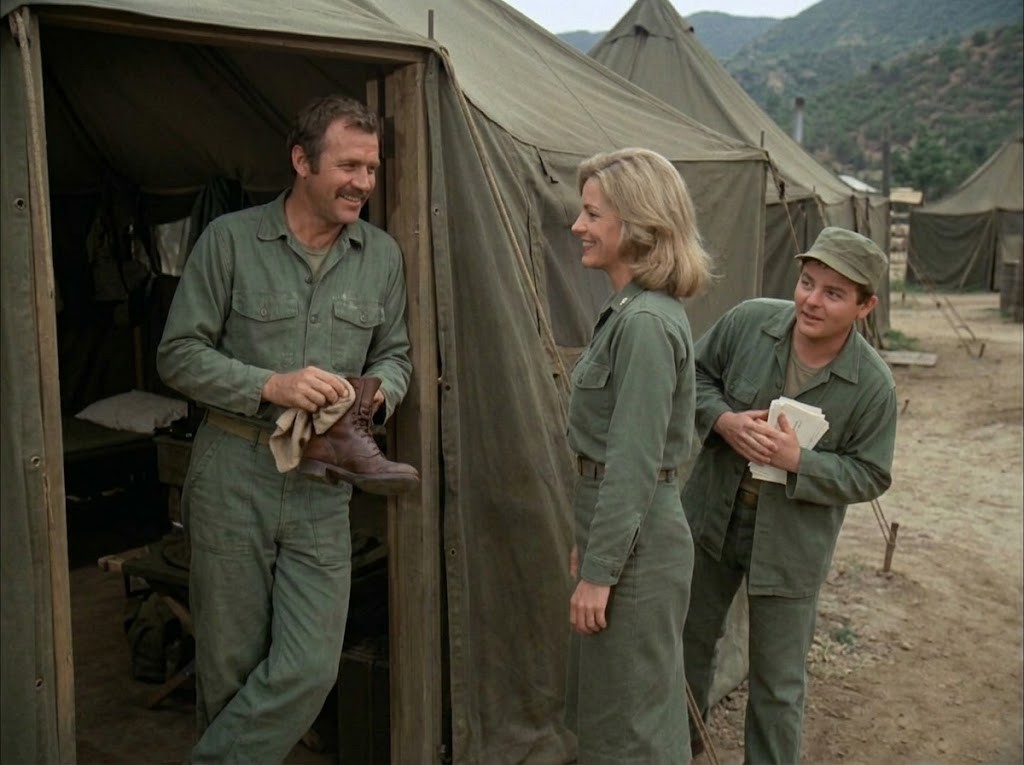
The mud of Korea had a way of settling into everything, from the seams of your olive drabs to the very back of your mind. After forty-eight straight hours in the operating room, the world usually shrank down to the size of a cot and a pillow. But sometimes, when the generators finally stopped groaning and the helicopters stopped coming, you just needed to do something that made sense.
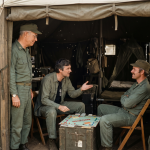
Captain B.J. Hunnicutt leaned against the wooden frame of the Swamp’s doorway, a rag in one hand and a combat boot in the other. He rubbed the leather in slow, rhythmic circles, watching the dark brown shine slowly fight its way through the dried red clay. It was a simple, grounding task, a quiet rebellion against the chaos of the 4077th.
“You’re going to wear a hole right through that leather, Hunnicutt,” a sharp, familiar voice called out, breaking the afternoon stillness.
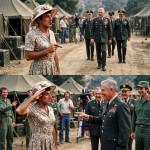
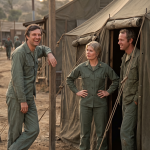
B.J. looked up and smiled as Major Margaret Houlihan walked toward him. Instead of her usual rigid, command-ready posture, her shoulders were relaxed, and a remarkably soft smile touched her lips. The relentless strain of the week’s casualties had left everyone exhausted, but in this rare, quiet moment, the military starch seemed to have washed right out of her.
“Just trying to remember what a mirror looks like, Margaret,” B.J. joked softly, pausing his hand. “Though I doubt the Colonel would approve of me using my footwear to check my shave.”
Margaret stopped a few feet away, looking at the boot with genuine amusement. For all her talk of discipline and regulations, she appreciated a job well done, even if it was just a surgeon daydreaming over a piece of government-issued leather. They stood there for a moment, enjoying a rare truce in the endless war against the elements and the army.
“It’s the little things, isn’t it?” Margaret said, her voice dropping to a tone she rarely used outside of a quiet tent. “Back home, I used to love the smell of fresh polish. My father always said you could judge a soldier’s character by the heels of his boots.”
B.J. nodded, his eyes reflecting a quiet understanding. “Peg always said she knew I was serious about her because I actually polished my shoes for our third date. Back then, I thought that was the hardest thing I’d ever have to face.”
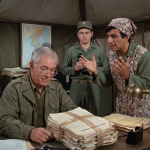
Before Margaret could reply, a small, olive-drab figure crept up into the space behind her. It was Corporal Radar Reilly, moving with the stealth of a cat trying not to wake a sleeping dog. In his arms, he clutched a thick stack of white envelopes—the lifeblood of the camp.
Radar’s face was a map of intense conflict; his jaw was set with earnest determination, but his wide eyes darted nervously between B.J. and the back of Margaret’s head. He held the letters tight against his chest like a shield, his gaze locking onto B.J. with a frantic, silent plea for assistance.
B.J. caught Radar’s eye over Margaret’s shoulder and froze, the polishing rag hovering in mid-air. Radar frantically shook his head, placing a single finger over his lips in a desperate “shh” motion, while pointing emphatically to a very specific, official-looking envelope buried in the middle of the mail delivery.
Margaret, sensing the sudden shift in B.J.’s attention, began to turn around, her brow furrowing with suspicion. B.J. knew that if Radar got caught sneaking up on the Chief Nurse with high-priority mail, the fragile peace of the afternoon would instantly vanish into a cloud of military reprimands.
“So, Margaret,” B.J. blurted out quickly, stepping forward to block her view and keeping his voice deliberately loud. “Do you think the General would have approved of my stitching in the O.R. this morning, or just my footwear?”
The distraction worked perfectly. Margaret paused her turn, looking back at B.J. with a wry expression, her attention successfully recaptured. “The General would say your stitching is adequate, Hunnicutt, but your posture leaves a lot to be desired. And don’t change the subject.”
Behind her, Radar let out a silent breath of relief that practically deflated his oversized utility cap. He shifted the mail carefully, sliding the specific envelope to the very top of the pile, his hands trembling slightly with the weight of what it contained.
B.J. kept his eyes locked on Margaret, giving Radar the extra seconds he needed to compose himself. “Well, we can’t all have West Point posture, Major. Some of us are just civilian doctors trapped in a very olive-drab nightmare.”
“It doesn’t take a West Point education to stand up straight, B.J.,” Margaret said, though the mock sternness in her voice lacked any real bite. She looked down at the ground, a shadow of fatigue crossing her face. “But lately… some days, the weight of this place just makes everyone want to slouch.”
It was a vulnerable confession, the kind that only happened at the 4077th when the guns in the distance were quiet enough to let the loneliness seep in. B.J. lowered his boot, his humor softening into pure, found-family empathy. They were all thousands of miles from home, holding each other together with nothing but shared grief, bad jokes, and sheer willpower.
“Ahem. Excuse me, Major. Captain,” Radar’s voice squeaked, finally stepping into the light and ruining any semblance of stealth he had left.
Margaret spun around, her professional mask instantly snapping back into place, though her eyes softened when she saw the young corporal. “Radar! Put those away before you track mud into my clean compound. What do you have there?”
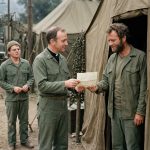
“Mail call, ma’am,” Radar said, his voice dropping its usual frantic pace to become something remarkably tender. He didn’t look at B.J.; he kept his eyes squarely on Margaret as he extended the top envelope. “This one came in on the special pouch from Tokyo. I thought… well, I knew you’d been waiting for it. Sir.”
Margaret looked down at the envelope. The official Department of the Army seal was stamped on the corner, but the handwriting beneath it was unmistakable—heavy, disciplined, and slightly shaky. It was from her father, the retired General, a man whose approval she had spent her entire life marching toward.
For a second, the entire camp seemed to hold its breath. The distant hum of the generator faded into the background as Margaret’s fingers brushed the paper. Her tough exterior didn’t shatter, but it cracked just enough to show the little girl who still wanted her dad to tell her she was doing a good job.
“He wrote,” she whispered, almost to herself, her thumb tracing the ink of her name.
“Yes, ma’am,” Radar said softly, a brilliant, proud smile breaking across his honest face. “The courier said it missed the regular truck, so I might have… accidentally-on-purpose borrowed a jeep from the motor pool to grab the Tokyo pouch early.”
Margaret looked up from the letter, her eyes shining with a sudden warmth that could have melted the winter snows of the Uijeongbu valley. She looked at Radar, then at B.J., who was smiling warmly from the doorway of the Swamp, his half-polished boot still held in his hand.
“Corporal,” Margaret said, her voice trembling just a fraction before she forced it back into a commanding tone. “If I ever find out you went AWOL for a piece of paper again, I’ll have you cleaning the latrines with a toothbrush.”
“Yes, ma’am,” Radar beamed, knowing exactly what she really meant.
“But,” Margaret added, stepping closer and gently touching Radar’s shoulder, “thank you. Truly.”
Radar nodded quickly, his ears turning a bright shade of pink as he clutched the rest of the mail and scurried off toward the administrative tent, his boots clicking happily against the dirt path.
Margaret turned back to B.J., the letter pressed safely against her heart. The exhaustion was still there in the lines around her eyes, and the war was still waiting for them just beyond the hills, but the air felt a little lighter now.
“You know, Hunnicutt,” Margaret said, her smile returning, brighter and truer this time. “I think your boots look absolutely perfect.”
“Thanks, Margaret,” B.J. smiled, lifting the rag back to the leather. “Go read your letter. I’ve got a date with a left shoe.”
As she walked away toward her tent, her stride a little lighter and her head held a little higher, B.J. went back to work. In a place where everything was broken, sometimes a little polish and a lot of heart were the only things keeping the world spinning.
In the mud of the 4077th, we learned that the pieces of home we carried in our hearts were the only things the war could never touch.