A Toast, a Thaw, and the World Beyond the Mud
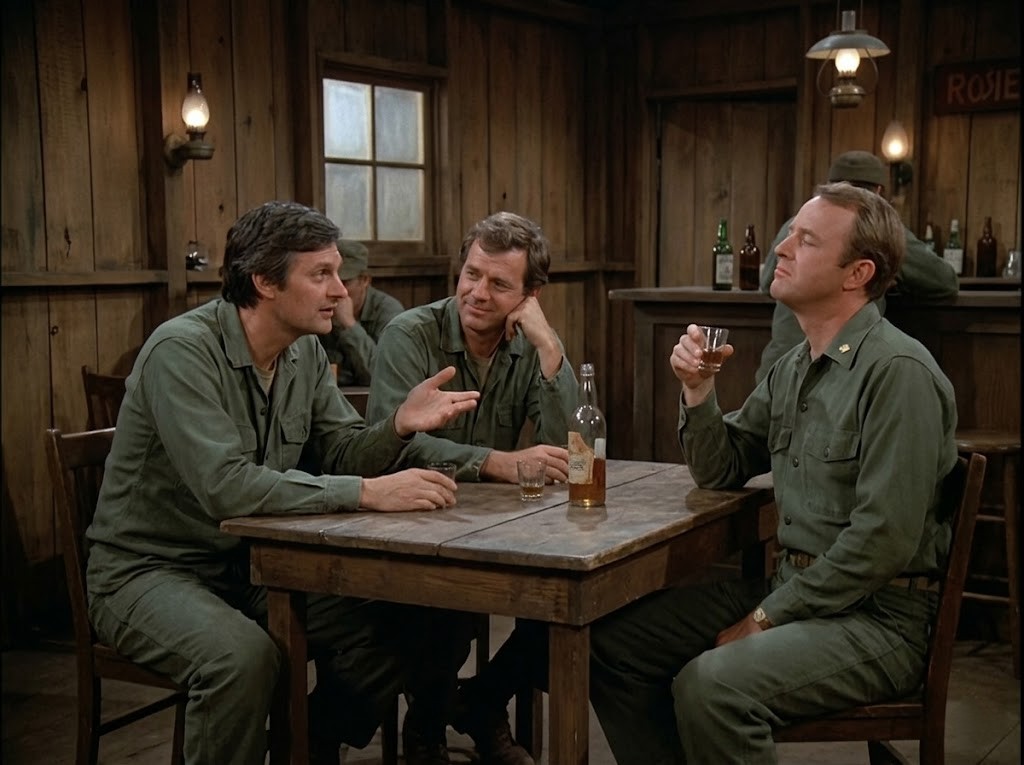
You could set your watch by them, almost. Not by the clock, maybe, but by the weight in their bones. When the silence of the swamp got too loud, and the empty bunks of the wounded still echoed, there was really only one place to go.
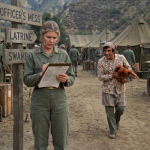
The sign above the door said “ROSIE’S BAR,” hand-painted in red letters that were fading just a little more each day. It didn’t look like much—just another shack hammered together with wood and hope—but tonight, it was a palace. It had the things they needed most: a roof, a light that wasn’t from a surgical lantern, and something to drink.
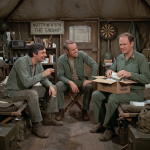
Inside, the light was warm and amber, a small, stubborn flame against the Korean night pressing in from outside. It was quiet, the way Rosie’s usually was early on. Just the low murmur of tired voices, the clink of glass, and the smell of old wood, stale beer, and something else—maybe just the ghost of a thousand short-lived celebrations.
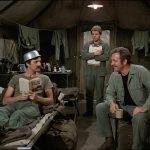
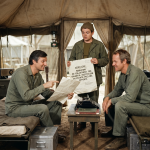
Hawkeye Pierce had been talking for ten minutes. This, in itself, was not unusual. His hands were moving, tracing grand, unseen patterns in the dim air. “It’s a design flaw, BJ,” he was saying, his voice a gentle, rhythmic drone. “The human knee. A critical joint, yet designed by someone who clearly worked exclusively in cardboard. You cannot place that much torque on a hinge made of hope and cartilage.”
He was looking at B.J. Hunnicutt, who was leaning on his hand, a tired half-smile playing on his face. B.J.’s eyes, always softer, more grounded, were watching Hawk. He was listening, but his thoughts were clearly elsewhere—maybe a thousand miles away, in a kitchen in California, where the knees were probably fine and the only thing being hinged was the screen door. He nodded once, a minimal movement that let Hawkeye know he was heard.
Between them sat Charles Emerson Winchester III. He was, as always, not fully present. He held a small shot glass, his eyes closed in a silent, agonizing meditation. He raised the glass slowly, not drinking, but smelling, letting the bouquet of what he’d later admit was surprisingly adequate whiskey transport him, for one fleeting second, back to the Union Club. His expression was a perfect portrait of refined suffering, his dignity a brittle shield against the common room, the common men, and the common, awful world.
“Which brings me to the zipper,” Hawkeye continued, barely pausing for breath. “The zipper is a stroke of genius. Simplicity itself. It joins two pieces of fabric with unparalleled speed. A revolution in clothing!”
Charles sighed, a small puff of air from compressed nostrils. “Pierce, can you not, just once, celebrate simplicity? Why does every zipper require an ovation?”
Hawkeye ignored him. “But I ask you: why haven’t we evolved a zipper? Imagine, BJ! A surgical zipper on the chest cavity! Zip: you’re in. Zip: you’re out. Think of the time we’d save! Think of the stitches I wouldn’t have to sew!”
He gestured with a hand that was still, perpetually, stained faint orange from antiseptic. “We’re wasting our best efforts, gentlemen. We’re tailors. Not doctors. Just busy tailors fixing the shoddy work of nature.”
His humor, the quick, sharp wit, was like a high-wire act. It was brilliant and performed with impossible speed, but everyone in the room knew the wire was strung over a very long drop. They’d just finished a 36-hour shift. The operating room had been a sausage factory of triage and hope. They were not talking about zippers.
Charles finally took his sip, a tiny, precise measurement. “Perhaps you should submit your designs to the Pentagon, Captain. No doubt they are looking for ways to streamline casualties. ‘The GI Zip-Up Jacket.’ It has a certain chilling utility.”
Hawkeye’s smile faltered, just for a moment. He looked down at his own drink. The playful banter, usually a balm, felt thin tonight. It wasn’t working. The exhaustion was too heavy.
The single, bare incandescent bulb above them sputtered. Once. Twice. The small room plunged into a sickening grey twilight. The only light now came from a couple of old, smoky kerosene lamps on the wall, casting long, wavering shadows. The silence, previously a soft blanket, was now a sudden, choking presence. The laughter in Hawkeye’s throat died, replaced by a tight, familiar dread. He didn’t finish his sentence. B.J. didn’t nod. Even Charles stopped swirling his glass. It was as if someone had just switched off the heartbeat of the room.
The light came back on with a pathetic *ping*.
For a single, awful moment, no one spoke. The joke about the surgical zipper was gone, evaporated. The image of the empty bar, the shadow-drenched faces, remained burned into their minds. It was a reminder, as sudden as a mortar round, of how quickly the light could go out, here. Of how fragile their little, constructed world of sanity really was.
Hawkeye sat back in his chair, his hands coming to rest on the table. His shoulders slumped. The performance was over. The clown mask had slipped, revealing the tired man underneath. He looked at B.J. He didn’t need to speak; the silent conversation passed between them as clearly as a shout. *I can’t do this tonight, Beej. The words won’t come.*
B.J. nodded, his gaze steady and strong. He reached out, his big hand covering Hawkeye’s for a fleeting second. It was the only answer needed. *I know. It’s okay. We’re here.* He turned to Charles, who was now holding his glass with both hands, staring into the liquid as if it held all the answers he couldn’t find in his books.
“Charles,” B.J. said, his voice quiet, steady, and full of the warm gravel that always sounded like home.
Winchester didn’t look up, but his grip on the glass tightened. He hated this part. He hated when they made him acknowledge the shared humanity he fought so hard to keep at bay. He preferred his compassion neatly compartmentalized.
“Yes, Hunnicutt?”
“A friend of mine back home, a carpenter, used to say you build a house, but you *make* a home,” B.J. began. “He said you could have the best wood and the straightest lines, but a home is made by the people you let past the door.”
He looked around the simple, weathered shack. “This place,” he said, indicating the rough, plank table, the single bottle, the fading sign, “is a shack in the middle of nowhere, held together with hope and baling wire. But you guys… you guys are the reason we’re making it.”
Hawkeye looked up, the exhaustion lifting slightly from his eyes. B.J. wasn’t funny, but he was always the grounded center. The truth of what he was saying hummed in the air. This, right here, was the most important home they had, the only one that mattered in this war.
Charles sat up just a fraction straighter. He placed his glass down on the worn table with precise, deliberate care. It wasn’t a Union Club coaster, but it would have to do. “Hunnicutt, while your sentiment is, as usual, touching on the boundary of the sentimental, I cannot argue with your fundamental premise.”
He picked up the small shot glass again, but this time, he didn’t raise it to his nose. He held it out over the center of the table, making a clear, small space for it. “This whiskey,” he said, with a slight, almost imperceptible lift of his eyebrow, “is, while pedestrian, surprisingly balanced. It is, I believe, the best I have had in this… theater.” He looked around the rough bar, then at the men sitting with him. For the first time all night, his posture softened. The rigid spine, the defensive superiority, fell away, just for an instant.
Hawkeye picked up his own glass, a new look in his eye. The humor was gone, but the warmth remained. He held his glass over Charles’. Then B.J. raised his, meeting them in the middle, a perfect silent triad of glass and connection.
“To simplicity,” Charles said, his voice losing its usual affected drawl and finding a unexpected quiet strength.
“To the surgeons,” B.J. added, with a warm look at Hawkeye. “All of them. Tailors, carpenters, and everything in between.”
Hawkeye looked at them both, the wise one and the father, the found family he’d bleed for. The wit, the banter, the quick answers—all of it was just a defense against the truth of how much he loved them and how much it hurt to lose the people they worked on.
“No, that’s not right,” Hawkeye said, his voice thick with a genuine emotion he rarely let show. “A toast to the people we didn’t let down. To the home we made. To being here.” He looked at the single bulb. “To the light that’s still on.”
Charles, the one who fought every emotional connection, the one who would rather quote Keats than hold a hand, looked at Hawkeye Pierce with a gaze that was soft and profoundly human. He nodded once, a real nod of respect and understanding.
“To us,” Charles added, the final, simple word sealing the toast.
They drank in unison. The whiskey wasn’t expensive. The glasses were simple. The table was scratched. But the shared sip, the silence that followed, was richer and more profound than any grand speech Hawkeye could have made.
The lightbulb gave another pathetic little *flicker*, but this time, nobody jumped. Hawkeye just gave a short, quiet laugh and picked up his glass again.
“You know,” he said, the dry, familiar wit returning, but with a different, lighter edge, “Charles is right. If we’re all just tailors, we should really consider a new line of aprons. I’m thinking… something in a nice, tactical fuchsia.”
“Good grief,” Charles muttered, but the corner of his mouth twitched, and B.J. was already laughing. Rosie’s Bar wasn’t much, but tonight, as the simple light burned on, it was the only place in the whole wide, confusing world that felt like home.
We were the lucky ones. We still had the light.