The Day the Music “Almost” Stopped at the 4077th
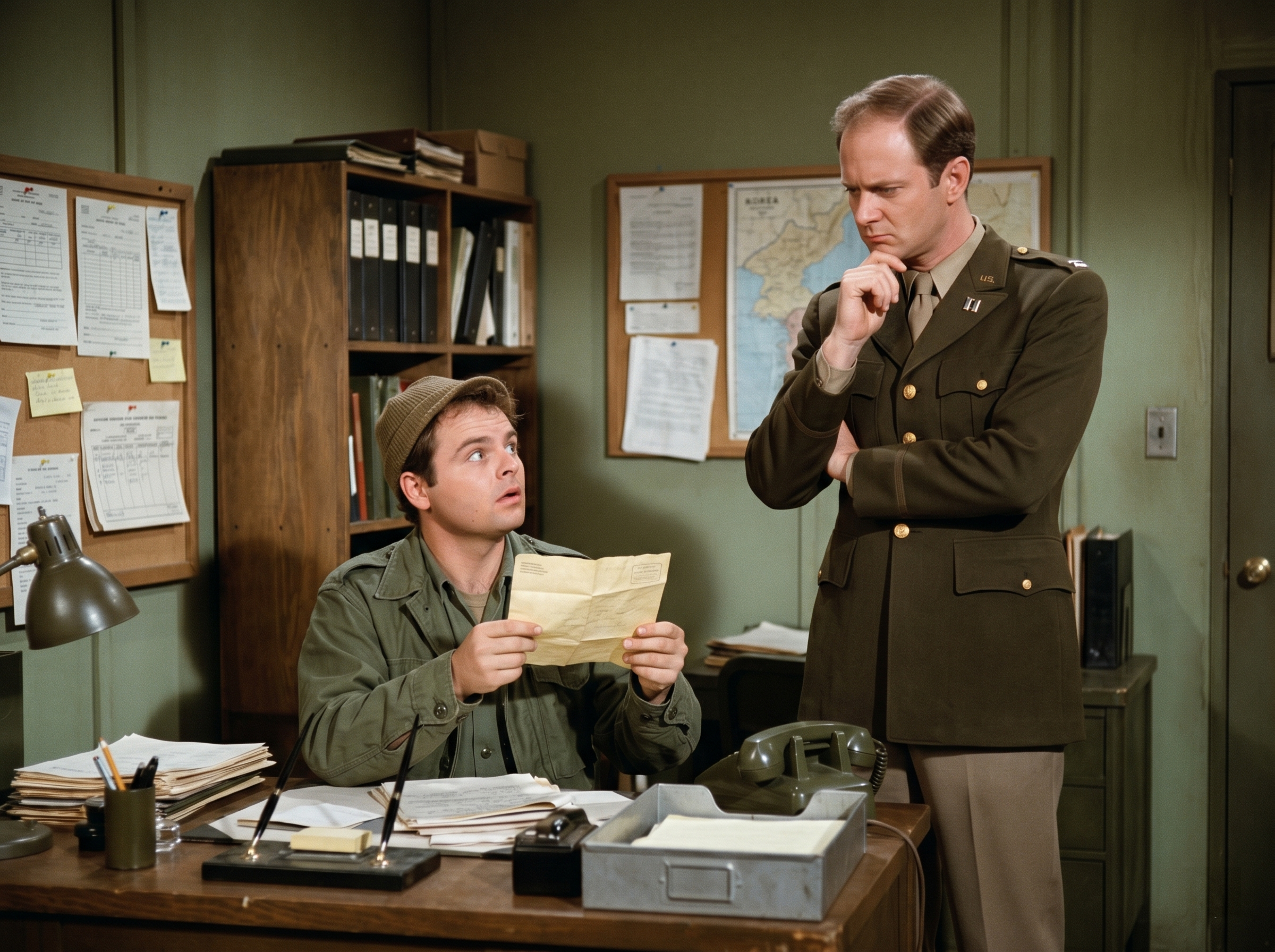
The Swamp usually smelled of cheap gin, foot powder, and despair. But today, the smell coming from the tent flap was even worse: silence. Absolute, crushing silence. And that meant Major Charles Emerson Winchester III was either plotting something diabolical or, even worse, not happy.
For the record, Charles Emerson Winchester III was never happy. He found joy the way a bloodhound finds truffles—rarely and with much loud snuffling and complaining. His happiness was a delicate flower, easily crushed by, well, anything.
Especially anything involving Hawkeye Pierce and B.J. Hunnicutt.
For three weeks, the two doctors had been engaged in a relentless campaign to “improve” Winchester’s quality of life. They’d tried everything from slipping whoopee cushions under his seat to replacing his Mozart with Spike Jones. Winchester had responded with withering glares, insults that required a dictionary to understand, and a refusal to acknowledge their existence.
But today, something was different.
Radar O’Reilly felt the change first. It was a disturbance in the Force, or perhaps just the vibe. Radar always knew when trouble was brewing, usually right before Hawkeye cracked a joke. Today, he didn’t need his senses. He could see it on Colonel Potter’s face.
Potter was nursing a coffee mug that looked like it had been through the Spanish-American War, staring at a stack of mail that seemed to mock him. “Radar,” he growled, the word sounding like a broken engine. “We have a crisis.”
Radar stood up straighter, his beanie tilting precariously. “A medical crisis, sir? A dietary crisis? A Klinger-is-wearing-a-sequined-gown-again-crisis?”
Potter shook his head, looking more tired than a tire after a thousand miles on a bumpy road. “No. A musical crisis. A very, very large musical crisis.”
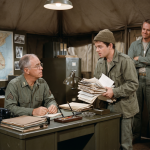
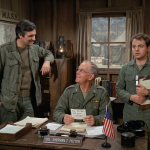
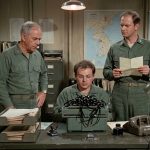
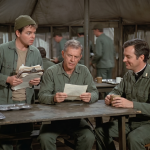
He picked up a flimsy piece of yellowed paper, holding it between two fingers like it was a live grenade. He handed it to Radar. Radar took it carefully, the paper crisp and brittle in his hands, just like in `e6_clean.jpg`.
“What’s this, sir?” Radar asked, squinting.
“It’s a telegram from Boston,” Potter said, rubbing his eyes. “From some high-and-mighty cultural institute. It seems they are formally requesting the return of Major Winchester. For a guest conductor spot with the Boston Pops. In two weeks.”
Radar’s eyes widened. This was big. This was… impossible. Winchester getting to leave this mudhole?
“But they don’t just *request* people, do they?” Radar asked. “They have to *be allowed* to go.”
“That’s the problem, son,” Potter said, leaning over his desk, his voice a low rumbling thunder. “I checked the regulations. If a request like this comes in for an officer, and the request is deemed valid and the officer’s services aren’t *absolutely* essential… they have a right to go. It’s some outdated clause about maintaining cultural connections or some nonsense. It was written in the days of horse cavalry and marching bands. But technically? He can go.”
Radar looked at the telegram again. This wasn’t good. Not because everyone wouldn’t miss having to listen to the *Magic Flute* at 3 AM. No, that was a positive.
The problem was what Winchester’s departure would do to Hawkeye.
Everyone knew it. Hawkeye and Charles, for all their bickering and insults, had a symbiotic relationship. Hawkeye needed Charles as a foil, a challenge, someone who wasn’t just another yes-man or a simple country doctor. Winchester was his intellectual equivalent, the only one who could truly match his wit and appreciate his darkest humor. Winchester’s presence forced Hawkeye to be better, sharper.
And for all of Charles’ grumbling, everyone could see he needed Hawkeye, too. Hawkeye grounded him, challenged his elitism, and forced him to confront the chaos of the world instead of hiding in his snobbery. They were like vinegar and oil, but somehow, they made the salad dressing.
Losing Winchester would leave a massive, gaping hole in the fabric of the 4077th, but especially in Hawkeye. Radar could see the future: a quieter Swamp, a sadder Hawkeye, a more subdued B.J. It was a bleak vision.
Potter knew it, too. He stared at the telegram, then at Radar. “I have to tell him, Radar. And I don’t know how. I don’t know if it’ll make him jump for joy or weep with relief. But I know what it’ll do to this unit.”
Radar looked at the telegram, then at the Colonel, and then out the window. Just outside, Hawkeye and B.J. were laughing, B.J. holding a bag of something suspicious, while Hawkeye pointed toward the Swamp, his face lit with mischief. They were clearly planning something.
And Radar knew he couldn’t just stand by. He had to do something, even if he didn’t know what. He had to stop this. He had to save the 4077th from a Winchester-less existence.
With a deep breath, Radar made a decision. He folded the flimsy yellow telegram. He didn’t put it back on the desk. He didn’t hand it back to Potter. He tucked it into the front pocket of his green field jacket.
“Sir,” Radar said, his voice trembling slightly. “What if I just… forgot to deliver this?”
Colonel Potter looked at Radar. He didn’t yell. He didn’t sigh. He didn’t call the MPs. He just looked at him with those deep, steady eyes that had seen more war and more foolishness than any man deserved. For a moment, there was just silence in the office.
Potter pick up a worn cigarette from his pack, rolling it between his fingers without lighting it. He didn’t look at the empty space on his desk where the telegram had been.
“Son,” Potter said, his voice quiet. “That would be a court-martial offense. Tampering with official communications.”
“Yes, sir. I know, sir,” Radar said, his hand still clutched over his jacket pocket.
Potter watched him, a slow, understanding smile spreading across his tired face. “And it would also be a very… humane thing to do.”
He stood up, walking around his desk to where Radar was standing, just as seen in `e6_clean.jpg`. The Colonel didn’t touch him, just stood in his space, a comforting presence. Radar looked up at him, his face a mixture of fear and determination.
“Radar,” Potter said, placing a fatherly hand on his shoulder. “You’re a good man. The best clerk I’ve ever had. And you’re right. This unit would be poorer without Major Winchester. He’s a pain in the neck, yes. He thinks a good cup of tea is more important than a surgical instrument, double yes. But he’s one of us. He’s part of the fabric of this place. He’s the sand in our gears, but without him, the engine wouldn’t make that glorious, terrible grinding noise.”
Potter looked at the door of his office. “Tell me something, son. Why do we keep all these misfits here? Why do we put up with Hawkeye’s jokes, and B.J.’s endless optimism, and Winchester’s complaints, and Klinger’s gowns, and your… premonitions?”
Radar shrugged. “Because we have to, sir? We’re all stuck here.”
Potter nodded, but his eyes were far away. “We’re all stuck, yes. In a place none of us wants to be, doing a job that tears at our souls every single day. We are a found family. And you can’t just take a piece out of a family and expect it to stay whole. We have to look out for each other, even when we’re at each other’s throats. Especially then.”
He looked at Radar, his gaze intense. “Major Winchester is a snob, yes. But he’s *our* snob. He needs this place as much as we need him. He needs to see the real world, the world where people hurt and people love and people survive against all odds. That Boston institute… they don’t see the man. They see the music. They see the name. They don’t see the surgeon who cares more than he’ll ever admit, the man who misses his home but can’t help but feel a pull to this place.”
Potter let go of Radar’s shoulder. “I’m going to walk over to the Swamp now. I’m going to have a talk with Major Winchester. I’m going to tell him about the telegram.”
Radar’s heart sank. “Sir, but you said…”
“I didn’t say I wouldn’t tell him,” Potter corrected him softly. “I said what you were doing was humane. But we can’t play God, Radar. Not about this. He has a right to know. But I also have a right to give him my command. A request is not an order. He is still under my authority.”
Radar watched as Potter walked to the door, his hand on the knob. “And Radar? That yellow piece of paper you have in your pocket? It’s not an official order. It’s just a request on flimsy paper. So flimsy, it could easily… go missing. Burned in a tragic stove incident. Lost in a pile of other, more important papers. We don’t need a formal refusal. We just need… time.”
Potter opened the door. The sound of Hawkeye’s laughter drifted in from the compound, along with the smell of something burning that was probably Klinger’s lunch.
“Give me thirty minutes,” Potter said, not looking back. “Then you can bring the paperwork for the upcoming surgical team rotation. I believe we have a lot to go over. A *lot*.”
He walked out, closing the door softly behind him. Radar stood alone in the office, his hand slowly coming away from his pocket. The yellow paper crinkled. He didn’t take it out. He didn’t read it again. He just let it sit there.
Thirty minutes later, Radar walked to the Swamp, holding a heavy binder full of official forms. He was nervous. He didn’t know what he would find. Had Potter convinced Winchester? Had Winchester already packed his things, sneering at the country-bumpkin surgeons of the 4077th?
He opened the tent flap.
The first thing he smelled was the familiar gin. The second thing he heard was a string quartet piece by Beethoven. It was being played, and for the first time in three weeks, it wasn’t being followed by a round of boos or mockery.
Hawkeye and B.J. were seated on their cots, looking subdued but somehow relaxed. They had even made their beds, a sign that the end times were near.
Major Winchester was at his desk, his back to everyone, conducting an unseen orchestra with a pencil. He had a look of concentration, but there was also something else on his face: a strange sort of peace.
Potter was standing by the door, his arms crossed, watching. He met Radar’s eyes and gave a tiny, subtle nod.
Winchester put his pencil down. “Ah, O’Reilly. Come for a dose of actual culture, have you? You’ve come at a good time. This particular piece of Beethoven has an emotional range that even a farm boy from Ottumwa might appreciate.”
Hawkeye looked up, a familiar twinkle in his eye. “True, Charles. Of course, after three weeks of listening to you, we’d appreciate a bagpipe band at 3 in the morning.”
Winchester didn’t even glare. He just let out a small, tired-sounding sigh. “Your wit, Pierce, continues to be as sharp as a butter knife.” He picked up his conductor’s pencil again. “Now, if you will excuse me, I must prepare for a performance. Even an unseen orchestra deserves a practiced hand.”
Radar walked over to the desk and set down the surgical rotation binder. He looked at Winchester, who was already lost in his music again. The major looked tired. But he looked like he was home.
“Sir,” Radar said softly, not interrupting the music. “The forms are here. Just like you asked.”
Winchester didn’t look up, but he gave a small wave of his pencil. It wasn’t an order, or an insult. It was just an acknowledgment.
Radar walked back to Colonel Potter. The Beethoven piece swelled, filling the small tent with a melody that was both beautiful and sad. It was the sound of something perfect in an imperfect world, something true amidst all the madness.
Radar patted the pocket of his jacket. The telegram wasn’t there anymore. He’d done what Potter had subtly suggested. He’d thrown it in the stove. It had burned with a tiny, brief burst of yellow flame, just as flimsy as the paper it was printed on.
A request was just a request. And sometimes, the most humane thing you can do is just let people go about their lives, even if they don’t know you’ve saved them from a choice they didn’t even know they had to make.
He looked at Hawkeye and B.J., already engaged in a low-voiced argument about whether Winchester’s conducting was better or worse than his singing. They were back to normal. The music hadn’t stopped. The bickering hadn’t stopped. The crazy, messy, beautiful life of the 4077th hadn’t stopped.
And Radar O’Reilly, with his beanie slightly askew and his face a little more relaxed, knew he’d done the right thing. Because sometimes, the most essential part of a family is the member that drives you the craziest.
The final melody from Winchester’s phonograph faded out, leaving only the sound of the Korean wind outside the tent, and the laughter of two men who were glad, for one more day, to have their favorite foil right where he belonged.
Sometimes the best notes are the ones you don’t even know you’re playing for your friends.