The Supply Tent Standoff and Other Fictions
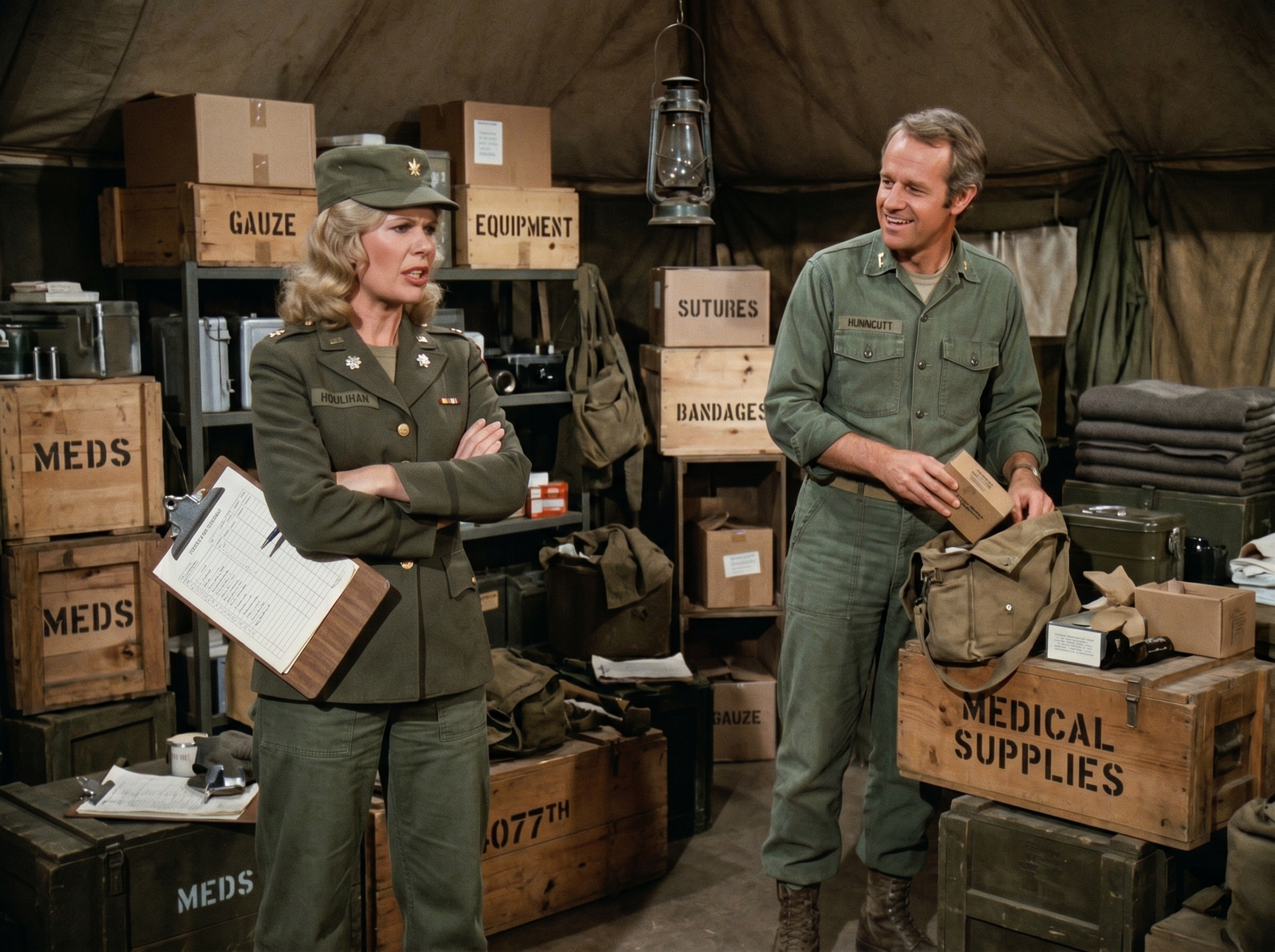
The war stopped for no one, but in the 4077th, a missing box of surgical supplies could bring the entire camp to a grinding, bureaucratic halt.
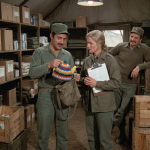
It was a Tuesday afternoon, which meant the air was thick with the smell of damp canvas, dust, and the ever-present sting of antiseptic. Inside the supply tent, the atmosphere was considerably colder than the breeze blowing across the compound.
Major Margaret Houlihan stood like a sentinel in the center of the cluttered space. Her posture was rigidly upright, her arms folded so tightly across her chest that the fabric of her tailored green uniform pulled taut across her shoulders.
Tucked firmly under one crossed arm was her ubiquitous metal clipboard, the sacred ledger of the camp’s inventory. She projected an aura of absolute, unyielding authority, her sharp eyes fixed entirely on the man standing across from her.
Captain B.J. Hunnicutt, on the other hand, looked as though he were leisurely browsing a neighborhood hardware store on a quiet Sunday afternoon.
Dressed in his comfortably faded green fatigues, the name “HUNNICUTT” stenciled neatly above his pocket, B.J. was the picture of unbothered calm. He stood beside a stack of wooden crates boldly labeled “MEDICAL SUPPLIES,” his canvas medical bag slung open on the wood.
In his hand, he casually held a small, unmarked cardboard box. He wasn’t hiding it. He wasn’t sneaking. He was simply looking at Margaret with that gentle, understated, and utterly infuriating California smile.
“I am not going to ask you again, Captain,” Margaret said, her voice a low, clipped warning that usually sent enlisted men running for the mess tent.
“That’s good, Major,” B.J. replied evenly, his voice smooth and easy. “Because if you ask me again, I’m liable to give you the exact same answer, and I know how much you hate repetition.”
“What I hate,” Margaret shot back, taking a half-step forward, “is insubordination. And theft. And the complete, blatant disregard for United States Army property.”
B.J. chuckled softly, looking down at the small box in his hand before meeting her fiery gaze again. “Margaret, it’s a box of specialized pediatric bandages. It’s hardly the gold reserves at Fort Knox.”
Margaret’s jaw tightened. She gestured sharply toward the towering walls of supplies surrounding them. “Do you see these crates, Captain? Look around you. ‘MEDS’. ‘GAUZE’. ‘SUTURES’. ‘BANDAGES’. Every single item in this tent is logged on this clipboard.”
She tapped her pen against the metal clip for emphasis. “Every roll of tape, every bottle of iodine, every single syringe has to be accounted for. General Headquarters demands a full inventory by eighteen-hundred hours.”
B.J. sighed, though his smile didn’t quite leave his eyes. He gently tossed the small box into his open canvas bag and began rummaging around inside it, shifting a stethoscope and a few loose rolls of gauze.
“The boys at GHQ are sitting behind mahogany desks in Tokyo, Margaret,” B.J. murmured, not looking up from his bag. “They aren’t patching up terrified locals who got caught in crossfire.”
“That is entirely beside the point!” Margaret’s voice rose, the familiar military bark finally cracking through her controlled exterior. “There are channels! There are requisition forms! Form 409-A in triplicate!”
She uncrossed her arms, gripping the clipboard with both hands as if holding onto a lifeline. The camp had been under heavy fire for three days. The O.R. had been a meat grinder. They were all running on stale coffee and three hours of sleep.
For Margaret, the neat, orderly rows of crates were the only things making sense in a world gone mad. If the inventory was right, the camp was safe. If the numbers matched, the chaos was kept at bay.
“I cannot have you doctors simply wandering in here and raiding my supply tent whenever you feel like playing Florence Nightingale to the entire countryside!” Margaret shouted, her voice suddenly tight with a brittle, exhausted edge. “If I don’t maintain order in this camp, B.J., the whole thing falls apart! Do you understand me? It all falls apart!”
She stopped, breathing heavily, her eyes wide and suddenly vulnerable under the harsh glare of the practical camp lighting. The echo of her outburst faded into the thick canvas walls, leaving a heavy, ringing silence in the small tent.
The easy, amused smile finally vanished from B.J.’s face.
He stopped rummaging in his canvas bag and stood up straight, resting his hand gently on the edge of the wooden crate. He looked at Margaret, really looked at her, and saw past the brass insignia and the impeccably styled hair.
He saw the dark shadows bruised beneath her eyes. He saw the slight tremble in the hands gripping the aluminum clipboard. He saw a brilliant, dedicated surgical nurse who was trying to hold a crumbling world together with paper clips and inventory sheets.
The tension in the room shifted. It stopped being a battle of rank and became something else entirely. It became a quiet moment between two tired people at the end of the world.
B.J. reached into his canvas bag. He moved slowly, deliberately, pulling the small cardboard box back out. He held it up in the soft, warm light of the hanging kerosene lantern.
“It’s not just bandages, Margaret,” B.J. said, his voice dropping into a register of quiet, earnest sincerity.
Margaret swallowed hard, her military posture remaining rigid, though her defensive anger had visibly deflated. “I don’t care what it is, Captain. I need the forms.”
B.J. took a slow step forward, bridging the physical gap between them. He didn’t offer the box to her, but he held it so she could see the faint, hand-written medical text on the side.
“There’s a Catholic orphanage about five miles down the road toward Uijeongbu,” B.J. explained softly, his eyes never leaving hers. “Father Mulcahy went down there this morning to deliver some blankets. He came back an hour ago and asked for my help.”
Margaret’s grip on the clipboard loosened just a fraction. She didn’t speak, but she didn’t interrupt him either.
“They took in a group of kids last night,” B.J. continued, the gentle humanity in his voice filling the dusty space. “A village got shelled. There’s a little girl, maybe four years old. She has second-degree burns on her arms and legs.”
B.J. looked down at the box in his hand. “The clinic down there is out of silvadene cream. They are out of non-stick sterile wraps. If they use regular gauze, it’s going to stick to the burns. Every time they change her dressings, it’s going to tear the skin right back off.”
He looked back up at Margaret. The quiet agony of a father separated from his own child briefly flashed across his face, a familiar ghost that haunted his eyes whenever the war touched the children of Korea.
“I know GHQ needs their numbers, Margaret,” B.J. said quietly. “But that little girl needs this box. And I don’t have time to wait three weeks for a piece of paper to clear through a desk in Tokyo.”
Margaret stood perfectly still. The silence in the supply tent stretched out, thick and heavy. She looked at the wooden crate behind B.J., reading the faded black stencil: ‘MEDICAL SUPPLIES’.
She thought of the O.R. She thought of the endless sea of olive-drab stretchers. She thought of the little girl, four years old, crying in a cold orphanage.
Slowly, Margaret looked down at her clipboard. Her face remained a mask of professional stoicism, but her eyes—usually so sharp and exacting—were remarkably soft.
She unclipped her pen. She flipped back one page on the ledger.
“It is a terrible shame about this leaky canvas roof,” Margaret said, her voice completely flat, devoid of any inflection.
B.J. blinked, slightly taken aback. “The roof?”
Margaret didn’t look up. She dragged her pen firmly across a line of neat handwriting, deliberately crossing out a number.
“Yes,” Margaret continued smoothly, scribbling a new number into the margin. “It seems we had a sudden, localized leak in the tent last night. Water damage ruined an entire box of pediatric burn supplies.”
She clicked her pen shut and snapped it back onto the clipboard. She finally looked up at B.J., her chin raised in her signature posture of unshakeable authority.
“I’ve had to strike them from the official inventory,” Margaret said, looking B.J. squarely in the eye. “As far as the United States Army is concerned, that box no longer exists. It is garbage. What you choose to do with the camp’s garbage, Captain Hunnicutt, is entirely your business.”
A slow, profoundly warm smile spread across B.J.’s face. It wasn’t the amused, teasing grin from earlier. It was a smile of deep, genuine respect. He saw her. He saw the massive, tender heart she hid behind the armor of Army regulations.
“You know, Major,” B.J. said softly, dropping the small box safely back into his canvas bag. “For a woman who loves the rules, you sure are terrible at following them.”
Margaret drew herself up, folding her arms tightly across her chest once again. The sharp, commanding Major was back in an instant, though the edges were noticeably softer.
“I don’t know what you are talking about, Captain,” she said briskly. “Now, unless you have business with the rest of my garbage, I suggest you take your bag and vacate my supply tent. I have an inventory to finish.”
B.J. slung the heavy canvas bag over his shoulder. He gave her a sharp, exaggerated, but entirely affectionate salute.
“Yes, ma’am,” B.J. said. He turned and walked toward the tent flaps, pausing just before he stepped out into the cold Korean afternoon. He looked back over his shoulder. “And Margaret?”
She looked up from her clipboard. “What?”
“Thank you,” he said simply.
Margaret didn’t smile. She didn’t need to. She simply gave a curt, professional nod, adjusting her clipboard as she turned back to the towering stacks of wooden crates.
B.J. slipped out into the noisy, chaotic compound, leaving Margaret alone in the quiet dimness of the tent. She took a deep breath, the smell of damp canvas and antiseptic suddenly feeling a little less oppressive. She looked at the crossed-out line on her pristine ledger, tapped her pen against the metal clip, and went back to counting.
In a place where everything was broken, the bravest thing they could do was quietly help each other fix the pieces.