The Toledo Petition of the Heart
The hardest part of the war wasn’t the screaming sirens or the rhythmic, heavy thud of the incoming choppers.
The hardest part was the quiet.
It was those rare, stagnant afternoons when the O.R. was scrubbed clean, the camp was still, and the heavy Korean heat settled over the 4077th like a damp wool blanket. That was when the homesickness crept out of the shadows. It lived in the corners of Colonel Sherman T. Potter’s office, hiding between the stack of morning reports and the brass base of his desk lamp.
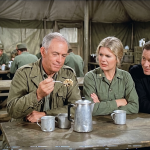
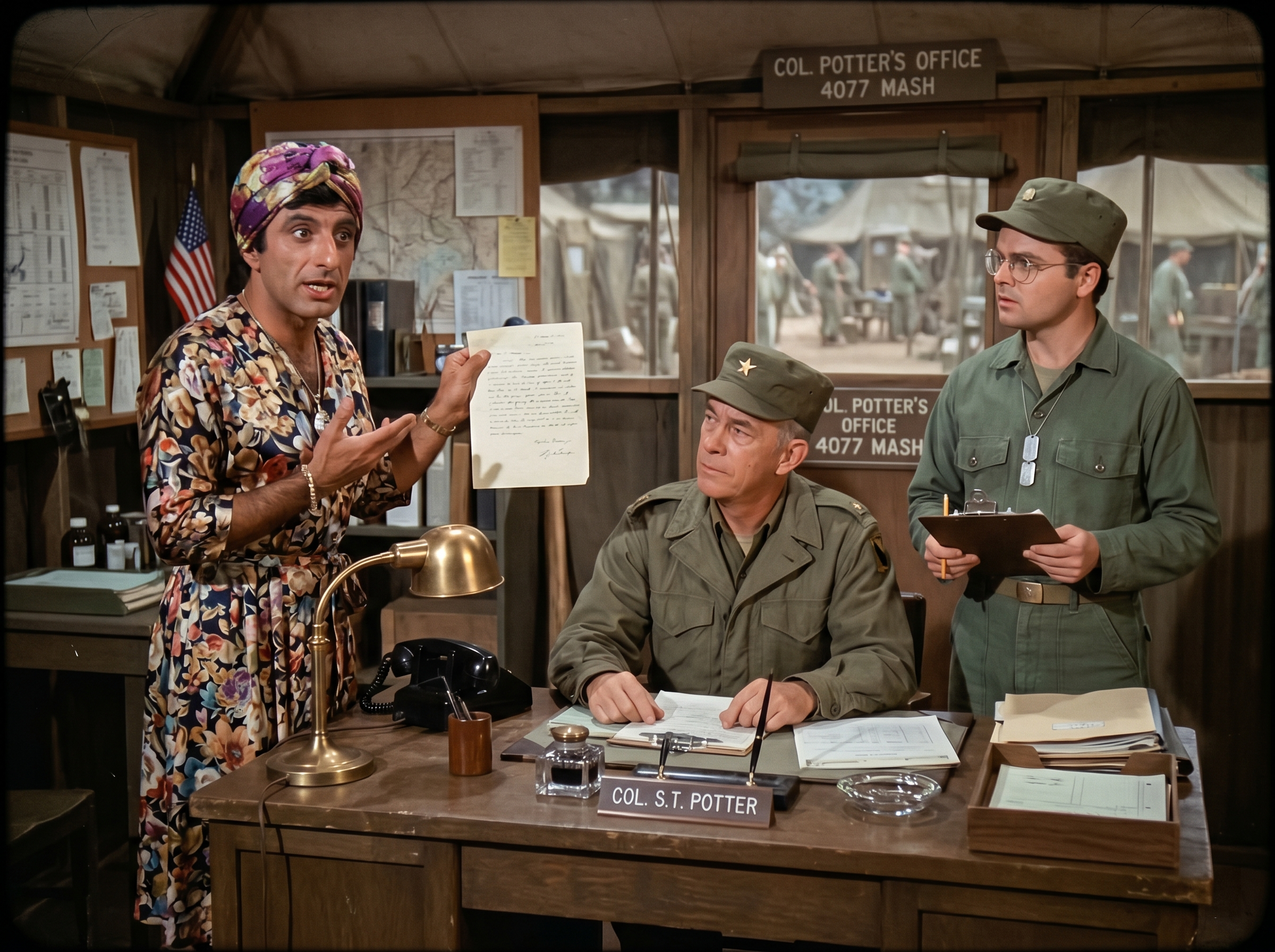
Potter sat behind his wooden desk, his hands resting lightly on a pile of requisition forms. He was a career army man, steady as an old oak, but even he felt the weight of the silence today. He stared straight ahead, his expression a masterpiece of dry, fatherly exasperation.
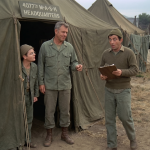
Standing rigidly to his right was Corporal Radar O’Reilly. Radar held his ever-present clipboard against his chest like a shield, his eyes wide and earnest behind his wire-rimmed glasses. He was polite, standing at attention, but slightly unsure of how to document the current situation.
And then, there was Corporal Maxwell Q. Klinger.
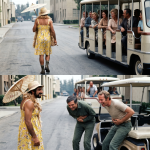
Klinger stood front and center, a brilliant splash of absurdity against the drab olive and faded brown wood of the command tent. He was wearing a dark, vividly patterned floral dress, complete with a matching, tightly wrapped turban that somehow managed to look both utterly ridiculous and fiercely dignified.
“Colonel,” Klinger announced, his voice trembling with theatrical outrage. “I hold in my hand a document of such undeniable legal magnitude that it will shake the very foundations of the United States Army!”
Klinger thrust a single, crinkled piece of paper forward. His left hand pinched the corner of the paper, while his right hand opened wide in a grand, wounded gesture. He looked like a tragic heroine making a final plea to a cruel king.
“Is that so, Klinger?” Potter asked, his voice a slow, gravelly drawl. He didn’t move an inch. He just let his eyes track up from the desk to Klinger’s desperate, expressive face.
“Yes, sir!” Klinger declared, stepping closer. “This is a sworn, notarized affidavit from my Uncle Abdul in Toledo. It clearly states that due to a rare, hereditary allergy to canvas, khaki, and the smell of powdered eggs, my continued presence in a military zone is a violation of the Geneva Convention!”
Radar leaned in slightly, his brow furrowed in genuine concern. “Uh, excuse me, Klinger, but… I don’t think the Geneva Convention covers powdered eggs.”
“Quiet, Radar!” Klinger snapped, never breaking eye contact with Potter. “The Colonel is a man of the world. He understands the profound medical implications of a delicate constitution!”
Potter didn’t blink. He just sat there, projecting a calm, absolute control over the room. He had seen young men try every trick in the book to escape the meat grinder of this war. He had seen madness, and he had seen pretending.
“Hand it over, son,” Potter said quietly.
Klinger hesitated. The grand theatricality faltered for just a fraction of a second. He slowly lowered his dramatic hand and passed the single sheet of faded paper across the desk.
Potter didn’t pick it up immediately. He just looked down at it, resting beside his black rotary field phone and his glass inkwell.
The silence in the office suddenly felt very heavy. The distant hum of a jeep engine outside seemed to fade away.
Radar swallowed hard, his knuckles turning white as he gripped his clipboard. Klinger stood frozen, his chest rising and falling beneath the floral print of his dress, waiting for the verdict.
Potter slowly reached out and picked up the paper.
Colonel Potter held the paper up to the soft, warm glow of the desk lamp.
The light caught the intricate loops and frantic underlines of Klinger’s handwriting. It wasn’t a legal document. It wasn’t an affidavit. It was just a piece of stationary, likely stolen from Major Winchester’s private stash, covered in desperate ink.
Potter read in silence. The ticking of his pocket watch seemed to echo in the small, cluttered command center.
Klinger shifted his weight, the fabric of his dress rustling softly. “As you can see, sir, the legal precedents are undeniable. Uncle Abdul hired a lawyer who specializes in… maritime law.”
“Maritime law,” Potter repeated softly, not looking up.
“Yes, sir. Because… because Toledo is on a lake. Lake Erie. Very treacherous waters, sir.” Klinger’s voice was losing its theatrical edge. It was getting quieter, thinner, stripping away the comedy and leaving only the frantic energy of a man grasping at straws.
Potter sighed. It was a long, deep sound that seemed to carry the weight of thirty years in the service. He lowered the paper and placed it gently back onto his desk. He folded his hands together again, looking directly at the young corporal in the dress.
“Maxwell,” Potter said.
Whenever Potter used a first name, the temperature in the room changed. Radar immediately relaxed his posture, knowing the danger of an explosion had passed. Klinger, however, seemed to brace himself.
“Sir?” Klinger asked, his voice barely a whisper.
“This is a very impressive piece of fiction,” Potter said, his tone devoid of anger. “You spelled ‘habeas corpus’ wrong, and I’m fairly certain the Mayor of Toledo cannot issue a royal decree. But it’s very passionate.”
“I can get it rewritten, sir! I know a guy in motor pool who has a typewriter—”
“Stop,” Potter said gently. He raised a single finger. “Stop fighting for a second, son.”
Klinger closed his mouth. He looked at the floor, suddenly hyper-aware of the floral dress, the absurd turban, and the sheer, exhausting futility of his daily routine. The wounded dignity he had walked in with was replaced by a profound, bone-deep weariness.
Potter leaned forward slightly. The dry amusement in his eyes was replaced by a quiet, fatherly tenderness.
“I read the second paragraph,” Potter said softly. “The part where you wrote about the neon sign outside Tony Packo’s cafe. The part about how the streetcars sound when they rattle past your mother’s apartment in the summer.”
Klinger swallowed hard. He didn’t look up. He just stared at the worn wooden floorboards of the office.
“That wasn’t legal jargon, Klinger,” Potter said. “That was just a boy who misses his home. And there is absolutely nothing crazy about that.”
Radar watched the exchange, his young face softening. He tightened his grip on his clipboard, suddenly thinking of his own uncle, his farm, and the animals waiting for him in Iowa. The war made everyone ache in the same way, no matter what uniform—or dress—they wore.
“I’m tired, Colonel,” Klinger whispered. It was the most honest thing he had said all week. There was no punchline, no grand gesture. Just a scared kid far from home.
“I know you are, son,” Potter said gently. “We all are. We’re all just trying to find a way to carry the weight. Some of us drink. Some of us make jokes.” Potter gestured vaguely to Klinger’s outfit. “Some of us raid the wardrobe department of a traveling theater troupe.”
A tiny, reluctant smile tugged at the corner of Klinger’s mouth.
“But I need you here,” Potter continued, his voice firming up just a fraction, returning to the steady command of a Colonel. “I need my clerk. I need the man who can scrounge up penicillin when the supply lines are down. I need the best scrounger in the Eighth Army.”
Klinger finally looked up. He met Potter’s eyes, seeing the genuine respect and quiet affection there. It wasn’t a Section 8, but in a way, it was exactly what he needed. It was validation. It was an acknowledgment of his humanity.
“The document goes in my file, sir?” Klinger asked, his voice regaining a tiny spark of its usual resilience.
“I’ll put it right at the top,” Potter said, picking up a pen and tapping it against the inkwell. “Right next to the letter from your fictitious brother claiming you were raised by wolves.”
Klinger stood up a little straighter. The theatricality returned, but it was softer now, an inside joke shared between friends rather than a desperate plea.
“Thank you, Colonel,” Klinger said. He executed a flawless, snappy military salute, which looked entirely ridiculous and perfectly beautiful in the floral dress.
Potter returned the salute. “Dismissed, Corporal.”
Klinger turned and marched out of the office, his head held high, the vibrant fabric of his dress swishing around his legs.
The office settled back into silence. Radar stepped forward, placing his clipboard gently on the corner of the desk.
“He’s a good man, sir,” Radar said quietly.
“The best, Radar,” Potter replied. He picked up Klinger’s handwritten petition, looking at it one last time before slipping it into a drawer. “Now, what do you say we get back to work before the real crazy starts up again?”
“Yes, sir,” Radar smiled, standing tall.
Outside, the distant rumble of a jeep engine started up again, but inside the office, the air felt just a little bit lighter, warmed by the quiet grace of a makeshift family trying to survive the madness together.
In a place where everything was broken, they survived by holding the pieces together for each other.