The Quiet Watch in Post-Op
In the 4077th, the real war didn’t happen in the operating room.
The OR was a place of loud, frantic, bloody action, fueled by adrenaline, bad jokes, and the desperate clatter of surgical steel. The real war, the one that tested a person’s soul, happened in the Post-Op ward at three in the morning.
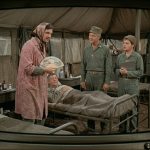
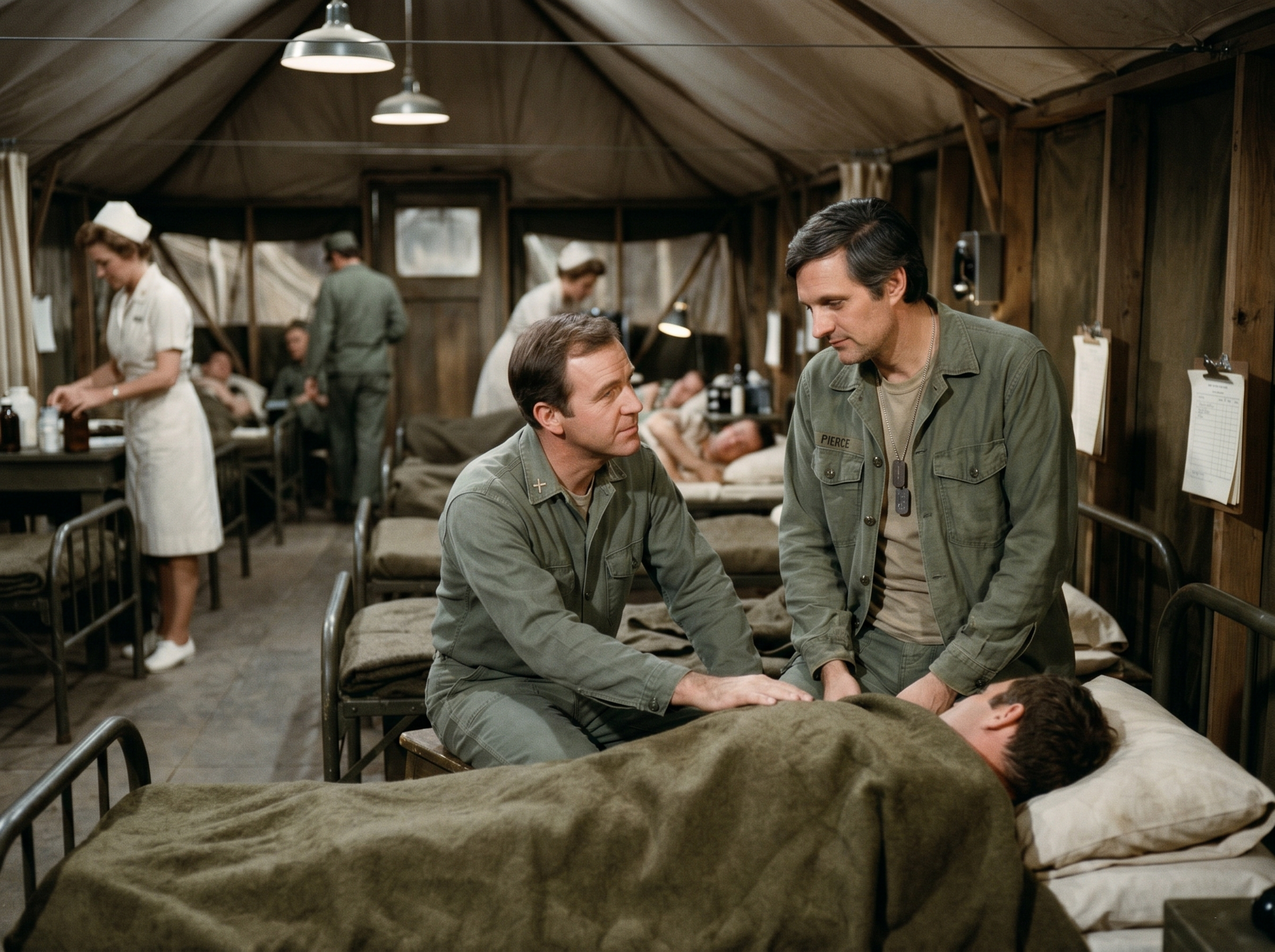
It was a quiet, dimly lit cavern of canvas and wood, smelling of rubbing alcohol, old wool, and exhausted prayers. Soft yellow light from overhead metal lamps cast long, gentle shadows across the neat rows of simple cots. The only sounds were the low, steady hum of the camp’s generators outside and the fragile, rhythmic breathing of the wounded men trying to survive the night.
In the background, a nurse in a crisp white uniform moved silently between the beds, checking charts and adjusting IV drips. Her movements were practiced and weary, a ghostly guardian in the dim light.
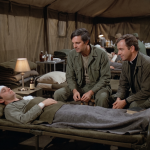
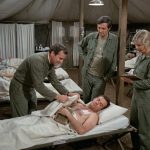
At the center of the ward, beneath the slope of the tent roof, stood Captain Benjamin Franklin Pierce.
Hawkeye was thirty hours into a marathon session of meatball surgery, and he looked every minute of it. His olive-drab fatigue shirt was wrinkled and stained with the ghosts of the day’s work. His silver dog tags rested heavily against his chest, a constant, cold reminder of where he was.
Usually, Hawkeye filled the silence of the camp with a relentless barrage of wise-cracks, deflecting the horror of the war with a shield of cynical wit. But standing beside this particular cot, the playful surface had completely vanished.
He was staring down at the young soldier in the bed, his expression thoughtful, quietly wounded, and entirely stripped of its armor. He looked deeply, profoundly tired.
Sitting on a wooden crate just beside the cot was Father John Patrick Mulcahy.
The camp’s gentle moral heart sat leaning forward, his posture radiating a quiet, steady compassion. He wore his standard green fatigues, the small gold cross on his collar catching a faint glimmer of the overhead light. His hands were clasped loosely, resting near the edge of the olive blanket that covered the young boy.
“If he sleeps any harder, he’s going to start charging us rent for the mattress,” Hawkeye murmured. His voice was a dry, raspy whisper, the joke falling flat even to his own ears.
“He’s resting, Hawkeye,” Father Mulcahy replied softly. A gentle, reassuring smile touched the corners of the priest’s eyes. “You might want to consider trying it yourself. You look like you’re sleepwalking.”
“I can’t,” Hawkeye said, his eyes never leaving the boy’s pale face. “I spent four hours putting this kid’s chest back together. I used so much thread I’m pretty sure I accidentally knitted him a sweater.”
Hawkeye crossed his arms, his fingers digging slightly into his own sleeves. “He’s too quiet, Father. I don’t like it when they’re this quiet.”
The boy in the bed was barely nineteen, a farm kid from somewhere in the Midwest who looked like he belonged on a baseball diamond, not in a Korean valley. His face was pale, his eyes bruised with exhaustion beneath closed lids.
Suddenly, the rhythm of the boy’s breathing changed. It shifted from a slow, shallow draw to a ragged, uneven hitch.
The boy’s head rolled to the side, a low, distressed moan escaping his dry lips. His brow furrowed in sudden, sharp agony, and his hands twitched against the rough fabric of the muted green blanket. He was trapped in a nightmare, reliving the artillery shell that had brought him here.
Hawkeye was instantly on high alert. The doctor in him overrode the exhaustion.
He stepped closer, leaning over the metal railing of the cot. His mind raced through a terrifying checklist of invisible disasters. Was it internal bleeding? A collapsed lung? A missed piece of shrapnel shifting in the dark?
“Damn it,” Hawkeye whispered, his voice suddenly tight with genuine fear. He reached out to check the boy’s pulse, his fingers pressing against the kid’s neck.
The boy’s breathing grew faster, more panicked, like he was drowning in the dry air of the canvas tent. Hawkeye looked down at Father Mulcahy, the deeply compassionate core of the surgeon fully exposed in the dim light.
“His pulse is racing, Father,” Hawkeye said, his voice cracking with the unbearable weight of it all. “I fixed him, I swear I did, but I don’t know if he’s strong enough to hold on until morning.”
The heavy silence of the Post-Op ward was suddenly shattered by the boy’s ragged, struggling breaths.
Hawkeye’s hands hovered helplessly over the kid’s chest. He was a master with a scalpel, a genius with clamps and sutures, but right now, there was nothing to cut, nothing to sew. The boy wasn’t dying of a physical wound; he was fighting a war in his own mind, and his traumatized body was threatening to give out from the sheer terror of it.
“Nurse!” Hawkeye called out, keeping his voice as low as possible to avoid waking the others, but the urgency was sharp. He looked around for his stethoscope, the frantic energy of a helpless healer taking over.
But before the nurse could cross the wooden floorboards, Father Mulcahy moved.
He didn’t reach for a medical chart, and he didn’t call for a crash cart. Instead, the priest simply leaned in closer. His expression remained incredibly calm, an anchor in the sudden storm of Hawkeye’s panic.
With a slow, deliberate gentleness, Father Mulcahy reached out and placed his warm hand softly over the boy’s trembling shoulder, right over the edge of the muted white bandage.
“Easy now, son,” Mulcahy murmured.
His voice was entirely different from the sharp, clipped tones of a surgical order. It was a low, soothing hum, vibrating with a deep, unwavering kindness. It was a voice built for echoing in quiet chapels, meant to carry comfort to the darkest corners of a human soul.
“You’re safe,” Mulcahy continued, leaning his face closer to the boy’s ear. “You are far away from the noise. You’re safe, and you are not alone.”
Hawkeye froze, his hands still hovering in the air. He watched the priest, the medical impulse in his brain fighting with the undeniable human reality playing out in front of him.
Mulcahy didn’t offer a prayer, nor did he preach. He simply offered his presence. He kept his hand firmly but gently on the boy’s shoulder, a grounding weight in a world that had suddenly blown apart.
“Just listen to the wind against the canvas,” Mulcahy said softly, his thumb tracing a slow, calming circle against the wool blanket. “Think of the breeze back home. Just rest.”
For a long, agonizing minute, nothing happened. The boy continued to gasp, his eyes darting frantically beneath his eyelids. Hawkeye’s jaw clenched, his heart hammering against his ribs as he prepared for the worst.
And then, slowly, the miracle happened.
It wasn’t a medical miracle. It was simply a human one. The boy’s erratic breathing caught on a ragged sigh, and then, very gradually, the tense muscles in his neck began to relax.
The frantic twitching in his hands slowed to a stop. The deep furrow on his brow smoothed out, the terrifying grip of the nightmare finally breaking. He let out a long, shuddering breath that seemed to carry the last of his panic away, and sank deeper into the thin pillow.
His chest began to rise and fall in a slow, steady, even rhythm. The crisis had passed.
Hawkeye stood perfectly still for a moment, simply watching the gentle rise and fall of the green blanket. He reached out, his fingers finding the boy’s wrist. The pulse was still weak, but it was steady, no longer racing like a frightened rabbit.
Hawkeye let out a long breath, his shoulders dropping two inches as the crushing weight of fear lifted from his back. He looked down at the priest.
Father Mulcahy hadn’t moved. He still sat on the crate, his hand resting near the boy, that same soft, gentle smile on his face. He looked up at Hawkeye, his eyes tired but shining with a quiet resilience.
“I don’t know what kind of medicine they teach you at seminary, Father,” Hawkeye said softly. The trademark wit was back, but it was stripped of its usual bite. It was tender, fragile, and filled with profound gratitude. “But you’ve got one hell of a bedside manner.”
Mulcahy offered a modest shrug, adjusting the cross on his collar. “Medicine heals the body, Hawkeye,” he replied gently. “But sometimes, a frightened spirit just needs a reminder that it hasn’t been abandoned in the dark.”
Hawkeye nodded slowly, the truth of it sinking into his tired bones. He shoved his hands deep into his pockets, the image of the cynical, wisecracking doctor melting away to reveal the deeply caring man underneath.
He didn’t leave. Despite the exhaustion pulling at his eyelids, Hawkeye pulled up an empty wooden crate and sat down on the other side of the cot.
They sat there together in the quiet hum of the Post-Op ward, two completely different men united by a single, desperate purpose. The atheist surgeon and the faithful priest, keeping a silent, watchful vigil over a sleeping farm boy from the Midwest.
Outside the tent flaps, the Korean War was still waiting for them. Tomorrow, the helicopters would come again, bringing more noise, more blood, and more heartbreak.
But for tonight, in the soft, muted light of this modest recovery space, they had won. The boy was sleeping peacefully. The canvas walls felt a little less like a military hospital, and a little more like a sanctuary.
Hawkeye looked across the bed at Mulcahy, sharing a silent look of mutual respect and shared burden. They were tired, they were far from home, but as long as they had each other, they could survive the night.
In a place designed to fix broken bodies, it was often the quietest moments that mended the soul.