The Sanctuary of Rosie’s
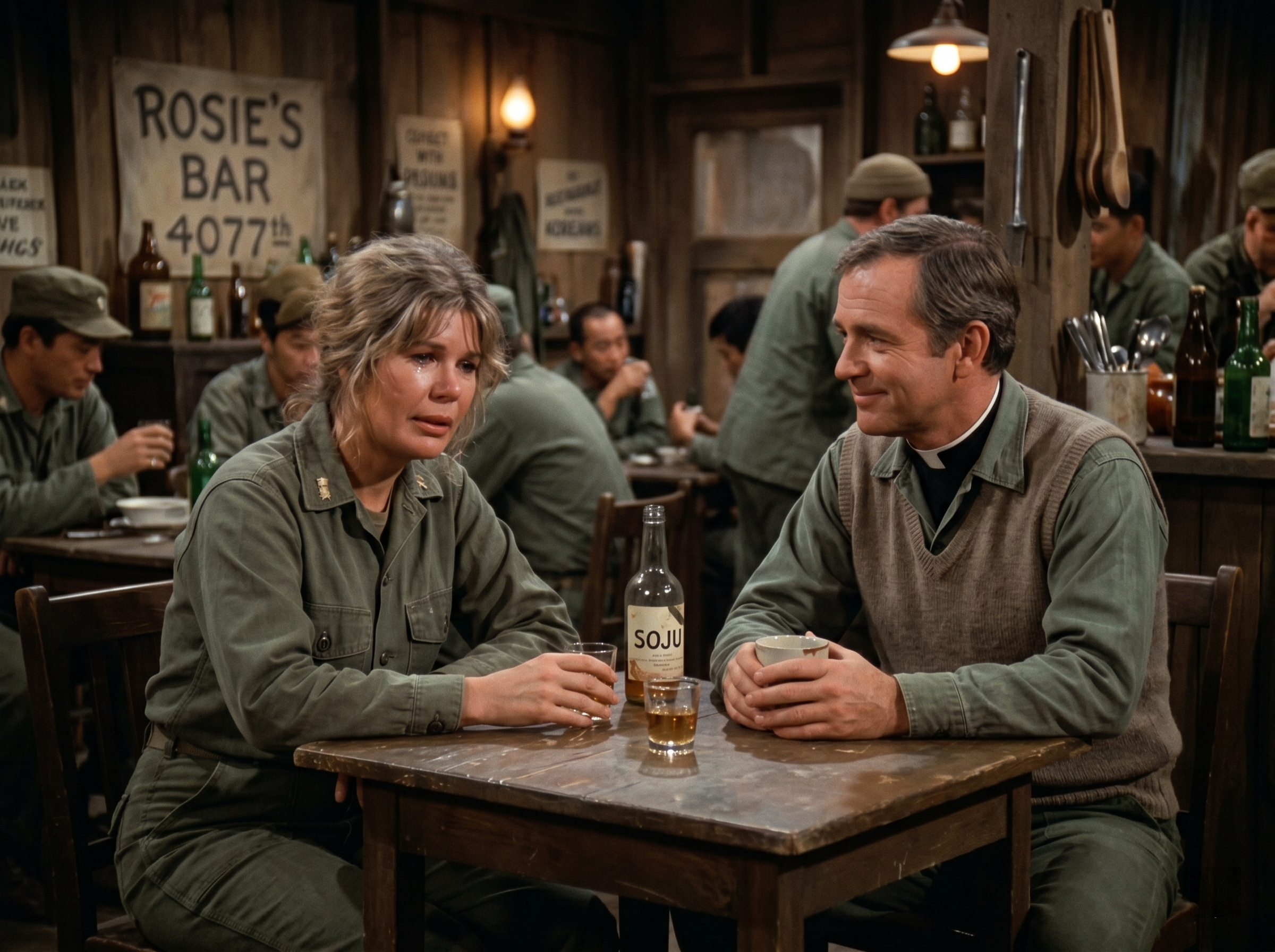
Rosie’s Bar was rarely a place for quiet reflection. Usually, it was a sanctuary of loud complaints, questionable food, and the desperate, ringing laughter of people trying to forget where they were.
The air was always thick with cheap cigar smoke, the smell of burnt ribs, and the tinny, scratchy sound of the jukebox in the corner.
But occasionally, if you found the right table tucked away in the back, Rosie’s could offer a strange, bruised kind of peace.
Tonight, the corner table was occupied by two people who desperately needed it.
Major Margaret Houlihan sat heavily in a simple wooden chair, looking completely unlike the rigid, unyielding Head Nurse of the 4077th.
She was still in her green fatigues, the fabric rumpled and worn from a brutal forty-eight-hour shift in the operating room.
Her normally perfect hair was loose and slightly tangled, framing a face that was pale with bone-deep exhaustion.
Across from her sat Father John Mulcahy, hands gently folded around a small ceramic cup.
He wore his familiar olive drab shirt and a brown sweater vest, his clerical collar a stark, quiet reminder of grace in a place that had entirely too little of it.
Between them on the scuffed wooden table sat a half-empty bottle with a plain white label that simply read, “SOJU.”
Father Mulcahy wasn’t drinking the harsh local liquor, but he was providing something far more intoxicating to the weary Major: he was offering his absolute, undivided attention.
He watched her with a soft, terribly sad smile, his eyes filled with the kind of boundless compassion that only came from seeing the worst of humanity and choosing to believe in the best of it.
Margaret stared at her small glass, her shoulders slumped forward, her emotional guard completely dismantled.
For the first three days of the current push of wounded, she had been a force of nature.
She had barked orders, rationed plasma, held the hands of terrified eighteen-year-old boys, and kept the entire nursing staff from collapsing under the sheer weight of the tragedy.
She had been iron. She had to be.
But now, three miles down the road in the dim, amber light of Rosie’s, the iron was finally rusting.
“I got a letter today, Father,” Margaret said, her voice barely rising above the low din of the enlisted men chatting at the bar behind them.
Her voice was thick, missing entirely its usual sharp, commanding edge.
“From my friend, Susan. Back in Monterey.”
Mulcahy didn’t interrupt. He simply nodded, leaning in slightly so she wouldn’t have to raise her voice.
“She had a baby girl,” Margaret continued, her gaze fixed on the amber liquid in her glass. “Her second. They bought a house with a yellow door. She wrote about picking out curtains. Curtains, Father.”
She let out a hollow, breathy laugh that held absolutely no humor.
“She complained that the fabric store didn’t have the right shade of blue.”
Margaret’s hands began to tremble slightly against the rough wood of the table.
“And I sat there on my cot, reading this letter, and my boots were still covered in… in…”
She couldn’t finish the sentence. The reality of the OR floor was too harsh to bring into the dim warmth of the bar.
Slowly, she looked up at him.
Her eyes were brimming with unshed tears, her face open and vulnerable in a way very few people at the 4077th were ever allowed to see.
“Father,” Margaret whispered, a single tear finally escaping and tracing a shining path down her tired cheek. “What if I forget how to live in a world that cares about curtains?”
Father Mulcahy did not offer a quick platitude.
He didn’t reach across the table to pat her hand or tell her that everything was going to be alright, because they both knew that in Korea, ‘alright’ was a luxury they couldn’t afford.
Instead, he kept his hands warmly wrapped around his small cup, his thumbs lightly tracing the rim.
He let the heavy, frightening question hang in the air between them, giving it the respect it deserved.
The low murmur of the bar continued around them, a steady hum of life moving forward despite the war just over the hills.
“It is a frightening thought, isn’t it?” Mulcahy finally said softly, his voice a gentle, steadying anchor in the dim room.
“To feel yourself becoming accustomed to the unimaginable.”
Margaret sniffled quietly, wiping the stray tear from her cheek with the back of her wrist, a remarkably childlike gesture for such a commanding woman.
“I look in the mirror,” she confessed, her voice shaking, “and I don’t see the woman who left the States. I see someone hard. Someone who can step over a pool of blood without blinking. I’m terrified of her, Father.”
Mulcahy smiled, a genuine, warm expression that crinkled the corners of his eyes.
“I don’t see a hard woman, Margaret,” he said gently.
“I see a woman who held a frightened corporal’s hand for three hours yesterday while they waited for anesthesia. I see a woman who makes sure her nurses get hot coffee before she takes a single sip.”
Margaret looked down, a flush of modest embarrassment coloring her cheeks.
“That’s just my job, Father. It’s discipline.”
“No, my dear,” Mulcahy corrected her, his tone mild but absolutely firm. “Discipline keeps the inventory logged. Compassion keeps those young men from giving up hope in the dark.”
He tilted his head slightly, studying her face with kind, observant eyes.
“You haven’t forgotten how to live in a gentle world, Margaret. You are simply spending all of your gentleness here, where it is needed most.”
Margaret stared at him, the words washing over her, loosening the tight, suffocating knot of panic that had been sitting in her chest since she opened the mail.
She took a slow, deep breath, the smell of the dusty bar and the harsh alcohol suddenly grounding her back in the present moment.
“Do you really believe that?” she asked, her voice small but steadying.
“With all my heart,” Mulcahy replied instantly.
He shifted slightly in his chair, a familiar, wry twinkle appearing in his eye.
“Though, I must admit,” he added smoothly, glancing at the bottle on the table, “I am less certain about the virtues of whatever Rosie is fermenting in that bottle.”
A short, surprised laugh escaped Margaret’s lips.
It wasn’t a loud laugh, but it was real. It broke the heavy, melancholic spell that had settled over their corner.
“It’s awful,” she agreed, wiping her eyes once more and finally reaching for her glass. “It tastes like iodine and regret.”
“A fitting vintage for the locale,” Mulcahy mused, raising his small ceramic cup in a quiet toast.
Margaret lifted her glass to meet his.
The glass clinked softly against the ceramic, a tiny, ringing sound of survival in the middle of a warzone.
She took a small sip, grimacing at the burn, but feeling the warmth spread through her tired chest.
The fear hadn’t completely vanished—the war was still waiting for them outside the wooden doors of the bar—but the crushing weight of the isolation was gone.
She wasn’t alone in the mud.
She looked across the worn table at the gentle priest in his sweater vest, feeling a profound wave of gratitude for this strange, ragtag family the army had forced upon her.
They sat together in comfortable silence for a long time, listening to the scratchy music from the jukebox.
The iron Major was still there, ready to take command when the choppers returned, but for tonight, the woman underneath was allowed to rest.
In a place built on patching up the broken, sometimes the best medicine was just someone willing to sit with you in the dark.