The Floral Apron and the Inventory Sheet
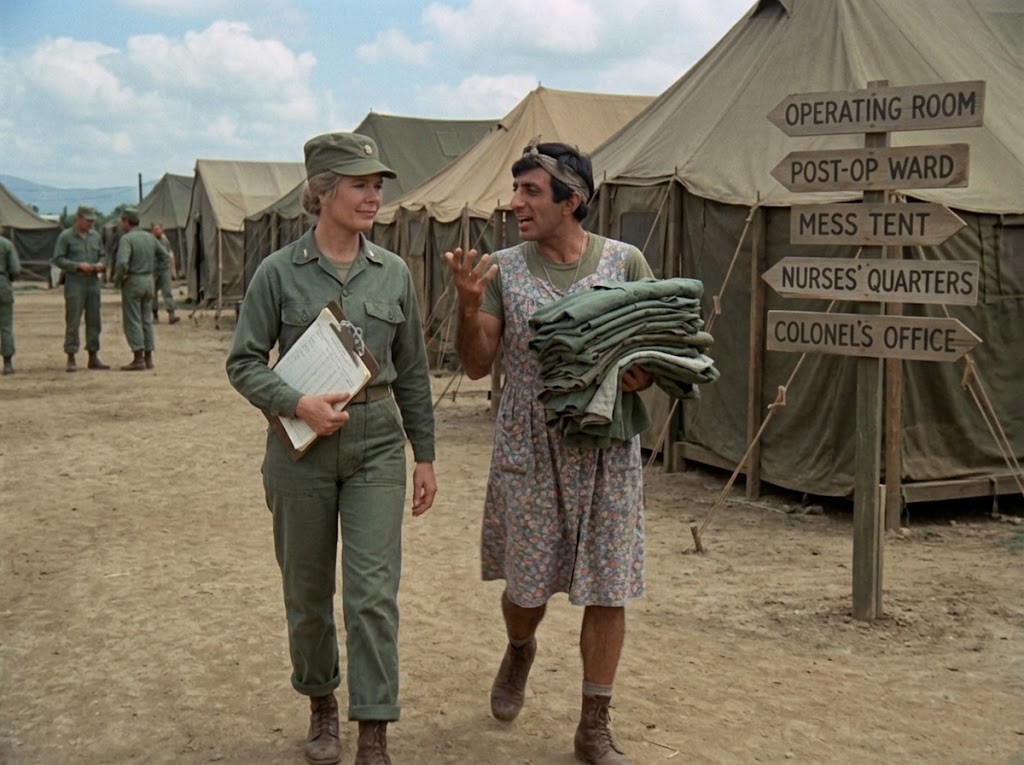
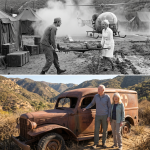
The mud of Uijeongbu had a way of soaking into everything, including a person’s soul, but today the sun was out and the camp smelled faintly of baked canvas and diesel fuel.
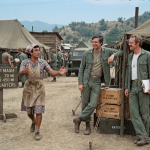
Major Margaret Houlihan walked down the main compound thoroughfare, her thumb hooked firmly under the edge of a wooden clipboard, her eyes scanning a fresh inventory sheet.
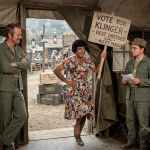
Beside her walked Corporal Maxwell Klinger, wearing a faded floral-print apron over his olive-drab undershirt, carrying a stack of freshly laundered, razor-folded surgical gowns like a precious offering.
“I’m telling you, Major, it’s a matter of basic human dignity,” Klinger said, his voice carrying that familiar Toledo cadence that could somehow make a supply grievance sound like a plea before the supreme court. “A man cannot be expected to maintain morale when the laundry truck returns three sheets short of a full rotation, especially when two of those sheets were designated for the VIP tent.”
Margaret didn’t stop walking, her polished boots crunching rhythmically on the dry dirt, though the corners of her mouth twitched with a microscopic hint of amusement.
“Corporal, we are running a combat hospital, not the Waldorf-Astoria,” she replied, keeping her voice strictly professional as she checked off a line item on her list. “If Colonel Potter says we stretch the linen budget until the end of the month, we stretch it, even if it means you have to look a little less glamorous during your afternoon rounds.”
“It’s not about glamour, Major, it’s about the principle,” Klinger insisted, shifting the heavy stack of green cotton in his arms and gesturing wildly with his free hand to emphasize his point. “Without order, we are just a bunch of people living in tents in the middle of nowhere, losing our minds one laundry load at a time.”
He paused, his expressive face softening from theatrical outrage into something much quieter, his eyes catching the light from the signposts pointing toward the Operating Room and the Post-Op Ward.
“And besides,” Klinger added softly, his tone suddenly dropping its defensive edge, “Father Mulcahy spent three hours yesterday trying to comfort a kid from Iowa who couldn’t sleep because the rough canvas cot reminded him too much of where he was, and I promised him I’d find something softer before the next choppers came in.”
Margaret stopped mid-stride, her pen hovering just above the clipboard as she looked at the man beside her.
The sudden silence between them felt heavier than the midday heat, filled only by the distant, rhythmic thumping of a generator near the mess tent.
Margaret looked down at Klinger’s floral apron, then at the meticulously folded gowns in his arms, recognizing the immense effort it took to keep anything clean, orderly, or soft in a place built entirely out of olive drab and exhaustion.
“A kid from Iowa?” she asked quietly, her eyes searching Klinger’s face, the stern chief nurse instantly giving way to the woman who stayed awake for thirty-six hours straight holding the hands of frightened boys.
Klinger nodded, the dramatic flair entirely gone now, replaced by the simple, tired resilience of a soldier who used humor to keep from breaking. “Private Miller, third cot from the door in Post-Op. He’s nineteen, Major. He keeps asking if his mother changed the sheets on his bed at home.”
Margaret looked back down at her inventory sheet, the sterile numbers and columns suddenly looking very small against the reality of a homesick boy in a crowded ward.
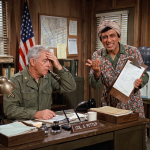
She turned her head slightly, looking toward the tents where Hawkeye and B.J. were likely catching a few hours of uneasy sleep, and where Colonel Potter was undoubtedly wrestling with his own mountain of supply reports in the office.
“Corporal,” Margaret said, her voice resuming its firm, authoritative tone, though it had a distinct warmth underneath that no military regulation could ever scrub out. “It seems I made an error in my calculations here.”
Klinger blinked, looking at her with a mixture of surprise and cautious hope. “An error, Major?”
“Yes,” Margaret said, decisively checking a box on the paper with a sharp, satisfying click of her pen. “According to my revised records, we have an unallocated surplus of three premium-grade cotton sheets currently stored in the back of the supply tent, listed under ‘miscellaneous medical padding.'”
A slow, brilliant smile spread across Klinger’s face, his eyes crinkling at the corners as he adjusted his grip on the laundry. “Miscellaneous medical padding. That’s a beautiful phrase, Major. It sounds almost poetic.”
“Don’t get used to it, Klinger,” Margaret warned, though she couldn’t hide her own small, fond smile any longer as they resumed walking toward the nurses’ quarters. “If Colonel Potter asks, you found them at the bottom of an old sea chest, and if you ever tell anyone I fudged an inventory report, I’ll have you scrubbing the latrines with a toothbrush until the armistice is signed.”
“My lips are sealed, Major,” Klinger said, giving her a theatrical nod of absolute loyalty. “The 4077th secret is safe with me.”
They walked on together through the dust, the nurse in her crisp fatigues and the clerk in his flowered apron, an impossible family bound together by the quiet, stubborn determination to bring a little bit of softness to a world that was far too hard.
Sometimes the greatest acts of healing at the 4077th didn’t happen in the operating room, but in the quiet spaces between the tents where humanity refused to be left behind.