A Little Piece of Static and a Whole Lot of Heart
If there’s one sound that defines life at the 4077th, it’s not the helicopters. It’s the static.
That ceaseless, scratchy white noise pouring from the speaker in the corner of the Colonel’s office, like a ghost haunting the tent.
Sometimes, though, that static breaks. And when it does, the whole camp seems to hold its breath.
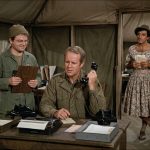
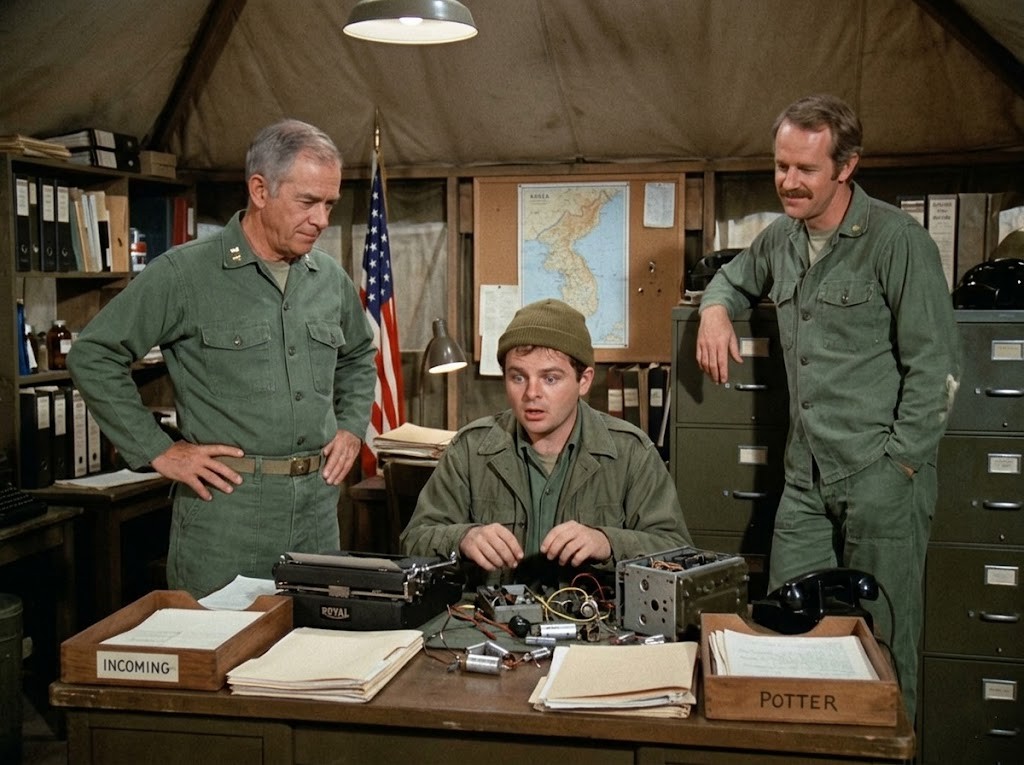
Inside the cluttered office, Colonel Potter and B.J. Hunnicutt stood shoulder-to-shoulder, their twin expressions of dry fatigue and quiet amusement fixed on the small figure between them.
Potter had his hands on his hips, a pose as familiar to the unit as his cavalry-officer stare. He looked at Radar like a father looking at a son who was currently, and creatively, in over his head.
Radar, as always, was the center of gravity, hunched low in his knit cap, eyes wide with a peculiar mix of desperate focus and dawning panic.
Between them, the desk—a landscape of incoming and outgoing paper trays—was a casualty zone of wires, transistors, and loose screws.
It wasn’t medical equipment. It was far more important than that.
“What you’re telling me, son,” Potter said, his voice a low, paternal rumble, “is that in your quest to improve our signal, you have essentially vivisected Mrs. O’Reilly’s favorite radio?”
Radar swallowed. He looked at the mangled mess. He looked at B.J. He looked anywhere but at Potter. “Sir, you see… in Des Moines… I once saw…”
He gestured vaguely. “I was trying to boost the gain on the ‘Korea’ band. So we could hear that big broadcast from Tokyo tonight. It’s the big comedy special, sir. Everyone was counting on it.”
B.J. leaned a casual shoulder against the filing cabinets, his face a perfect mask of controlled neutrality, hiding the amusement in his eyes.
“And you thought the best way to do that was to expose the radio’s *guts* like that, Radar?” B.J. asked gently.
“It… it looked simpler in the diagram I drew,” Radar managed. “On a napkin.”
“Radar,” Potter said, “that radio is the entire company’s only window to a world that isn’t green canvas or surgical fluid. Right now, it looks like a junk heap. And I am hearing… absolute… silence.”
Radar flinched. The silence, indeed, was louder than the static had ever been. He didn’t know what to do. His fingers hovered over the mess. He looked at B.J., silent. He looked at Potter. His eyes were watering. He knew if they didn’t hear the show, it would be *his* fault.
It would be the one thing he couldn’t fix. The one time he would let them down. And they needed it so badly.
He looked up at the Colonel, the entire weight of the 4077th’s collective hope on his small shoulders, and said, “Sir… I don’t think it’s coming back.”
Potter stared at him. He didn’t yell. He didn’t bluster. He just stared. And that was worse.
B.J. shifted his weight. The joke was gone now. He could feel Radar’s despair filling the room.
“You don’t *think* it’s coming back,” Potter repeated, his voice quiet.
A sudden, sharp movement came from the corner of the tent. Hawkeye was standing there, leaning against a post, having slipped in unnoticed.
“Did I hear the terrible news?” he said, his voice cutting through the heavy air with that specific edge that could make any room less serious. “Has our only link to civilization been brutally murdered? And did you, Radar, do it with a *screw*?”
“He was trying to make it better, Pierce,” B.J. said, stepping in. “For the broadcast.”
Hawkeye walked to the desk, peering over Radar’s shoulder at the chaotic collection of parts. He let out a low whistle. “Well, my friend, you haven’t just killed it. You’ve given it a complete autopsy. This radio is officially DOA.”
“Doc, please,” Radar whispered. “They were waiting for it.”
Potter finally sighed. A deep, weary sound. He walked around to the front of his desk.
“Alright,” he said. “Everyone back up. Give the poor boy some room.”
“Sir, you are a compassionate man,” Hawkeye said. “But the radio isn’t wounded. It’s expired. It has ceased to be. It is bereft of life. It’s an *ex*-radio.”
Radar was blinking rapidly. “It’s my fault.”
Potter sat down, heavily, in his chair. He picked up one of the large batteries. He didn’t look at Radar; he looked at the battery.
“In the cavalry,” Potter began, “when a horse throws a shoe, you don’t just stand there and look at it. You either find a smith, or you learn to do it yourself.”
He looked up. “Radar, you messed it up. That’s a fact. But you were trying to bring us something. Something good. Something we needed.”
“Sir…”
“And,” Potter continued, looking at Hawkeye, “one thing I know about my medics is that they don’t like to give up on a patient.”
Hawkeye paused. “Colonel, if you’re suggesting we attempt a resuscitation on this pile of hardware, I must remind you that my license only covers the biological variety.”
“Consider it a humanitarian mission,” Potter said.
B.J. chuckled and pushed his sleeves up. “Alright. Let’s see. If this transistor controls the power… and that capacitor controls the band…”
“Then this loose wire must be its soul,” Hawkeye said, taking the pliers from Radar’s frozen hand.
Radar looked at them. His breath was shallow. “But… but…”
Potter nodded, just once. “Go on, then. Don’t worry about me. I’ve got nothing but time.”
“Alright,” Hawkeye muttered, focusing. “We’ll need more light. B.J., hold that mirror to angle the bulb down. Radar, you be the scrub nurse. Pliers. Small ones. No, smaller. This is neurosurgery.”
The room fell quiet, but it was a different kind of quiet. Radar sat motionless, handing tools with an intense, ritualized respect. B.J. guided the light. Hawkeye worked with focused, deliberate precision. Potter sat back, watching them, his eyes steady.
“Bypass,” Hawkeye murmured. “The connection is weak. B.J., can you jump the wire?”
“On it,” B.J. said.
Minute after minute ticked by. The light was harsh. The tent felt hot and stuffy. No one spoke, only the small clicks of tools and the soft whispers of technical instructions. The entire war, the helicopters, the static… everything else seemed to fade. Only this small circle of light and effort existed.
Finally, Hawkeye leaned back. “I’ve made a terrible mistake.”
“Pierce,” Potter warned.
“I connected the funny bone to the ankle bone. And the hip bone… well, we won’t discuss where that went. But the soul? It’s attached.”
B.J. flipped a tiny switch.
A low, buzzing hum filled the air. And then, through a crackle of static, a voice. Faint. But clear. And very, very American. “…coming to you live from Tokyo! Welcome to…”
A roar of audience laughter erupted from the small speaker.
Radar let out a sound that was half-gasp, half-sob. “It’s on! Docs! You did it! It’s on!”
Potter didn’t smile. But the tension went out of his face. He leaned forward and adjusted the volume dial, turning it up just enough to hear the comedians’ opening monologue over the background hiss.
He looked at Hawkeye and B.J. “Good work, doctors.”
“All in a day’s work,” Hawkeye said, pushing away from the desk. “Now if you’ll excuse me, I believe my martini hour has been rudely interrupted by a complete and total lack of medical emergency.”
He and B.J. shared a quick, tired smile and walked out of the tent, the Tokyo broadcast laughing them out the door.
Potter turned back to Radar, who was still staring at the radio as if it were a newly-born child.
“Well, O’Reilly,” Potter said, his voice low again. “It looks like the 4077th’s signal is coming in loud and clear tonight. You can tell Mrs. O’Reilly that you… adjusted… her radio. And that she can come back and collect it tomorrow morning. After the broadcast.”
“Yes, sir,” Radar said. He looked at the Colonel. “Sir?”
“What is it, son?”
“Thank you.”
Potter didn’t answer. He just picked up his glasses and turned to a report in his ‘incoming’ tray. He waved his hand, a small dismissal that felt more like a paternal push.
“Go on,” he said, without looking up. “The show’s on. I’ll listen to the static when it’s done.”
And as Radar quickly and carefully scooped his salvaged parts back into a pile, and as the laughter on the radio echoed in the tent, he finally turned and walked into the Korean night. The static had been silenced, replaced by something far better. It wasn’t perfect. The sound was still weak, still tinny, still far away.
But as he heard the laughter rise and fill the camp, as the tired surgeons and nurses leaned a little more easily and smiled a little more truly, Radar knew it was the clearest and most beautiful signal he had ever heard.
They were all listening together. And in that one moment, it was more than just static and laughter. It was a faint, scratchy echo of home.
FINAL LINE: And for one magical, impossible hour, they weren’t the 4077th in Korea; they were just three friends in an office, laughing at the same jokes, together.