A Flash of Toledo Pink
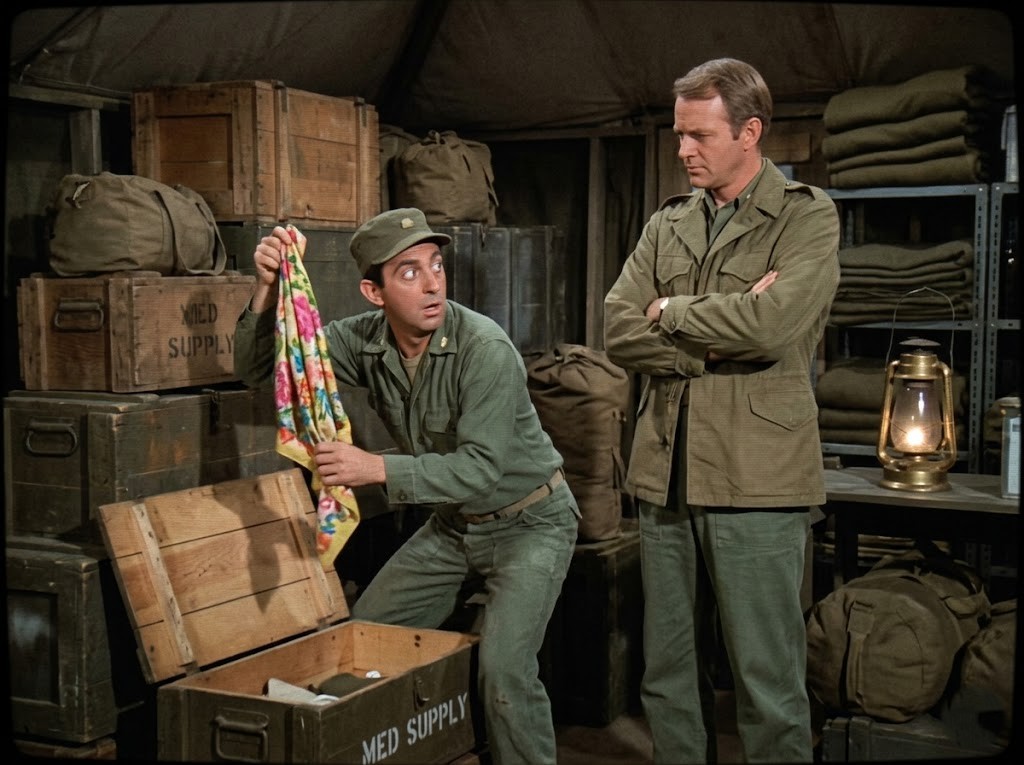
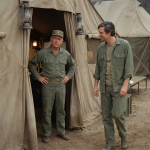
If there was one thing you could count on in the Korean dawn, it was the damp. It seeped into the canvas, into the blankets, and into your bones. The 4077th supply tent was always the coldest spot, smelling perpetually of stale canvas, dust, and dried potatoes. It was here that Captain B.J. Hunnicutt found himself, arms crossed, fighting back a yawn. He was just looking for a fresh box of surgical gloves. What he found instead was a moment of absolute stillness in the gloom.
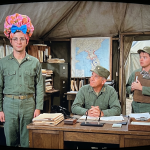
Corporal Klinger was crouched over an open wooden crate marked “MED SUPPLY.” For once, he wasn’t in a flowing dress, heels, or a matching handbag. He was in standard-issue fatigues, his cap pulled low, and his shoulders hunched in a posture of extreme secrecy. The only light came from a single, sputtering brass lantern sitting on a makeshift table. That warm glow illuminated the object in Klinger’s hands. It was a flash of vibrant, beautiful color—pink, green, and gold—a silk scarf patterned with wild flowers.
Klinger was caught. B.J. had cleared his throat, a soft *a-hem* that seemed to echo like a gunshot in the quiet tent. The Corporal’s large eyes went even wider, his expression shifting from careful focused attention to genuine surprise. He didn’t drop the scarf, but held it frozen mid-gesture above the crate, looking back at B.J. with an expression that said both ‘You caught me’ and ‘Please don’t ask.’ It was the classic Klinger look: innocent, guilty, and ready with a dozen alibis.
B.J. leaned against a stack of crates, his pose casual but his eyes serious. He’d seen a lot of things in this camp, but Klinger—*this* Klinger, without the theatrical armor of a chiffon gown—always managed to surprise him. He watched the light catch the fine texture of the silk. B.J. knew every item on the standard medical inventory. Silk flower scarves from Toledo were definitely not on it.
“Corporal,” B.J. said quietly, his voice dry. “I didn’t realize the Army was now supplying floral camouflage.”
Klinger didn’t blink. He lowered his hand slightly, still clutching the precious silk. His mouth worked for a moment, searching for the right words, the right angle. He glanced at the open crate, then back at the Captain. The humor was there, standard defensive posture, but something else was underneath it—a rare, raw nervousness that B.J. couldn’t quite place.
“Captain, sir,” Klinger finally said, his voice dropping an octave, losing some of its usual Toledo brass. “It’s, uh, a personal item. For dust protection. The wind out here, it ruins a man’s complexion.”
B.J. couldn’t help a soft chuckle. “Dust protection? In the middle of an operating room supply crate? With a pattern that could distract a sniper from three miles away?” He stepped closer, the lantern light now reflecting in his own eyes. B.J. knew the truth about “dust protection,” and he knew the truth about Klinger. He wasn’t mad about the rules; he was just curious about the heart. “Who’s it for, Klinger? And what did you trade for it?”
Klinger sighed, his shoulders sagging, his dramatic defense melting into the chilly air. He held the scarf with both hands, smoothing the delicate fabric as if it were a fragile bird. The lantern light caught the subtle green of the leaves and the rich pink of the petals.
“You remember Private Miller?” Klinger asked, not looking up. “The kid from Ohio? Got hit two days ago?”
B.J. nodded slowly. He remembered. The OR had been a chaotic blur, and the kid was young, too young, with a gut wound that made the entire surgical team hold their breath. He was stable now, barely, but the trauma ran deeper than the physical injury. “Yeah, I remember him. Father Mulcahy’s been sitting with him all night.”
“The kid… he just lies there,” Klinger whispered. “He doesn’t talk. Doesn’t look at anything. He just stares at the tent canvas like he’s already gone. Mulcahy told me… he told me the kid was holding onto a small silk handkerchief his sister gave him. It got ruined. Lost in the shuffle, or soaked through. Either way, it’s gone.”
Klinger finally looked up, meeting B.J.’s steady gaze. The humor was completely absent. In its place was a fierce, protective compassion. “It was the only thing he had from home, Captain. The only color in his whole damn life right now.”
B.J. was silent. The image hit him like a physical blow. A wounded kid clinging to a scrap of home, and now, even that was gone. He looked at the scarf in Klinger’s hands again. The vibrant colors suddenly didn’t look silly. They looked essential. They looked like oxygen.
“What did you trade?” B.J. asked, his voice softer now, more respectful.
Klinger hesitated, glancing down at his bare wrist. B.J. didn’t notice at first. He just saw Klinger wince.
“I… I traded that chrome watch the Colonel gave me when I made Corporal the first time,” Klinger admitted. “The one with the tiny compass on the side. The Korean supply sergeant in Seoul has a thing for novelty items. He gave me this… and a crate of actual tongue depressors, since the ones we have are just splinters with ambition.”
Klinger ran a thumb over the flower pattern. “It’s not perfect. It’s not the kid’s sister’s. But it’s silk. It’s colorful. And I thought… maybe when he opens his eyes… he won’t just see the mud.”
B.J. stared at him. The sheer absurdity of the deal—a military-issue novelty watch for a scrap of forbidden civilian silk—was the most $M^*A^*S^*H$ thing he could imagine. And the reason was the most human. This wasn’t about the rules or the Section 8. It was about one soldier trying to fix a small, deep ache in another soldier, in the only way he knew how.
“Klinger,” B.J. said, his heart full. He reached out and touched the Corporal’s shoulder. “That watch meant a lot to you.”
“It’s just metal, Captain,” Klinger said, a faint smile returning. “The compass always pointed southwest anyway. I don’t think I need to know the way back to Toledo that bad. But this kid…” He gestured with the scarf. “This kid just needs to know there’s still something bright left in the world.”
B.J. felt the warmth of Klinger’s gesture pushing back the cold of the tent. He saw the genuine care in the Corporal’s expression, the tired resilience of a man who fought his own war, but would always find the strength to fight for someone else. B.J. thought of his own family, of Peg and Erin, and the things that kept him sane. He realized he was seeing that same tether to humanity right here, in the dirt of a Korean supply tent.
He let his arms fall. The official military skepticism evaporated. “It’s beautiful, Klinger. Truly beautiful. Do you think he’s awake?”
Klinger folded the scarf carefully, reverently, like it was a sacred flag. “Mulcahy said he’d be coming to around now. I was going to… sneaky-like… slip it under his hand while he slept.”
B.J. checked his own watch. It was almost time for the morning rounds. “Tell you what, Corporal. I need to make a stop at Post-Op. Why don’t you join me? We can see how Private Miller is doing. And maybe… we can help him see some color.”
A genuine, wide grin spread across Klinger’s face. The nervous tension was gone, replaced by simple, eager hope. He gave a sharp, happy nod. “Right away, Captain. Right away.”
The two men, a doctor and a supply corporal, a found-family of misfits, picked up the lantern. The bright flower scarf was safely tucked into Klinger’s fatigue pocket. They walked out of the tent, the soft glow of the lantern illuminating their path through the damp morning. As they walked toward the Post-Op tent, the sound of their boots synchronized, the only break in the dawn quiet. B.J. knew that for Private Miller, the war was still happening. But today, thanks to a crazy Corporal with a heart as big as Lake Erie, the mud might just feel a little warmer.
They say you can’t ship a piece of home to Korea, but sometimes, a hero in fatigues figures out how to bring the color.