The Mountain Under the Lightbulb: A 4077th Memory
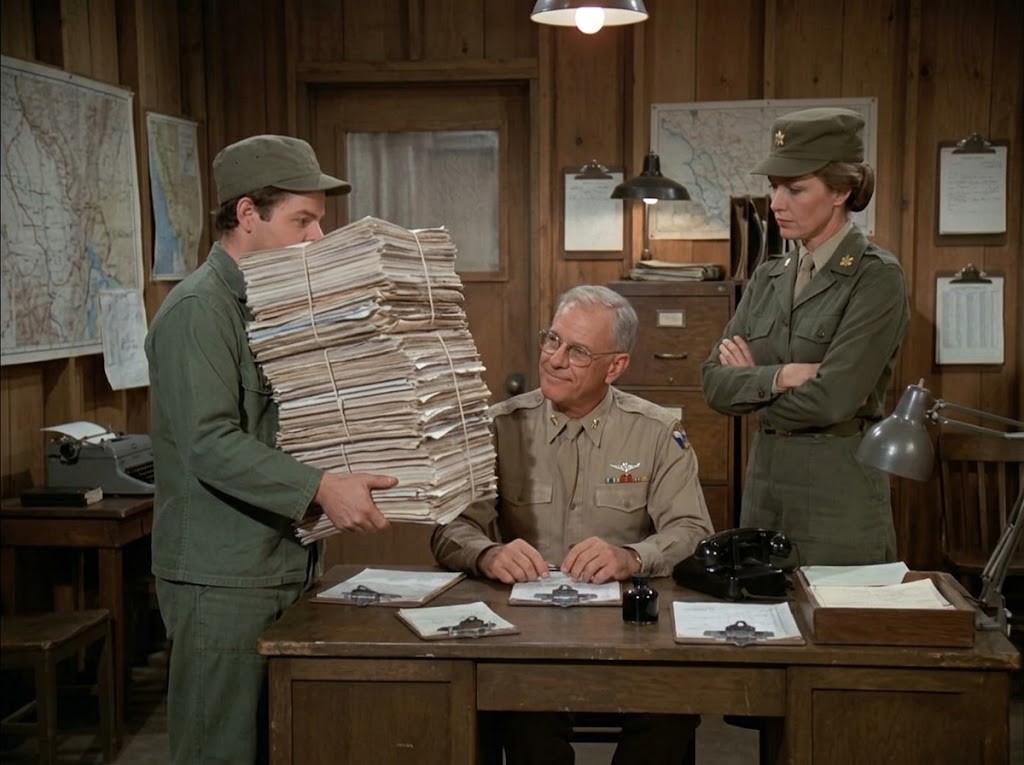
Sometimes the silence in Colonel Potter’s office was heavier than the artillery rumble.
It was late. Past the time anyone should be awake, save for the guard or the doctors recovering from the latest push. The overhead light in the office was a solitary, weak halo against the encroaching Korean darkness. It hummed slightly, the only companion to the scratch of Potter’s pen.
This was the quiet time. The administrative limbo where the blood, the sweat, and the O.R. lights faded into columns of numbers and requisitions.
Then, the door opened.
Or rather, the door opened, and a stack of paper walked in.
Corporal Radar O’Reilly stood on the threshold, a mountain of bundled files held in his arms like a precious, impossible child. The stack was so high it completely obscured his face, reaching high above his fatigue cap. All that was visible were his hands, gripping the frayed rope binding the burden, and his boots, stepping carefully.
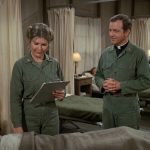
Major Margaret Houlihan was already there. She had come to file her reports, her uniform crisp even at this hour, her arms crossed in that signature pose of weary authority. She looked at the incoming avalanche of bureaucracy with a practiced eye, then let out a sigh that sounded like a tire losing air.
“Good grief, Corporal,” she said, her voice low but sharp. “Are you attempting to relocate the entire Army records department?”
Potter, sitting calmly at his desk with his pen poised, didn’t even look up at first. He just smiled that gentle, knowing smile. The smile of a man who had seen horses, cavalry charges, and two world wars, and now, apparently, was about to be buried in paper.
“It’s the quarterly medical audit, Sir,” Radar’s voice squeaked from somewhere behind the ink-stained cliff. “And the personal effects reports. And the supply inventory. And… well, and a directive from General Clayton about the proper conservation of rubber gloves.”
He took another shuffling step, the massive pile listing precariously. He looked like an ant carrying an entire loaf of bread.
“General Clayton wants to conserve gloves,” Margaret said, her eyebrow arching toward her cap, “while we are running low on everything else.”
Potter finally set down his pen and looked at the swaying tower. His expression was a mix of mild amusement and sheer paternal concern. He watched Radar navigate the small space between the filing cabinets and the edge of his desk.
The office map on the wall, showing positions that seemed to change every hour, felt distant. This paper mountain was the real front line for the 4077th tonight.
“Careful now, Son,” Potter said, his voice steady. “That audit isn’t going to help us if it becomes part of the floorboards.”
Radar tried to pivot toward the small wooden table next to Potter’s desk. The stack shifted. The frayed rope binding it tightened, making a quiet *pop*.
The entire column gave a sickening lurch.
For a heartbeat, time suspended in the weak light. Potter’s calm smile froze. Margaret took a quick step forward, her crossed arms dropping to help, her professional mask cracking with genuine alarm.
It wasn’t a sudden explosion. It was the slow-motion collapse of their entire evening.
The stack began to fall. Not as a single unit, but a cascade. Files separated. Papers fluttered. A long, red tape from a directive began to unfurl like a streamer.
The topmost papers slid straight off and headed directly toward Potter’s open desk, aiming true for his bottle of black ink and his stacked, completed clipboards.
A catastrophe of administrative proportions was about to unfold.
Radar dropped to his knees, not from a desire to pray, but in a panicked attempt to catch the mid-section of the collapse. He looked like he was tackling an octopus.
But Margaret Houlihan, trained for emergencies, moved with the precision she used in the O.R. She abandoned dignity and lunged forward, her hands, just moments ago crossed in judgment, shooting out like a shortstop.
She managed to trap the bulk of the tilting files against the side of Potter’s desk. Her crisp uniform met the ink-stained dust of the paper, and she didn’t care.
Potter, with practiced efficiency, snatched his ink bottle and his clipboards from the desk surface just as the loose top-most pages rained down where they had been. He set them aside and used his other hand to help anchor the slipping papers near his elbow.
The avalanche stopped, though barely. The pile was no longer a stack; it was a heap, held together only by Radar’s chest, Margaret’s shoulder, and Potter’s determined hand.
The silence that followed was different from the pre-paper silence. It was the breathless quiet of shared, messy teamwork. They looked at each other over the chaos.
Radar was now fully visible, peering up from the floor, his face flushed and his cap askew. Margaret was flushed too, her neat uniform slightly rumpled from where she had leaned into the mess.
Potter looked at the pair of them, then at the sprawling monument to bureaucratic madness on his desk. He smiled. Not the wry smile of endurance, but a genuine, quiet chuckle.
“Well,” he said, setting the ink bottle back down far from the edge. “At least we know we have excellent hand-eye coordination. Excellent save, Major. And you, Corporal… next time, two trips.”
Radar blinked, letting out a breath he seemed to have been holding since he walked in. “Yes, Sir. Sorry, Sir.”
“Don’t be sorry, Radar,” Potter said gently, the fatherly tone replacing the officer. “It’s not your fault. It’s just… paper.”
Margaret sat down hard in the guest chair, her hands smoothing the dust off her jacket. She looked at the mass of papers they were all now somehow intimate with. The tension drained out of her, replaced by simple exhaustion.
“We will be sorting this until morning,” she said, her voice stripped of its usual sharpness, revealing the same fatigue they all felt. “The 4077th never seems to run out of patients, and it *definitely* never runs out of forms.”
Potter stood and walked to the side of the desk, reaching down to help Radar up. He dusted off the corporal’s shoulders.
“This is the war they don’t put in the newsreels, Major,” Potter said, looking around his small, wood-paneled command post. “This is the glue that keeps us from just dissolving into the mud.”
He looked back at the table where the paper heap now rested. “It looks like we are pulling an all-nighter. Margaret, pull up a chair. Radar, bring that small table over.”
They didn’t start processing the audit. They just sat.
Potter reached into his desk and pulled out a tin of simple butter cookies, the kind his wife sent. He opened it and offered one to Margaret, then to Radar.
In the small circle of light, the shared cookie and the mutual fatigue felt like a communion. They were more than a Colonel, a Major, and a Corporal. They were just three tired people, found family in a strange land, bound together by duty and a very messy save.
The humor came back, dry and human.
“Pierce would just light a match,” Margaret said, the corner of her mouth twitching.
“Winchester would dictate a scathing letter and assign me to sort it,” Radar chimed in, a little braver now.
Potter chuckled again, a comforting sound against the quiet hum of the bulb. “Well, Winchester can dictate all he wants. We’re the ones here.”
They sat and talked for twenty minutes. Not about the war. Not about the audit. They talked about the smell of rain back in Iowa, the performance of horses at the county fair, and the simple luxury of a hot shower that lasted longer than thirty seconds.
They were building the reserves of humanity they would need when the helicopters next broke the silence.
Slowly, the conversation drifted back. They didn’t tackle the whole mountain. They just separated one small, manageable stack. A shared burden.
They worked. Radar would sort, Margaret would review, and Potter would sign, the synchronized rhythm soothing after the panic. They worked not as officer and subordinate, but as a unit.
Klinger, wearing a flowered dress and carrying a tray of coffee mugs, peeked in an hour later, surprised to see the command staff deep in files. He offered the coffee silently, sensing the mood, and slipped out.
The coffee helped. The shared memory of the near-disaster helped.
As the first hints of grey light touched the canvas walls outside, the heap was gone, replaced by neat, signed stacks. The audit was done.
Margaret stood and stretched, her professional posture returning. “Thank you, Sir. And good work, Corporal.”
Radar, though his eyes were heavy, stood up straight. “Yes, Ma’am. You too, Ma’am.”
Potter watched them leave, the soft closing of the office door echoing the one from hours ago. But the office felt different. The lightbulb didn’t seem so lonely now.
He touched the pile of completed forms. It was just paper, yes. But it was *their* paper. It was the proof they were still function, still here, still a team against the darkness.
He turned off the solitary light, stepped out into the pre-dawn cool of the camp, and watched a few distant stars fade, knowing the silence would never last, but grateful for the shared moment that had made the night bearable.
The 4077th endures.
Sometimes, the strongest bonds were made not in surgery, but over a mountain of paper that nearly won.