The Starch in the Olive Drab
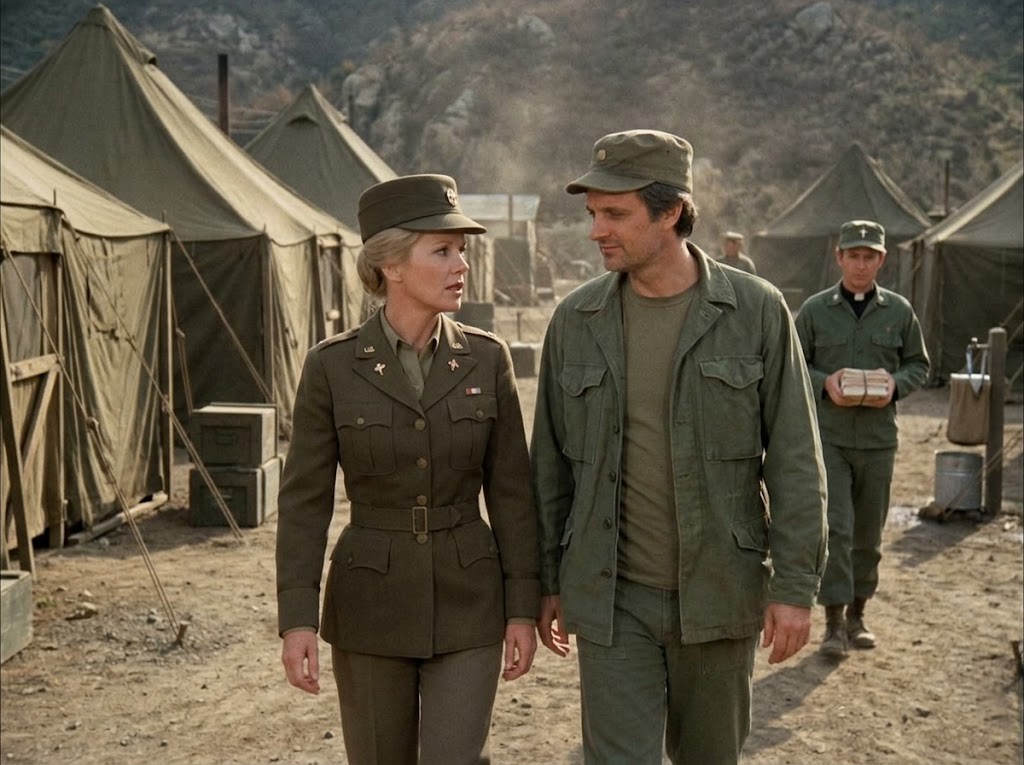
The mud of Korea has a way of swallowing everything—boots, trucks, sanity, and especially hope. But on some rare afternoons, when the chopper blades stop screaming and the generators settle into a steady hum, the 4077th slows down just enough for us to remember who we used to be.
Today was one of those days, born from a three-day stretch in the operating room that left everyone smelling of antiseptic and exhaustion.
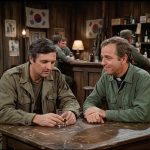
Hawkeye Pierce walked down the dirt compound artery, his olive drab jacket hanging open like a deflated sail, hands jammed deep into his pockets. He looked exactly how he felt: unwashed, unraveled, and held together entirely by cheap gin and stubbornness.
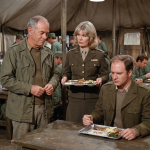
Beside him walked Margaret Houlihan, looking like an impossible miracle of military discipline.
Somehow, despite the dust kicking up around her boots, her dress uniform was crisp, every brass button catching the weak afternoon sun, her cap sitting at a precise, regulation angle. She was a vision of home, or at least a version of home that came with a manual and a court-martial warning.
“You know, Margaret,” Hawkeye muttered, his voice raspy from smoke and silence, “if you get any crisper, the wind is going to snap you right in half.”
Margaret didn’t look at him, keeping her eyes fixed on the tents ahead, her jaw set firmly. “It’s called pride, Pierce. You should look it up sometime under the letter ‘P’. It usually follows ‘Preparation’ and precedes ‘ prendre une douche’.”
Hawkeye let out a dry, tired chuckle, shifting his gaze over to her. He noticed the slight tremble in her hands, the tiny crease between her eyebrows that no amount of military posture could quite iron out.
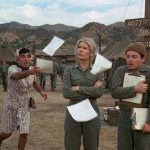
Behind them, a quiet shadow followed. Father Mulcahy was crossing the compound, holding a bundle of freshly arrived mail close to his chest like a sacred relic. His gentle face looked worn, his eyes fixed on the two doctors ahead of him, sensing the fragile silence between them.
The 4077th was a family built on the edge of a cliff, and right now, the rope was fraying.
Hawkeye stopped walking, his hands remaining in his pockets as he turned his torso slightly toward her. “Come on, Major. The war is on a coffee break. You can let the shoulders drop a quarter of an inch. I won’t tell General MacArthur.”
Margaret halted, her spine stiffening even more as she finally turned her head to look him in the eyes. Her expression was a mix of fierce pride and a vulnerability she hated letting anyone see.
“Some of us need the starch, Hawkeye,” she said, her voice dropping its sharp edge, replaced by something dangerously close to a whisper. “Because if I let my shoulders drop today… I don’t think I’ll ever get them back up.”
Hawkeye’s smirk vanished, the sarcastic remark dying on his lips as he looked at the exhaustion hiding behind her perfect composure, realizing just how close she was to breaking.
The silence stretched between them, heavy and thick, punctuated only by the distant, rhythmic crunch of Father Mulcahy’s boots on the gravel behind them.
Hawkeye looked down at the dirt for a brief second, his usual armor of jokes suddenly feeling too heavy to wear. When he looked back up at Margaret, his eyes were soft, devoid of the cynicism that usually protected him from the camp’s misery.
“I know,” he said softly, his voice dropping the theatrical tone. “I know, Margaret.”
Father Mulcahy caught up to them, slowing his pace to a gentle stop a few feet away. He adjusted the letters in his arms, offering a small, knowing smile that carried the weight of a hundred confessions.
“Peace be with you both,” the priest said quietly, his voice a soothing balm in the dusty air. “The mail jeep just arrived from Seoul. I believe there is a letter from your father, Margaret. And Hawkeye… your father sent another box of clam chowder.”
Hawkeye let out a genuine, breathless laugh, the tension breaking like a fever. “God bless America and Crabby Appleton. If that chowder leaks, Father, the North Koreans will smell it and declare a permanent ceasefire out of sheer terror.”
A tiny, involuntary smile broke through Margaret’s strict composure, softening the hard lines of her face. She looked at the priest, then back at Hawkeye, her shoulders finally dropping that fraction of an inch he had asked for.
“Thank you, Father,” Margaret said, her voice steady once more, but warmer now. “Please leave it on my cot. I’ll… I’ll read it after I finish checking the penicillin inventory.”
Mulcahy nodded kindly, giving them a brief, supportive look before continuing his walk toward the post office tent, his boots leaving quiet imprints in the dust.
Hawkeye and Margaret began to walk again, their pace slower now, matching each other’s stride in a way they rarely did when the cameras of the world were watching.
“You really are a piece of work, Houlihan,” Hawkeye said, his elbow gently nudging hers as they walked past the olive drab tents. “Even your letters arrive in alphabetical order.”
“And you are a disgrace to the uniform, Pierce,” she replied automatically, but there was no venom in it, only the comfortable, worn-in affection of two people who had survived the worst nights of their lives side by side.
“Guilty as charged,” Hawkeye said, looking out over the camp as Colonel Potter’s horse neighed in the distance. “But hey, if the uniform falls apart, at least we know your starch will hold up the tent.”
Margaret let out a soft laugh, a sound that felt out of place and entirely necessary in the middle of a war zone.
They walked on together through the dirt, two tired people leaning on an invisible wall of mutual survival, finding a strange kind of peace in the middle of nowhere.
Behind the jokes and the starch, they were just ordinary people keeping each other alive in a world gone mad.