The Midnight Tuck-In: When the War Stands Still
The lights in Post-Op were different after midnight. They didn’t illuminate; they just sort of suspended the heavy silence in a weary, yellow glow. The endless squeak of a ceiling fan did its best to keep the dust moving, but the air remained thick with the coppery tang of old iodine, the sharp scent of alcohol, and the stale, human smell of exhaustion. If fatigue were a physical entity, you could reach out and grab a fistful of it in that canvas tent.
Tonight, it wasn’t just physical weariness. A heavy ‘push’ had finally ended, and the surgeons were elsewhere, sleeping with their eyes open. Remaining was the Post-Op trio: Colonel Potter, Major Houlihan, and Father Mulcahy, each holding down their specific piece of the 4077th’s soul. The tent was full, a field of quiet, sleeping forms on simple cots, but the three of them were centered around the bed of Private First Class Henderson.
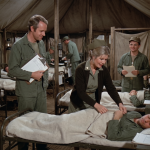
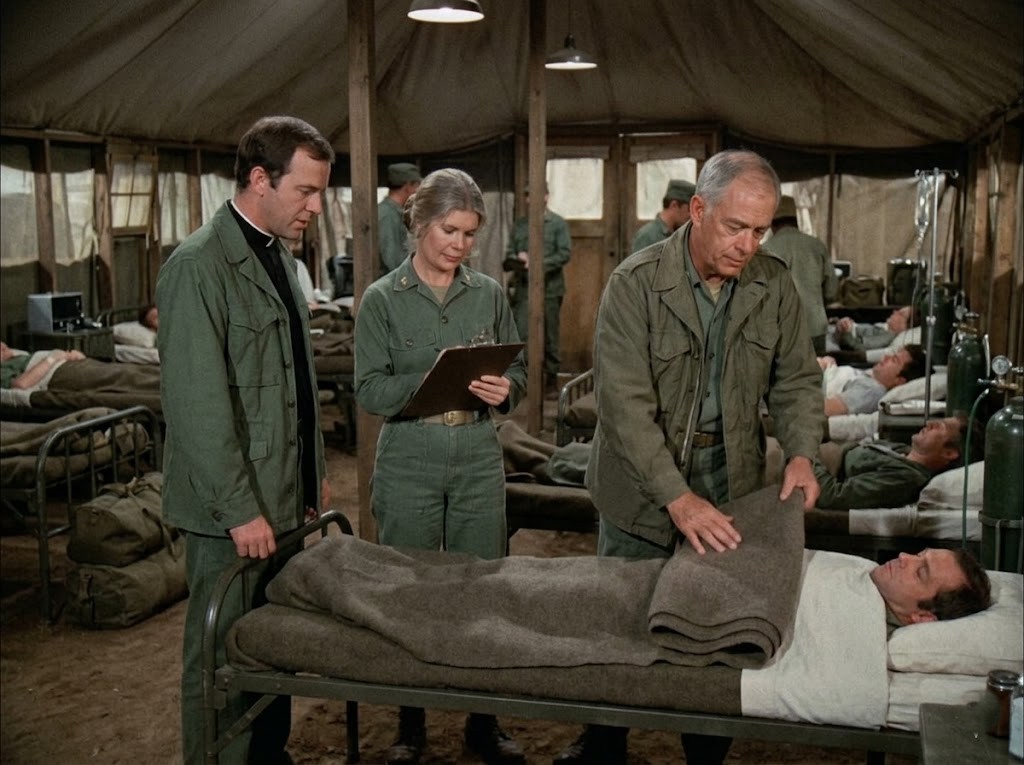
Look at “P (8).jpg,” and you see exactly where they were.
Colonel Potter stood right, a man who commanded with a growl and loved with a gruff tenderness that everyone saw through. His field jacket was a shield against the damp night, and he was doing something as simple and profound as tucking a heavy wool blanket around a young soldier’s shoulder. He didn’t just pull it up; he adjusted the edge with his strong, farmer’s hand, creating a small, safe pocket. He did it with the practiced, unconscious precision of a man who had done it for his own children back in Hannibal, Missouri. His brow was furrowed, not in command, but in paternal concern, a focused silence that said more than any speech.
In the center, Major Margaret Houlihan was the image of professional devotion. Fully in her fatigues, clipboard cradled against her arm, she watched. Her expression was calm, but her eyes held a specific sort of weary tenderness. She’d read the chart five times already—she knew Henderson’s vitals better than she knew her own. But seeing him now, not as a recovery stat but as a resting body, she was looking *at* him, not *at* the clipboard. Her hair, usually so perfect, had escaped a few pins, a subtle admission that the night had won a small victory over military discipline.
Standing left, Father Mulcahy was the silent watcher. His collar was visible beneath his field jacket, and his hands were clasped loosely before him. He was looking down at Henderson too, not assessing vitals or tucking a blanket, but lending the quiet strength of his presence. He was the gentle moral anchor, the one whose very proximity suggested that some things were still worth saving, and that compassion was a form of medicine that didn’t come in a bottle. He’d seen a lot that night, from last rites to the first tentative breath, and his quiet look here was a final benediction on the day’s hard work.
And PFC Henderson? He lay on his back, conscious and looking straight up at the canopy or perhaps at Potter’s hand. He wasn’t smiling, but he wasn’t grimacing either. His expression was a blank slate of acceptance. The light caught his wide-open eyes, which held the profound stillness of someone who had survived the unthinkable and was now allowing himself to accept comfort.
The silence held them together. The dirt floor, the exposed wires, the rows of other cots fading into the background—it all dissolved into this single focus point. It was just the human act of care in a place designed for suffering.
And then, just as Potter made the final fold of the blanket, a single, clear tear escaped the corner of Henderson’s eye and slid silently down his cheek, catching the light as it went.
Potter’s hand froze. Margaret’s grip on her clipboard tightened, the knuckles whitening just slightly. Mulcahy didn’t move a muscle, but the entire balance of the room seemed to shift.
Potter maintained his grasp on the blanket for a moment, the fatherly touch paralyzed by the pure vulnerability of that tear. He looked from Henderson’s silent face to Margaret’s. He didn’t say a word, but his eyes said everything: *We’re in the deep water now.* This was the human moment they were all desperately tired of seeing, and desperately determined to protect.
Margaret was the first to act. Her professional demeanor didn’t crack, but it softened into a steely resolve. She looked past the tear to the person.
“Private,” she said quietly, her voice a low anchor in the silence. “Is it pain, or just… everything?”
Henderson blinks, the light still reflecting in his wide eyes. He didn’t answer for a long moment. Then, his dry lips parted. “I thought you were my mom for a second,” he whispered, a voice so small it could barely be heard over the hum of the fan. His gaze hadn’t left the simple act of Potter’s hand.
Potter, without letting go of the blanket, sighed. It was the sound of a century of military service accepting a single, impossible truth. He looked at Mulcahy.
Mulcahy stepped forward, placing his hand gently on Henderson’s other shoulder. The simple weight of that hand was a different kind of medicine. “It’s a common feeling, son,” Mulcahy said, his voice like warm silk. “And a safe one to have. We are all family here.”
Potter finally released the blanket, having made it perfect. He gruffly swiped at a speck of dirt (or something else) that seemed to be bothering his own eye. “Nonsense,” he said, and then, because he was Potter, he had to undercut the sentiment with a dose of his own brand of 4077th reality. “That boy’s mother is probably in Illinois, making meatloaf and worrying about her curtains. I’m an old cavalry officer from Missouri whose primary talent is avoiding paperwork. Believe me, you’d know the difference.”
Margaret managed a dry, quick smile. “He’s right, Private. His meatloaf is terrible. You’re better off with the cook.”
A small, genuine ripple of amusement moved through the tent. It wasn’t a laugh, just a collective, knowing softening. They knew what Potter meant, and they knew Margaret knew. It was their way. They used humor to armor the emotion, to make it something they could manage, even when they were this tired.
Henderson’s eyes crinkled. It was the first human expression he had made, beyond a stare, in days. “I thought so,” he said, closing his eyes for the first time. The tear was gone. His face, still resting on the white pillow seen in “P (8).jpg,” seemed to sink deeper, accepting true rest.
Potter, Margaret, and Mulcahy held their positions for a minute longer. They were a tableau of care, each role defined by the image. Potter’s tuck, Margaret’s focus, Mulcahy’s presence—together they made a temporary home for a tired boy. The moment didn’t win the war, and it didn’t make tomorrow any easier, but it made that one space of Post-Op into a sanctuary.
Eventually, Potter slapped his knee. “Well. I suppose I should go find that horse I rode in on and see if I can’t get two hours of sleep before the morning report.”
“I’ll finish this chart, Colonel,” Margaret said, her voice professional again, already tapping her pen against the clipboard. She looked down, her work not done, but her spirit lighter.
“Goodnight, Major. Goodnight, Father,” Potter said, turning.
Mulcahy smiled and whispered, “Godnight, Colonel. God bless.”
Potter shuffled out of the Post-Op light and into the dark. Margaret moved to the next chart. Mulcahy watched Henderson sleep, just for one more quiet minute, before slipping away to find his own cot.
The only sound remaining was the constant squeak of the ceiling fan and the collective breath of fifty tired soldiers, living through another night, held together by nothing more substantial than canvas, dirt, and the unwavering care of people they called their family because they had no other choice.
It wasn’t much, but in that weary tent, in the middle of a war, it was everything.