A Splash of Color in a Sea of Olive Drab
If the dust and the heat of Korea didn’t wear you down, the sheer, relentless *sameness* of the 4077th eventually would. It was a landscape painted exclusively in olive drab—the tents, the jeeps, the trucks, and the endless rotation of weary souls. Every day, the doctors and nurses woke up, pulled on the same canvas-green clothes, and marched toward the same operating theater to fight the same unwinnable war, one patient at a time. The only thing that changed was the name on the casualties list.
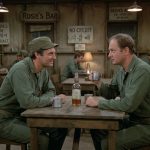
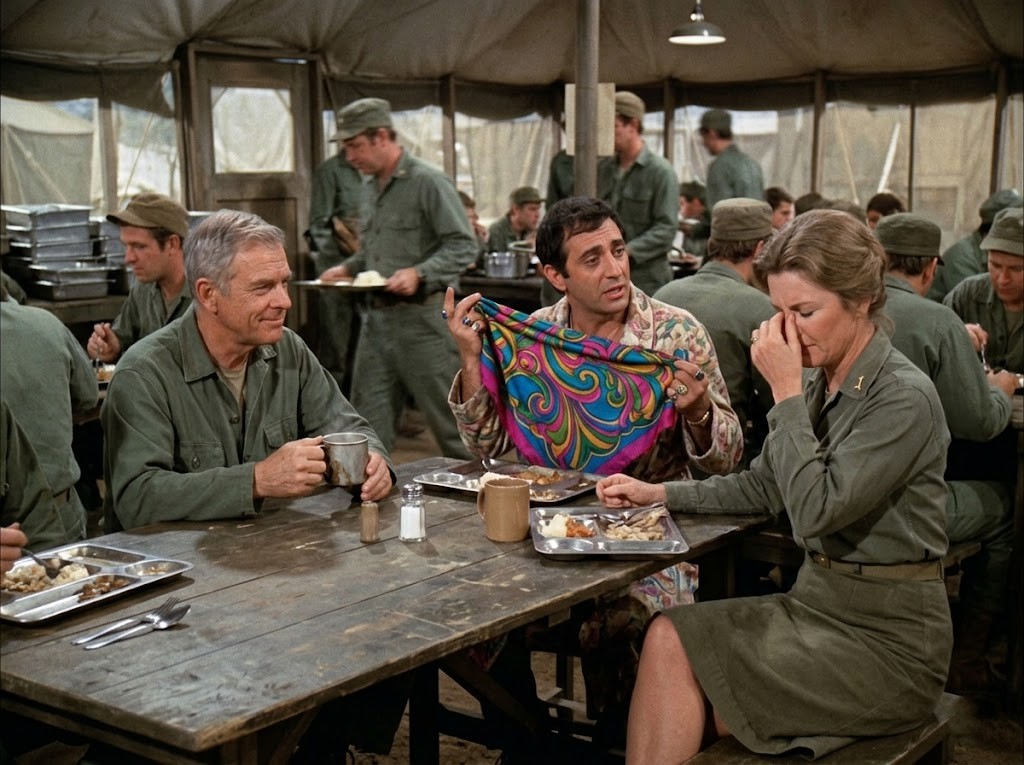
Lunch in the mess tent was supposed to be a reprieve, but it rarely felt like one. Today was no different. Colonel Sherman Potter sat at a corner table, cradling a chipped metal mug of coffee with both hands, his weathered face softened by a smile that spoke of deep, patient affection. He was watching his people, a family that hadn’t asked to be a family, but had become one all the same. He appreciated these quiet moments of observation; they kept him grounded when the madness threatened to take over.
Across from him sat Major Margaret Houlihan. In this particular moment, she was not the head nurse, nor the fierce disciplinarian. She looked utterly defeated. One hand was raised to her face, massaging the bridge of her nose, her eyes squeezed shut, shielding herself from the world. A solitary tear was tracing its way down her cheek. It had been another brutal night shift, a conveyor belt of tragedy, and she was simply, bone-deep, tired. This was a side of Margaret few people were allowed to see—the cracking veneer of strength.
And then there was Corporal Maxwell Klinger.
The mess tent was already busy, filled with soldiers in fatigues focused only on eating, but Klinger commanded the space. He had arrived at the table wearing one of his preferred alternatives to the uniform: a patterned robe in a soft, floral material. He seemed to carry a strange energy, a kinetic force of both desperation and genuine, theatrical heart. He had been chattering at the table, a rapid-fire commentary about a supply mix-up, but something in Margaret’s quiet distress had finally cut through his spiel.
Klinger froze, his usual manic energy funneling into a singular focus. He looked at Margaret, really *looked* at her, and his theatrical demeanor shifted slightly to something more tender. He didn’t offer a joke. He didn’t try to get a Section 8 discharge form signed. He did what only Maxwell Klinger would think to do in that moment.
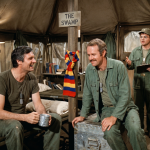
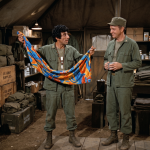
Klinger reached into a deep, hidden pocket of his robe and, with the drama of a magician revealing his prize, whipped out a large square of fabric. It was a silk scarf. But this wasn’t just any scarf. It was an explosion of sound made visual—swirls of electric blue, magenta pink, deep purple, vibrant green, and shimmering gold. In the monochrome mess tent, it was a blinding, beautiful anomaly.
He didn’t just show it; he *presented* it. Klinger held it wide with both hands, extending it toward Margaret like a sacred relic. “Major,” he declared, his voice ringing with earnest conviction, “Look at this! Straight from the streets of Tokyo, Major. A merchant was practically giving it away! It’s the very soul of the sunrise!”
Margaret flinched. She didn’t want the noise. She didn’t want the spectacle. She finally snapped, her voice trembling with frustration and exhaustion. “Klinger, please… for the love of everything, I do *not* have the strength for one of your routines right now!” Another tear slipped free as she pressed her fingers harder against her eyes, feeling the weight of the war and the exhaustion crushing down on her.
The entire table fell silent. Klinger stood there, holding his vibrant treasure, rejected and stunned, his hands still spread wide as Margaret hid her face, unable to look.
The quiet in the mess tent felt heavier than the shelling from the hills. The usual clatter of forks on metal trays seemed to stop. A few GIs nearby looked up, unsure if this was a comic bit gone wrong or a genuine human fracture. Colonel Potter simply set his coffee mug down, a gentle thud, and said softly, “Klinger, maybe you should sit down, son.” His eyes never left Margaret, radiating a fatherly concern that needed no words.
But Maxwell Klinger didn’t sit down.
He lowered the scarf slightly, his expression softening from shock to understanding. He saw the genuine distress, the vulnerability she tried so hard to hide. Klinger understood pain. He understood trying to escape a reality you couldn’t control. He pulled up a stool, sat down slowly across from her, and gently leaned in.
He spoke now in a quiet, grounded voice, a voice he rarely used, reserved for moments that broke the comedy. “This isn’t a routine, Major,” Klinger said. “I know how it feels. I know what the nights do to us. You look around, and everything is green, or brown, or grey. Even the coffee looks like mud.”
Margaret slowly lowered her hand, her eyes red and glassy, looking at him. For a moment, she didn’t see the funny soldier in the dress. She saw a fellow human being who was just as tired as she was. “What point are you making, Klinger?” she asked, her voice a whisper, the fight gone out of her.
Klinger gently raised the scarf again, holding it just over the center of the table. “This isn’t about me, and it’s not a performance,” he said. “It’s silk. It’s light. And these colors… they don’t give a damn about the war. This blue is the sky we used to see, and this pink… it’s the color of the flowers from a place called Toledo in the spring.”
He extended one arm, letting the corner of the vibrant fabric graze the table near her metal lunch tray. It was a splash of life amidst the olive drab. “Sometimes you just need to remind your eyes that there’s more to the world than this camp, Major. Take it. Keep it in your footlocker. Just knowing it’s there… it helps. It fights back.”
Margaret looked down at the bright, psychedelic swirls. It was the antithesis of everything she knew about military discipline. It was loud, chaotic, and entirely unnecessary. And it was beautiful. Her hand, still trembling slightly, slowly reached out and touched the fabric. It was silk, incredibly soft and cool, a shocking contrast to the coarse wool of her uniform and the hard metal of the tray. She ran her fingers over a swirl of magenta, and she felt her chest finally loosen.
She looked from the scarf to Klinger, who was watching her with a sincere, hopeful gaze. The theater was gone; only the heart remained. Margaret Houlihan, the tough head nurse, managed a weak, watery smile—the subtle, genuine smile now visible on her face after the tears. It wasn’t a large smile, but it was real.
“It… it’s a ridiculous scarf, Klinger,” she said, her voice catching but steady. She wiped her eyes one last time. “Entirely too loud.”
Klinger’s face split into a broad, triumphant grin. “Only the best for the best, Major.”
She picked up the scarf, holding it carefully. “Thank you, Corporal. And I mean it. Thank you.”
Colonel Potter watched the entire exchange, his quiet smile deepening. He took another sip of his coffee. He didn’t need to say anything, or file a report, or give an order. He was simply grateful to be the father of this strange, found family, where a splash of silk in a mess tent was enough to heal a heart, at least for a little while. This was the 4077th. This was home.
—
Sometimes the strongest medicine didn’t come from a syringe, but from a piece of colored silk and the heart of a friend who understood.