Requisition for a Little Piece of Home
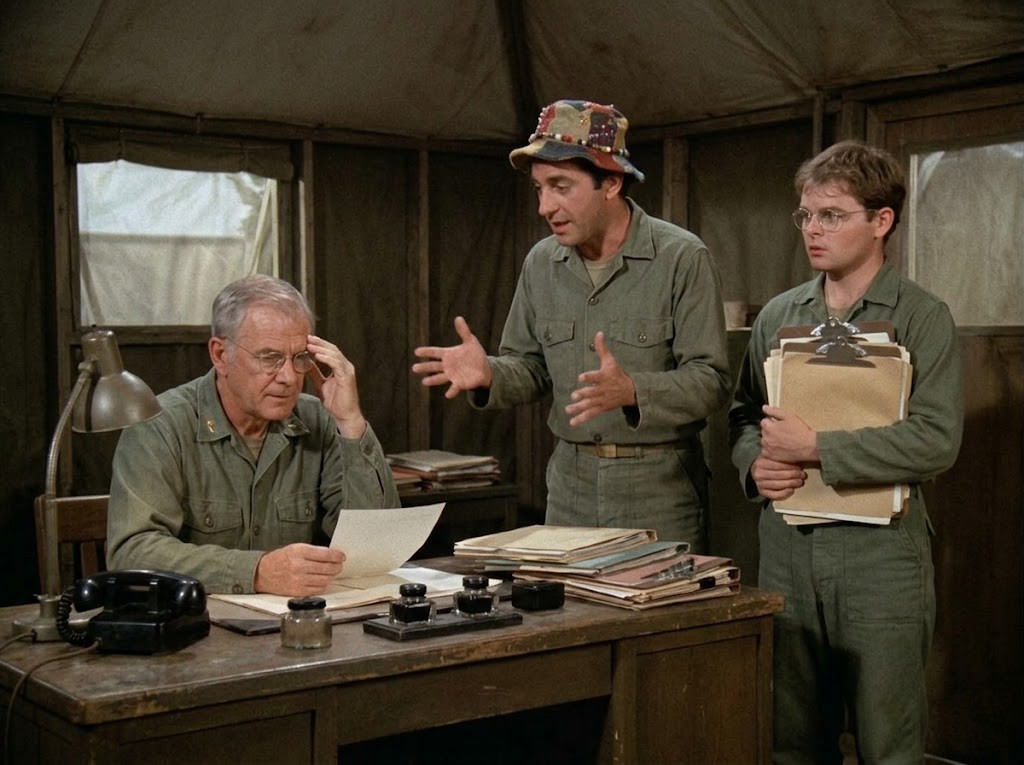
The air in Colonel Potter’s office was thicker than the Seoul smog, heavy with the weight of another forty-eight-hour shift and the dusty smell of old paper. In the small, dim tent, three men were locked in a quiet, familiar dance that felt less like command and more like family.
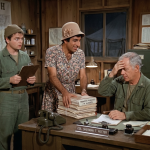
Colonel Sherman Potter sat at his desk, his glasses perched on his nose, one hand massaging his aching temple as the other held a single sheet of paper. His face was a map of exhaustion, a mosaic of years spent carrying a burden no man should have. His signature steady demeanor was wavering, just slightly, under the strain of a difficult choice.
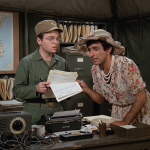
Opposite him, Corporal Maxwell Klinger, a vision in his mismatched but clean green fatigues, stood with his hands animated, palms open to the heavens. His colorful beanie was slightly askew on his head, adding a bizarre, almost whimsical counterpoint to the gravity of his pleading expression.
Radar O’Reilly, the company clerk, was the audience to this ritual. He stood respectfully to the side, clutch of wooden clipboards pressed against his chest as if they were a shield. His large, attentive eyes behind his thick glasses watched the exchange with a mixture of concern and practiced neutrality.
“Klinger,” Potter’s voice was weary, a low growl of affection and irritation. “You are not, repeat *not*, writing a letter to the Pentagon about the quality of the canned peaches.”
Klinger didn’t miss a beat, his hands flying faster. “But Colonel! They’re gray! They’re the same color as the Jeeps! We’re serving gray-green food to wounded men! It’s psychological warfare against our own! The morale, Sir, is in the toilet! I’m only thinking of the patients!”
“The patients need medicine and rest, Corporal. Not to be used as leverage for your personal war against the canned fruit lobby.”
Klinger huffed, his expressive face crumpling in a dramatic display of defeat that only he could master. “Sir, I just thought that maybe… just one little container… one pint… of the real thing… from back home…” He looked down, his theatrical performance momentarily dropping to reveal a genuine, deep-seated homesickness.
“We cannot just order ice cream on the US Army’s dime, Klinger. Not for the entire camp,” Potter said, setting the single sheet of paper back down on a stack of files with a finality that made Radar shift uncomfortably. “It’s impossible. It’s frivolous. Denial stands.”
Potter squeezed his eyes shut again, the tension from the decision evident in his posture. Klinger stood motionless, his open-palmed plea having been met with a brick wall of logistics and policy. Radar’s eyes darted between them, the silence in the room suddenly louder than any artillery fire. The disappointment was palpable, an invisible weight pressing down on everyone, threatening to crush the small shred of hope Klinger had managed to stir.
The office plunged into stillness, a quiet, mournful stillness that felt as if someone had just pronounced a beloved pet dead. Klinger looked at the paper on the desk, the ‘DENIED’ stamp screaming in invisible, black ink. He didn’t try to make another case; he just slowly lowered his arms, the defiance draining from him.
“Alright, Sir,” he whispered, the flamboyance replaced by a flat, defeated tone. He spun on his heel, his eyes already searching for the quickest escape route from the tent.
Before he could reach the canvas flap, Radar’s voice cut through the silence, soft but resolute. “Actually, Colonel… Klinger didn’t tell you the rest of it.”
Potter’s eyes opened. “The rest of what?”
Radar pushed the clipboards even tighter to his chest, his gaze fixed on the floor, avoiding direct eye contact with his commanding officer. “The part about Operation Sweet Tooth.”
Klinger stopped, turning back with an expression of complete confusion. Potter’s brow furrowed. “Care to elaborate, Radar? While I’m still awake?”
“Yes, Sir.” Radar took a small step forward. “Klinger was trying to requisition the ice cream for the whole camp, true. But… he had a different requisition form ready, just in case that one failed.”
Radar nudged one of the wooden clipboards he was holding, and a second, different sheet of paper was pushed forward. “This one is for medical supplies. Specifically, it’s for a request to trade a supply of penicillin that is nearing its expiration date. A supply we can’t possibly use up in time.”
Potter reached for the new clipboard, his curiosity replacing his fatigue. He skimmed the document. “What’s the trade?”
“A supply sergeant at the supply depot in Seoul,” Radar said, his eyes now finding the Colonel’s. “He has access to a refrigerated truck that was just filled with frozen vanilla cups. They are, apparently, leftovers from an officers’ reception that got canceled. The whole lot of them will melt by 0600 tomorrow if they don’t get dry ice. They have plenty of dry ice, Sir, but no way to keep them at the right temperature for transport.”
Radar swallowed. “He’s willing to trade 300 vanilla cups for our near-expired penicillin. Just for the chance to say he had a real ice cream cup before they all melted.”
The room was utterly quiet again, but this time it was the silence of calculation and mounting, quiet joy. Potter looked from the paper to Radar, then to Klinger, who was staring at Radar with his mouth wide open, his entire face a mask of complete and total adoration.
Potter’s tired face seemed to shed ten years. A genuine, quiet smile spread across it, the lines of worry temporarily erased. He didn’t say a word, just reached for his pen. He dipped it into one of the three inkwells and signed the second requisition with a flourish.
“Horse hockey to the regulations,” Potter muttered, his hand returning to massage his temple, but the headache felt different now. He handed the signed clipboard back to Radar. “Make it happen, O’Reilly. And Klinger?”
Klinger, still frozen in awe, snapped to. “Sir!”
“When that truck arrives,” Potter said, his voice softer than usual, “I expect you to personally deliver a vanilla cup to every nurse, orderly, and patient who can manage it. If you have to dress as a giant sundae to do it, so be it.”
“With cherry on top, Colonel!” Klinger saluted, not a trace of a crazy scheme or theatricality in his voice, but a deep, true respect.
Klinger didn’t just walk out; he virtually floated, a renewed skip in his step. Radar followed, a quiet sense of accomplishment radiating from him as he clutched the vital clipboard. Potter was alone again, the small desk lamp his only light. He leaned back in his chair, the memory of home washing over him, distinct and clear. The smell of his wife’s vanilla cupcakes. The sound of his family. Distant artillery thudded in the hills, but the room felt, for a single, precious moment, like a safe harbor.
Among the chaos, sometimes all you needed was 300 tiny containers of vanilla to remember what normal felt like.