The Grease Pencil Pardon
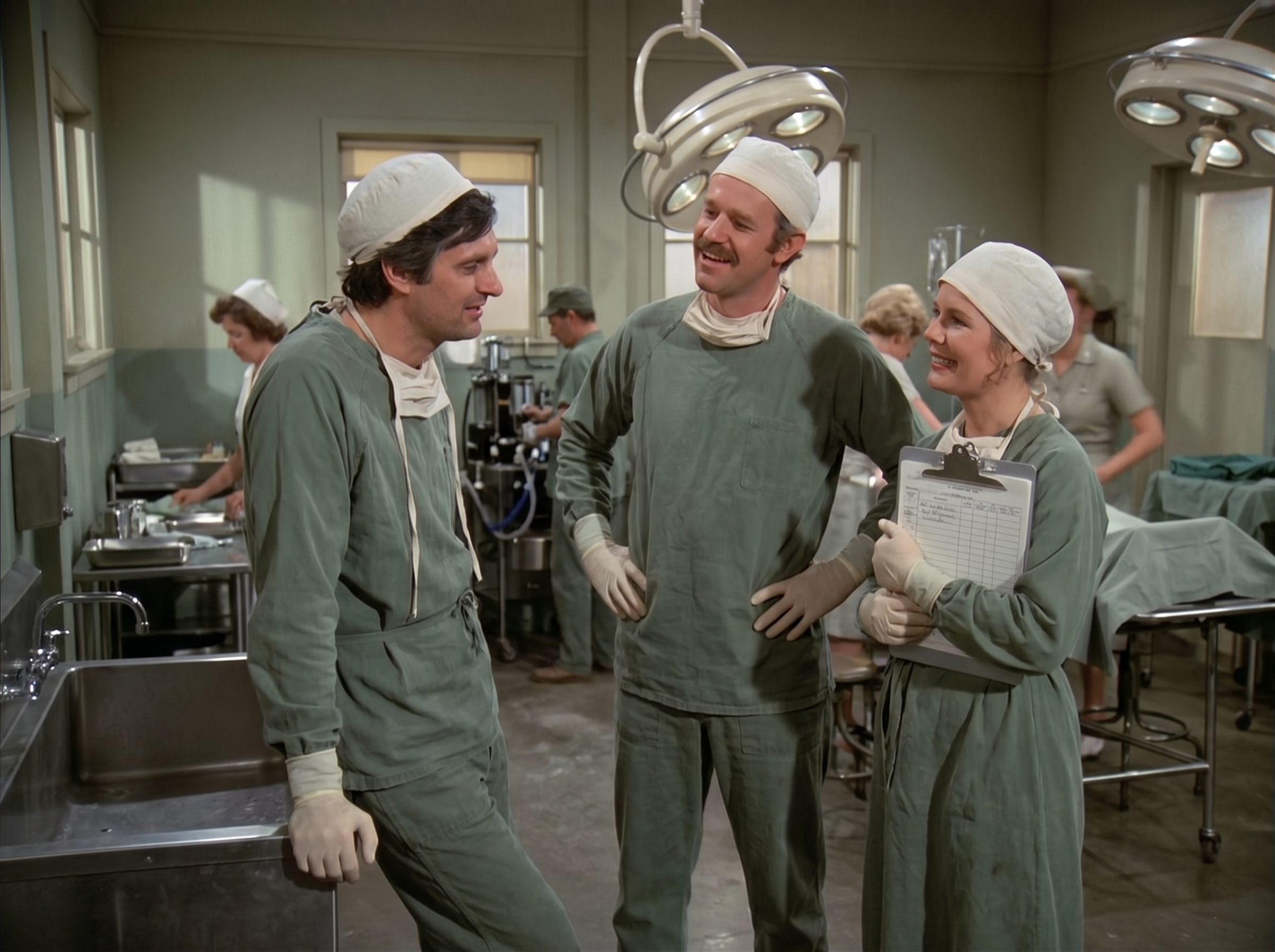
The smell of antiseptic and stale coffee always clung to the canvas of the 4077th, but after eighteen straight hours in theater, it felt like it was baked right into their skin.
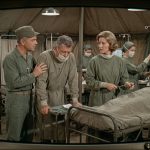
Hawkeye Pierce leaned heavily against the edge of the stainless steel scrub sink, his shoulders slumped under the weight of a hundred delicate, split-second decisions. His surgical gown was rumpled, the ties dangling loose, and his scrub cap sat crookedly on his dark hair.
Beside him stood B.J. Hunnicutt, hands planted firmly on his hips, a tired but brilliant grin breaking through his mustache.
And right there with them was Major Margaret Houlihan, her usual rigid military posture softened by the sheer relief of a cleared triage pad. She held her clipboard tightly against her chest like a shield, a rare, genuine smile illuminating her face as she looked at the two doctors.
It had been a brutal night. The choppers had arrived in endless waves, their rhythmic thumping echoing through the valley like an erratic heartbeat.
Inside the operating room, humor had been their only armor against the dark. Hawkeye had spun ridiculous yarns about Crabapple Cove, B.J. had countered with sweet stories of Peg and Erin back in San Francisco, and Margaret had kept order with her sharp tongue and flawless precision.
Now, the final patient was stable in post-op, and the quiet that settled over the compound was almost deafening.
Hawkeye shifted his weight, his eyes tracking the steam rising from the empty sink. “You know, B.J.,” he murmured, his voice raspy from hours of shouting over the roar of the generators, “if my feet get any redder from this iodine, I’m going to have to start billing myself as a carrot.”
B.J. let out a soft chuckle, his eyes crinkling at the corners. “At least you’d be rich in vitamin A, Hawk. Heaven knows this camp needs some nutrition.”
Margaret looked up from her clipboard, her eyes softening as she watched the two men. She had spent years maintaining a strict distance, keeping the professional wall firmly in place, but nights like this changed things. Nights like this stripped away the ranks and the regulations, leaving only three human beings who had survived another trip to the brink together.
“According to the logs, gentlemen,” Margaret said, her voice unusually gentle, “we processed seventy-three admissions since yesterday evening. Every single one of them walked—or was carried—out of this room alive.”
Hawkeye looked at her, the usual sarcastic spark in his eyes replaced by something deep and profoundly grateful. “Seventy-three,” he repeated softly. “That’s seventy-three mothers who don’t get a telegram this week.”
“And seventy-three reasons why we might actually deserve a cup of that battery acid Klinger calls coffee,” B.J. added, trying to keep the mood light, though his hand trembled slightly from muscle fatigue.
Margaret smiled, looking down at the neat rows of names she had meticulously recorded. She loved the order of her charts; they were proof that amid the chaos of war, they could still impose a tiny bit of sanity.
But as she flipped to the final page of the manifest to officially close out the shift, her smile suddenly faltered.
Her eyes widened, her fingers tightening around the cold metal of the clipboard. She blinked, staring intensely at a small scribble at the very bottom of the page, written in a shaky, unfamiliar handwriting that definitely didn’t belong to her or Radar.
Hawkeye noticed the sudden shift in her posture instantly. The easy, relaxed atmosphere in the scrub room vanished, replaced by an immediate, protective tension.
“Margaret?” Hawkeye asked, straightening up from the sink, his humor evaporating. “What is it? Did we miss someone?”
B.J.’s smile faded too, his hands dropping from his hips as he stepped closer to her, the silence suddenly heavy with dread.
The silence in the scrub room stretched thin, punctuated only by the distant, rhythmic hum of the generator outside. Hawkeye and B.J. exchanged a quick, worried glance before turning their full attention back to the Major.
“Margaret, talk to us,” B.J. said softly, his voice full of the quiet steadiness that always made him the anchor of the Swamp. “Is there a problem with the post-op count?”
Margaret swallowed hard, trying to regain her trademark composure, but her voice trembled when she finally spoke. “It’s… it’s not a medical error,” she whispered, looking up at them, her eyes reflecting the harsh overhead lights. “It’s a note. Left on the back of the final intake form.”
She turned the clipboard around so they could see.
At the bottom of the page, underneath the sterile, official military stamps, someone had used a stubby grease pencil to scrawl a message. The handwriting was jagged, clearly written by someone whose hand was shaking violently from pain or exhaustion.
Hawkeye squinted, leaning forward to read the words aloud.
“‘To the tall doctor who told the story about the dancing bear in Maine, and the mustache guy who held my hand… and the beautiful angel who yelled at everyone to keep me alive. I didn’t think I’d see twenty-one. Thank you for my tomorrow.'”
Hawkeye stared at the words, the witty retort that usually lived on the tip of his tongue completely deserting him. He swallowed hard, his throat suddenly tight as he remembered the boy—Private Miller, a kid from Iowa who had arrived with a chest wound so severe they had all held their breath for three hours straight.
B.J. looked down, a soft, bittersweet smile returning to his face. He rubbed the back of his neck, his eyes shining. “He was terrified,” B.J. murmured. “He just kept asking if he’d ever see his family’s farm again. I didn’t even realize he was listening to Hawkeye’s nonsense about the bear.”
“It wasn’t nonsense,” Hawkeye said, his voice barely above a whisper, though there was no heat in it. “It was highly therapeutic hogwash. It’s a medical fact that laughing makes the blood move faster.”
Margaret let out a shaky, emotional laugh, wiping a stray tear from her cheek with the back of her gloved hand. She looked at the two of them, seeing past the blood-stained scrubs, the dark circles under their eyes, and the profound exhaustion that lined their faces.
In that moment, the barriers of rank, the endless arguments about military discipline, and the stress of their daily existence dissolved entirely.
“He sneaked the pencil from my pocket while I was checking his vitals before they moved him to the ward,” Margaret said, her voice filled with a profound warmth. “I was going to reprimand him for tampering with official army property.”
“A heinous crime, Major,” Hawkeye said, the familiar playful glint returning to his eyes, though his voice remained soft. “I believe the penalty for stealing a grease pencil in a combat zone is twenty years of eating corporate meatloaf.”
“Fortunately for him,” Margaret replied, looking directly at Hawkeye with a tenderness that rarely showed outside these walls, “the head nurse is willing to grant a full pardon.”
B.J. stepped forward, placing a comforting, gloved hand on Margaret’s shoulder. “We do good work here, don’t we? Despite everything. Despite the mud, the cold, and the generals who think these kids are just numbers on a map.”
“We do the only work that matters,” Hawkeye said, finally moving away from the sink. He looked around the scrub room—the dented basins, the stark lighting, the green canvas walls that had witnessed so much sorrow and so much miraculous survival.
The tension that had built up over the long, agonizing night didn’t just break; it transformed into a quiet, beautiful solidarity. They were an unlikely family, thrown together by the madness of a world at war, but they were bound by a shared humanity that no conflict could ever destroy.
Outside, the first pale rays of dawn were beginning to slice through the Korean morning mist, painting the hills in soft shades of gray and gold. A rooster crowed somewhere in the distance, a surreal reminder that life continued to happen just beyond the perimeter of their makeshift hospital.
Margaret carefully unclipped the sheet of paper, folding it with deliberate precision before tucking it safely inside the pocket of her fatigues. It wouldn’t go into the official army archives, and it certainly wouldn’t be reviewed by the Pentagon, but it would be kept.
“Come on,” B.J. said, gently nudging Hawkeye’s arm. “Let’s go find that terrible coffee. I think we’ve earned the right to complain about it together.”
“Lead the way, Hunnicutt,” Hawkeye smiled, falling into step beside his friend. He looked back at Margaret, offering a small, respectful tilt of his head. “After you, Major. Let’s go face the daylight.”
Margaret fell into step between them, the heavy clipboard finally resting by her side. As they walked out of the operating room and into the crisp morning air, the weight of the last eighteen hours felt just a little bit lighter, carried together by the enduring warmth of the 4077th.
Because out here in the mud, sometimes a scribbled note on a clipboard is the only map you need to find your way back to being human.