The Quiet Currency of the 4077th
Some nights in Korea don’t announce themselves with the screech of incoming choppers or the frantic roar of the sirens. Instead, they settle over the camp like a heavy, damp blanket, smelling of wet canvas, stale coffee, and the deep, bone-weary exhaustion that only a thirty-hour session in Post-Op can bring. It’s in these quiet hours that the real heart of the 4077th beats, faint but steady, underneath the jokes and the clinking of surgical instruments.
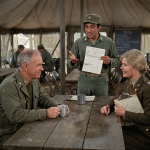
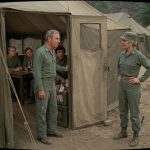
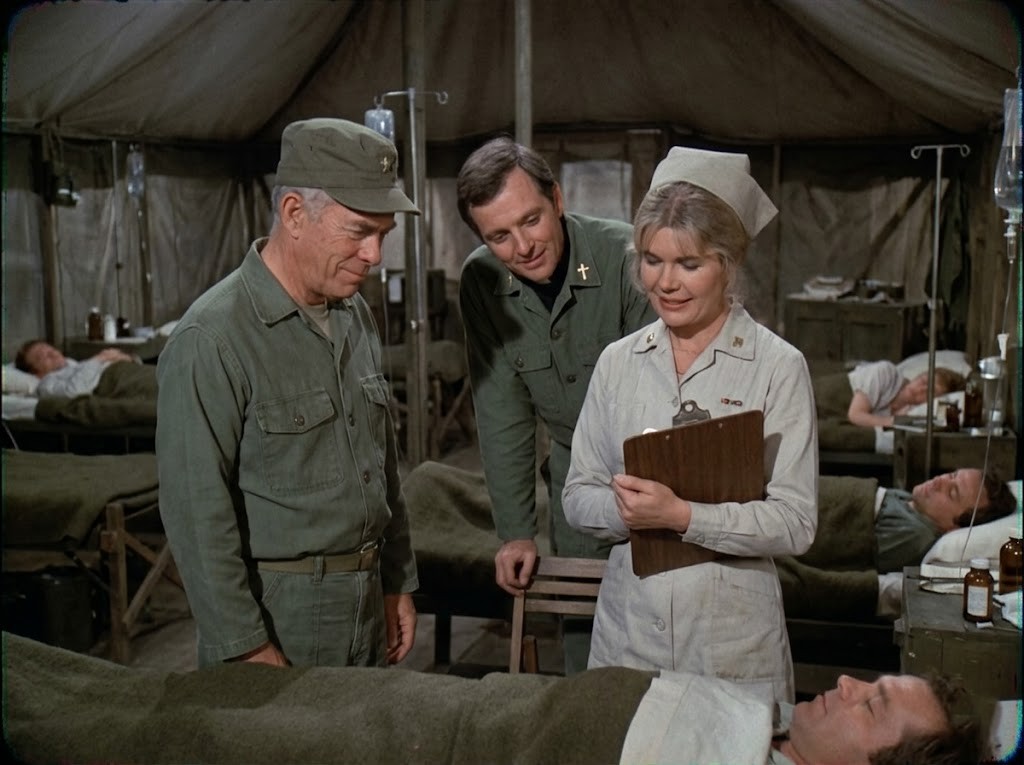
Inside the dimly lit recovery tent, the air was thick with the rhythmic, shallow breathing of recovering young men. Colonel Potter stood at the foot of a cot, his cap pushed slightly back on his head, hands resting against his hips in that familiar, fatherly posture of a man who had seen too many wars and too many boys far from home. Beside him, Hawkeye Pierce leaned in, the usual manic energy drained from his face, replaced by a soft, attentive focus. Nurse Margaret Houlihan stood at the center, clutching a wooden clipboard tightly against her chest, her expression a fragile mix of professional discipline and fierce, maternal protectiveness.
They were looking down at Private Tommy Miller, a quiet kid from Iowa who hadn’t spoken a single word since waking up from anesthesia.
The surgery had been a success, a routine piece of shrapnel removal that Hawkeye could have done with his eyes closed. Yet, the boy’s silence was a heavy weight in the room, more troubling than a fluctuating pulse. He just stared at the canvas ceiling, his eyes wide and completely hollow, holding a crumpled, unreadable letter from home in his left hand.
Hawkeye cleared his throat, his voice dropping its usual theatrical edge for something much gentler. “You know, Tommy, if you’re staying silent just to avoid hearing Margaret yell at us, I highly recommend it. But if you’re trying to give me the silent treatment, I should warn you—my ex-girlfriends tried that, and I just talked twice as much to fill the void.”
Margaret didn’t snap back with her usual defense of military protocol. She merely offered a small, tired smile, her eyes never leaving the patient’s face. “He’s been like this for three hours, Pierce. No fever, vitals are stable. He just… won’t let go of that paper.”
Colonel Potter shifted his weight, his boots creaking softly on the wooden floorboards. “Sometimes the mind takes a little longer to march back from where it’s been, Houlihan. But we need him to swallow some fluids. A man can’t heal on memories alone.”
Hawkeye leaned a bit closer, his hand coming to rest lightly on the edge of the cot. “Come on, kiddo. Just a sip of water. Or, if you promise not to tell the Colonel, I might be able to find something distilled in a old oil drum that tastes vaguely like gin. It cures everything from tonsillitis to a broken heart.”
The private didn’t blink. A single tear tracked slowly down his temple, disappearing into his hair.
Margaret’s grip on the clipboard tightened until her knuckles turned white. She looked up at Hawkeye, then at the Colonel, an unspoken, desperate plea passing between them. For all their bickering, their jokes, and their differences, in this square foot of canvas, they were entirely united by a profound, aching helplessness that threatened to break the quiet night wide open.
The silence stretched, heavy and demanding, until the canvas flap of the tent rustled open. Father Mulcahy slipped inside, his collar slightly frayed, carrying a small, dented metal cup of warm broth. He didn’t say a word at first; he just stepped into the circle of light, his gentle presence immediately softening the sharp edges of the room’s anxiety.
“I thought perhaps he might try some of this,” Mulcahy said softly, his voice a calm anchor. “Corporal Klinger swore it was chicken soup, though knowing our current supply chain, I suspect it’s mostly prayer and a very clever use of dehydrated onions.”
Hawkeye let out a dry, quiet chuckle. “At this point, Father, I’d trust Klinger’s kitchen magic over the entire Department of the Army.”
Margaret stepped closer to the side of the bed, lowering her clipboard. With a tenderness she rarely allowed the rest of the camp to see, she reached down and gently smoothed the blanket over the boy’s chest. “Private Miller,” she whispered, her voice cracking just a fraction. “Tommy. You’re safe here. The worst part is over. You’re going to go home.”
At the word *home*, the boy’s fingers twitched against the crumpled letter.
Colonel Potter took a slow step forward, looking down at the young soldier with the wisdom of a man who knew exactly what it felt like to be young, terrified, and surrounded by mud. “Son,” the Colonel said, his voice dropping into a low, gravelly rumble that felt like a warm hearth. “You don’t have to carry the whole war by yourself. That’s why there’s so many of us in this tent. We divide the weight.”
Hawkeye watched the boy, his own cynical defenses completely melting away. He reached out and gently placed his hand over the private’s trembling, fist-clenched fingers, the ones holding the letter. “We’re a pretty miserable excuse for a family, Tommy,” Hawkeye murmured, a fierce sincerity shining in his eyes. “We argue, we steal each other’s socks, and the food is a crime against humanity. But we don’t let go of each other. Not out here.”
For a long, agonizing second, nothing changed. Then, very slowly, the boy’s fingers began to uncurl.
He didn’t speak, but his eyes moved away from the ceiling, shifting until they met Hawkeye’s gaze, then Margaret’s, and finally Colonel Potter’s steady, reassuring nod. A small, ragged breath escaped the private’s lips, followed by a nod so slight it was almost invisible.
Margaret quickly blinked away a sudden brightness in her eyes and adjusted her clipboard, her professional composure instantly snapping back into place to hide her emotion. “I’ll help him with the broth, Father,” she said, her voice steady once more.
“Good work, Doctor,” Potter said quietly, tapping Hawkeye on the shoulder before turning to check on the next cot down the row.
Hawkeye stood up straight, stretching his aching back, a faint, tired smirk returning to his face as the heavy tension in the tent finally dissolved. “Well, Father, it seems your dehydrated onions have triumphed over medical science once again. Don’t let it go to your head; I still have better hair.”
Mulcahy smiled gently, holding out the cup. “I shall credit the onions, Pierce. And perhaps a little bit of the company.”
As the rest of the camp slept outside under the indifferent Korean stars, the small group remained in the warm, dim light of Post-Op, watching over another life stitched back together, reminded once again that the greatest medicine they had to offer didn’t come out of a supply crate.
In a place built on the edge of heartbreak, sometimes the most heroic thing they did was simply show up for each other, one quiet night at a time.