The Longest Form in Korea
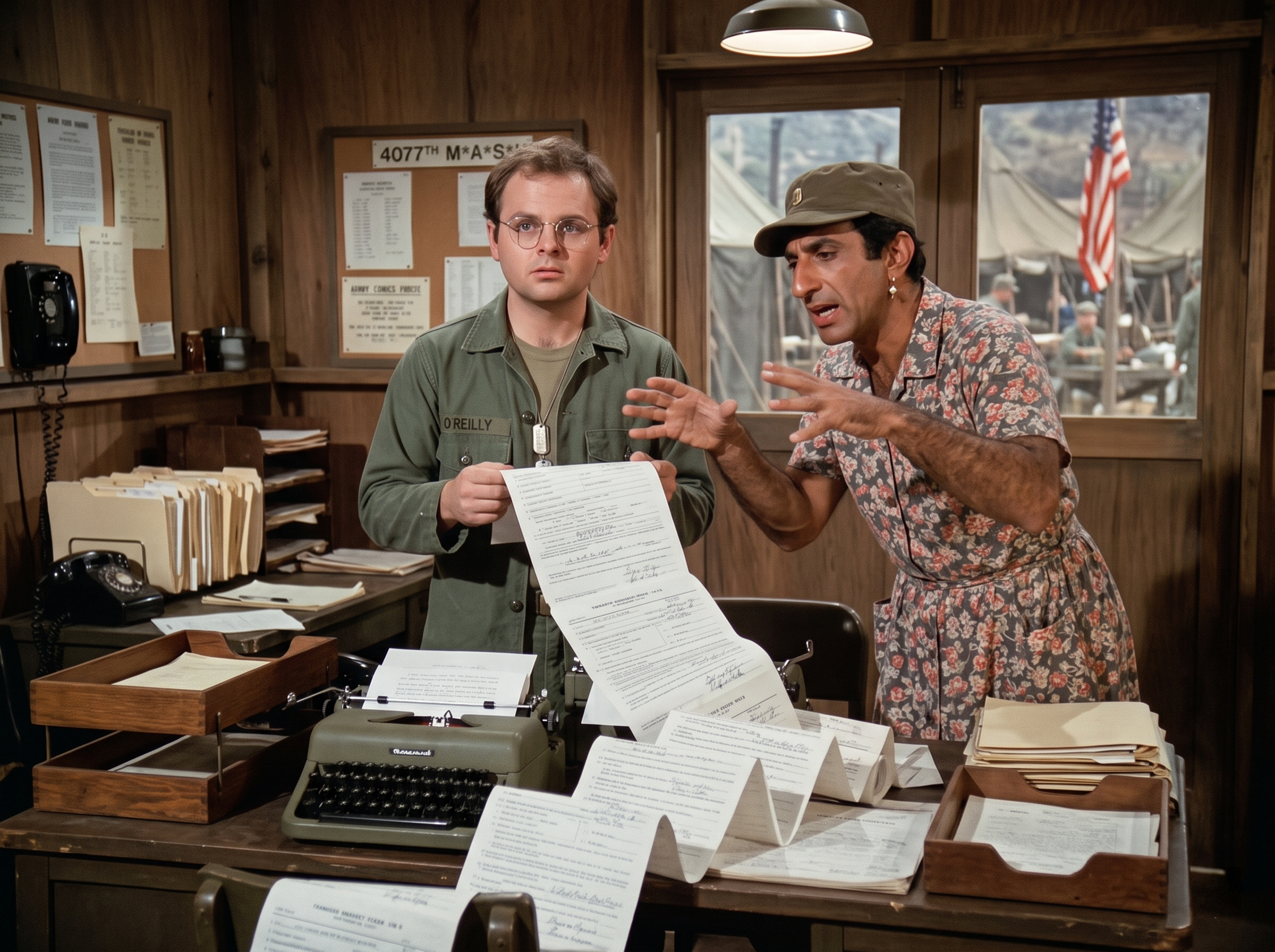
The paper seemed to cascade over the edge of the olive-green typewriter like a bureaucratic waterfall.
It was an accordion-style document, a towering achievement of red tape, carbon copies, and sheer, unadulterated desperation.
In the cramped, wood-paneled confines of the clerk’s office at the 4077th, Corporal Walter “Radar” O’Reilly stood perfectly still. He was clutching the top edge of the form as if holding it too tightly might cause it to detonate.
His round, boyish face was a portrait of pure, earnest confusion.
Leaning heavily across the wooden desk was Corporal Maxwell Q. Klinger.
Klinger was practically vibrating with nervous, theatrical energy. He was dressed in a faded, floral-print housecoat that had seen better days in Toledo, complete with a regulation olive-drab cap and a pair of silver hoop earrings that caught the dim light of the overhead bulb.
His hands were thrown wide in a grand, dramatic gesture, like an orchestra conductor pleading with his violins for just a little more passion.
“It’s a masterpiece, Radar,” Klinger insisted. His voice was a raspy, conspiratorial whisper that filled the small space between the file trays and the field phone. “It is the Mona Lisa of military documentation. The ceiling of the Sistine Chapel, typed in triplicate.”
Radar blinked behind his wire-rimmed glasses. He looked down at the endless river of beige paper, then back up at Klinger.
“Klinger, it’s… it’s seventy-four pages long,” Radar said, his voice cracking slightly. “You taped twelve different requisition forms together. And I think part of this is a menu from the mess tent.”
“A minor administrative necessity!” Klinger countered, leaning even closer. The floral fabric of his dress rustled against the stack of morning reports on the desk.
“You see, my young, naive friend, the army operates on confusion. If I submit a standard Section 8, they laugh, they tear it up, and they send me back to the motor pool. But this?” Klinger tapped the cascading paper with a dramatically manicured fingernail. “This is impenetrable.”
Radar sighed, adjusting his grip on the top sheet. He felt the familiar, dull ache of fatigue behind his eyes. It had been a long week at the 4077th. The choppers had been flying non-stop, and the entire camp was running on bad coffee and frayed nerves.
Even in the quiet of the clerk’s office, the distant, muffled sounds of the surgical hospital were a constant reminder of where they were.
“I don’t know, Klinger,” Radar said slowly, his eyes scanning the typewritten lines. “Colonel Potter is going to take one look at this and pop a gasket. You’ve got clauses in here that don’t even make sense.”
“Read clause forty-two, sub-section B,” Klinger demanded, puffing out his chest with a look of sly, desperate hope. “The one about the acute psychological allergy to canvas.”
Radar traced his finger down the page. He squinted at the faded typewriter ink.
He read in silence for a moment, his lips moving slightly.
Then, Radar stopped.
The innocence faded from his eyes, replaced by a sudden, heavy stillness. He read the paragraph again, just to be sure.
Klinger’s theatrical smile began to falter. The silence in the office suddenly felt very thick.
“Klinger…” Radar whispered, his voice losing all its nervous bounce. He looked up, meeting the older corporal’s eyes directly. “Do you know what you actually wrote here? On page four?”
Klinger’s hands slowly dropped to the desk.
The grand, pleading maestro vanished, leaving behind just a very tired man from Ohio wearing a dusty dress.
“It’s the legal jargon, Radar,” Klinger said, though his voice had lost its confident swagger. “It’s meant to confuse the brass in Seoul.”
Radar shook his head slowly. He didn’t look angry, or confused anymore. He just looked impossibly sad.
He gently folded the top section of the accordion paper backward, holding it up so Klinger could see the lines he had typed late in the night.
“You hid it in the middle of all this crazy stuff about imaginary diseases and wardrobe malfunctions,” Radar said quietly. “Right here under ‘Primary Cause for Separation.’”
Radar took a breath and read aloud, his voice soft against the hum of a distant jeep engine outside.
“’The applicant respectfully requests immediate transfer. Not because he is crazy. But because he closed the eyes of three boys from Michigan this week, and he doesn’t think his heart can take watching a fourth.’”
The words hung in the stale air of the office.
Outside, the familiar, rhythmic thumping of an incoming chopper began to echo over the hills, but neither man moved to look out the window.
Klinger stared at the paper. The sly, comedic mask he wore every single day—the dresses, the stunts, the loud Toledo bravado—completely shattered.
He slumped into the wooden chair opposite Radar’s desk. The vibrant floral pattern of his dress suddenly looked terribly out of place against the drab, olive-green reality of the war around them.
He rested his face in his hands, rubbing his eyes beneath the brim of his army cap.
“I was typing at three in the morning, Radar,” Klinger whispered into his palms. His voice was thick, stripped of all its usual theatrics. “I guess… I guess the joke just got tired for a minute.”
Radar watched his friend. People often treated Radar like a naive kid, the mascot of the 4077th who slept with a teddy bear and drank Grape Nehi.
But sitting behind that desk, reading the endless casualty reports day after day, Radar knew the weight of the war just as intimately as the surgeons in the OR. He knew what it cost to keep smiling. He knew what it cost to wear a dress and pretend you were crazy, just so you didn’t actually lose your mind.
Radar didn’t laugh. He didn’t lecture.
With quiet, methodical care, Radar began to fold the massive, seventy-four-page document. He gathered the yards of paper that had spilled over the typewriter, folding them neatly along the creases, section by section.
The crinkling of the beige paper was the only sound in the room.
When the enormous document was finally folded into a thick, manageable square, Radar didn’t drop it into the wastebasket.
Instead, he opened the heavy wooden drawer of his desk—the bottom drawer, the one he kept locked. The one where he kept the things that mattered. Letters from home that people didn’t want to mail yet. Photographs that were too painful to look at.
He placed Klinger’s impossibly long form gently inside and closed the drawer with a soft, definitive click.
Klinger looked up, his dark eyes red-rimmed and exhausted. “You’re not going to file it?”
“I just did,” Radar said softly. He offered a small, gentle smile that didn’t quite reach his eyes. “It’s in the special pending file. Right next to Captain Pierce’s request for a civilian hospital ship, and Father Mulcahy’s requisition for world peace.”
Klinger let out a breath that was half-sigh, half-chuckle. He reached up and adjusted one of his hoop earrings, sitting up a little straighter in the chair.
The theatrical armor was slowly slipping back into place, piece by piece. It had to. It was the only way they survived.
“You think they’ll process it?” Klinger asked, a tiny hint of the old Toledo spark returning to his voice.
“I think,” Radar said, leaning forward on his desk and looking his friend in the eye, “that it’s the best piece of paperwork I’ve ever read. And I think we’re going to need you here a little while longer to write the sequel.”
Klinger nodded slowly. He stood up, smoothing the front of his floral dress with a tired dignity. He gave Radar a crisp, surprisingly perfect salute, which Radar returned with equal respect.
As Klinger turned and walked out the door, back into the dust and the noise of the compound, Radar pulled his typewriter back to the center of the desk. He rolled a fresh, blank piece of paper into the carriage, ready for whatever the 4077th needed him to do next.
In a place surrounded by madness, the greatest act of sanity was simply holding onto each other.