The Mystery on the Metal Tray
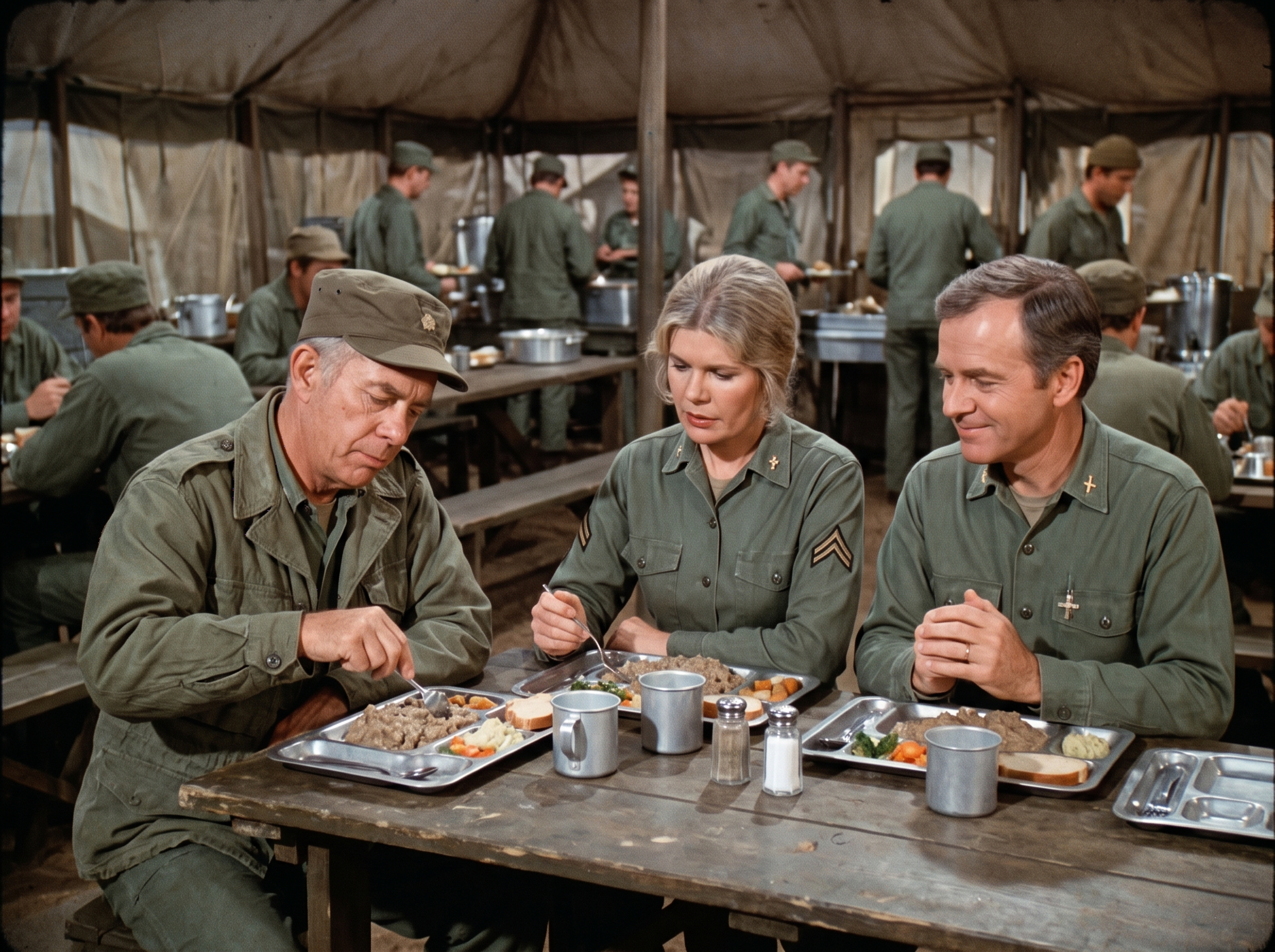
There were always two ongoing wars at the 4077th Mobile Army Surgical Hospital. There was the very real, deafening conflict raging just over the surrounding hills, and then there was the daily, quiet battle of endurance taking place inside the mess tent.
On this particular Tuesday, or perhaps it was Thursday, the mess tent was winning.
The canvas walls flapped lazily in the dry Korean wind, letting in just enough dust to coat the long, wooden tables. The air smelled of stale coffee, industrial floor wax, and whatever tragedy Private Igor had boiled into submission that afternoon.
It was a quiet hour in the camp. The surgical ward was temporarily empty, the helicopters were silent, and the camp was catching its collective breath.
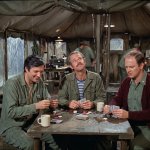
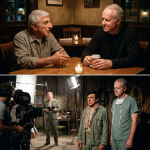
At a table near the center, sitting shoulder-to-shoulder against the olive-drab monotony of the war, sat Colonel Sherman T. Potter, Major Margaret Houlihan, and Father John Mulcahy.
They had just come off a brutal, grinding eighteen-hour shift in the OR. They were running on fumes, black coffee, and the simple human need to sit down for five minutes without someone shouting for a clamp.
But as they looked down at their metal trays, their hard-earned moment of rest was violently interrupted by their lunch.
Sitting in the main compartment of each tray was a mound of something entirely unidentifiable. It was a dense, gray-brown lump, glistening slightly under the harsh, bare bulbs of the studio-like overhead lights.
Colonel Potter leaned forward, adjusting his spectacles. His face was a map of weary, fatherly exasperation. He had survived two world wars, the Great Depression, and the United States Cavalry, but this lump of culinary despair was testing the very limits of his Midwestern patience.
With a look of dry, quiet authority, Potter picked up his fork. He didn’t scoop the food. He simply poked it.
The mound did not yield. It seemed to push back against the tines of the fork.
To Potter’s right, Major Houlihan sat with perfectly straight, controlled posture. Even after a grueling shift, Margaret maintained the sharp, composed air of a professional army officer.
But as she stared down at her tray, her composure was cracking just slightly around the edges. Her brow furrowed in sharp, professional frustration. It was an insult to army regulations, to basic nutrition, and to her rank.
“This is unacceptable,” Margaret whispered, her voice tight with restrained indignation. “There are strictly defined caloric requirements for medical personnel in a combat zone.”
“Major, I’ve seen things in my horse’s stall with more nutritional value than this,” Potter muttered, poking the anomaly a second time. “And they usually smelled a sight better, too.”
Beside them, Father Mulcahy simply sat with his hands gently folded together near the edge of his tray.
While the other two radiated exhaustion and annoyance, the chaplain offered a soft, mild smile of innocent, hopeful optimism. He looked at the food not as an offense, but as an opportunity for spiritual growth.
“Now, let’s not be too hasty,” Mulcahy said gently, his voice a soothing balm against the metallic clatter of the tent. “Perhaps it’s a local delicacy. A… hearty stew, perhaps, that simply needed more time to set.”
“Father,” Potter sighed, “if this sets any harder, we’re going to have to call in the engineers to blow it up.”
The camp was watching them. As the commanding officer, the head nurse, and the spiritual leader of the 4077th, they set the tone for the rest of the unit. If they surrendered to the mystery meat, morale would plummet.
Potter knew his duty. With a heavy sigh, he dug the side of his fork into the mound, breaking off a small, questionable piece.
Margaret stiffened, her eyes going wide. “Colonel, I wouldn’t advise—”
Potter raised the fork. The metal felt heavy in his hand. The mess tent suddenly felt very quiet, the clattering of trays fading away as he brought the gray, gelatinous mystery closer and closer to his mouth.
The fork hovered just two inches from Colonel Potter’s gray mustache.
He stared cross-eyed at the strange, shimmering lump on the tines. He could almost hear the faint sound of taps playing in the distance.
Slowly, deliberately, he lowered his hand and placed the fork back onto the metal tray with a soft clink.
“A good commander,” Potter announced with profound dignity, “knows when to order a strategic retreat.”
Margaret let out a breath she hadn’t realized she was holding. The rigid line of her shoulders dropped just a fraction of an inch, the strict military professional giving way to the deeply exhausted nurse.
“Thank heavens,” she murmured softly. “I was already mentally preparing the triage tags.”
Father Mulcahy’s mild smile widened just a bit, his eyes crinkling warmly at the corners. He reached out and gently moved his own tray an inch further away from his chest.
“I believe the Good Lord provides,” Mulcahy said kindly. “But I also believe He gave us the wisdom to recognize when Igor has lost a battle with the supply tent.”
Potter chuckled, a dry, gravelly sound that seemed to chase away some of the shadows hanging over their table.
He reached into the pocket of his faded olive-drab uniform, pulled out a slightly crushed cigar, and rolled it thoughtfully between his fingers. He didn’t light it. He just needed the familiar comfort of it.
“You know,” Potter said, leaning back on the hard wooden bench, “when I was stationed in Guam, we had a cook named Miller. Fella could burn water. But even Miller wouldn’t have dared serve something that looks like it crawled out of a swamp and gave up.”
Margaret managed a small, tired smile. It was a rare, genuine expression that softened the sharp lines of her face.
“It’s not just the food, Colonel,” she said quietly, her voice losing its usual commanding edge. “It’s the endlessness of it all. The mud. The cold. The… the sheer volume of beige.”
She looked around the tent. Everything was a dull, washed-out shade of military brown or olive drab. The uniforms, the canvas, the tables, the trays, and now, even their lunch.
“It wears on a person’s soul,” she added, her eyes dropping back to her folded hands.
Potter looked at her. He saw the incredible strength it took for her to hold the nurses together day after day, keeping them sharp and focused when they were all terrified and far from home. He saw the vulnerability she worked so hard to hide.
“It does, Margaret,” Potter said gently, his voice full of fatherly warmth. “It surely does. But we don’t have to eat the beige.”
He reached across the table and pulled a small, relatively clean plate of saltine crackers toward them.
“Gentlemen. Lady,” Potter said, gesturing to the crackers like they were a five-course meal at a fine dining restaurant in Paris. “I invite you to partake in the finest stale baked goods the United States Army has to offer.”
Mulcahy laughed softly, a bright, pure sound in the dim tent. He reached out and took a cracker, holding it delicately.
“A feast, Colonel,” the priest said with absolute sincerity. “Truly a feast.”
Margaret hesitated, then took one as well. She broke it in half, her posture relaxing completely as she leaned into the shared, quiet misery of the moment.
They sat there together, three vastly different people from vastly different worlds, united by the shared exhaustion of saving lives in a place that seemed determined to end them.
They chewed the dry crackers in companionable silence. The mystery meat sat ignored on their metal trays, entirely forgotten.
Outside, the wind howled through the camp, rattling the ropes and snapping the canvas. A jeep geared down on the dirt road, and somewhere in the distance, a voice called out over the PA system.
But here, at this table, under the soft, even studio-like glow of the mess tent lights, there was a pocket of absolute peace.
Potter looked at his head nurse and his chaplain. He saw their fatigue, their resilience, and their quiet grace. He realized, not for the first time, how incredibly lucky he was to be stuck in this awful place with such remarkable people.
They weren’t just a medical unit. They were a family. A strange, worn-out, displaced family sitting on hard wooden benches, finding comfort in stale crackers and each other’s presence.
Margaret caught him looking and raised an eyebrow, though her eyes were soft. “Something wrong, Colonel?”
“Not a thing, Major,” Potter smiled, taking a slow sip of his terrible coffee. “Not a darn thing.”
They stayed at the table a little longer, savoring the warmth of the company, delaying their return to the war just a few minutes more.
In a place where everything was broken, the simple act of sitting together was the only medicine that truly worked.