A Pause in the Dust
The dust of the 4077th had a way of settling into everything.
It coated the olive-drab canvas of the tents, crept into the seams of the uniform boots, and managed to find its way into the very spirit of the people stationed there. It was a constant, gritty reminder of exactly where they were.
On this particular afternoon, the camp was suspended in that restless, heavy quiet that always followed a marathon session in the Operating Room.
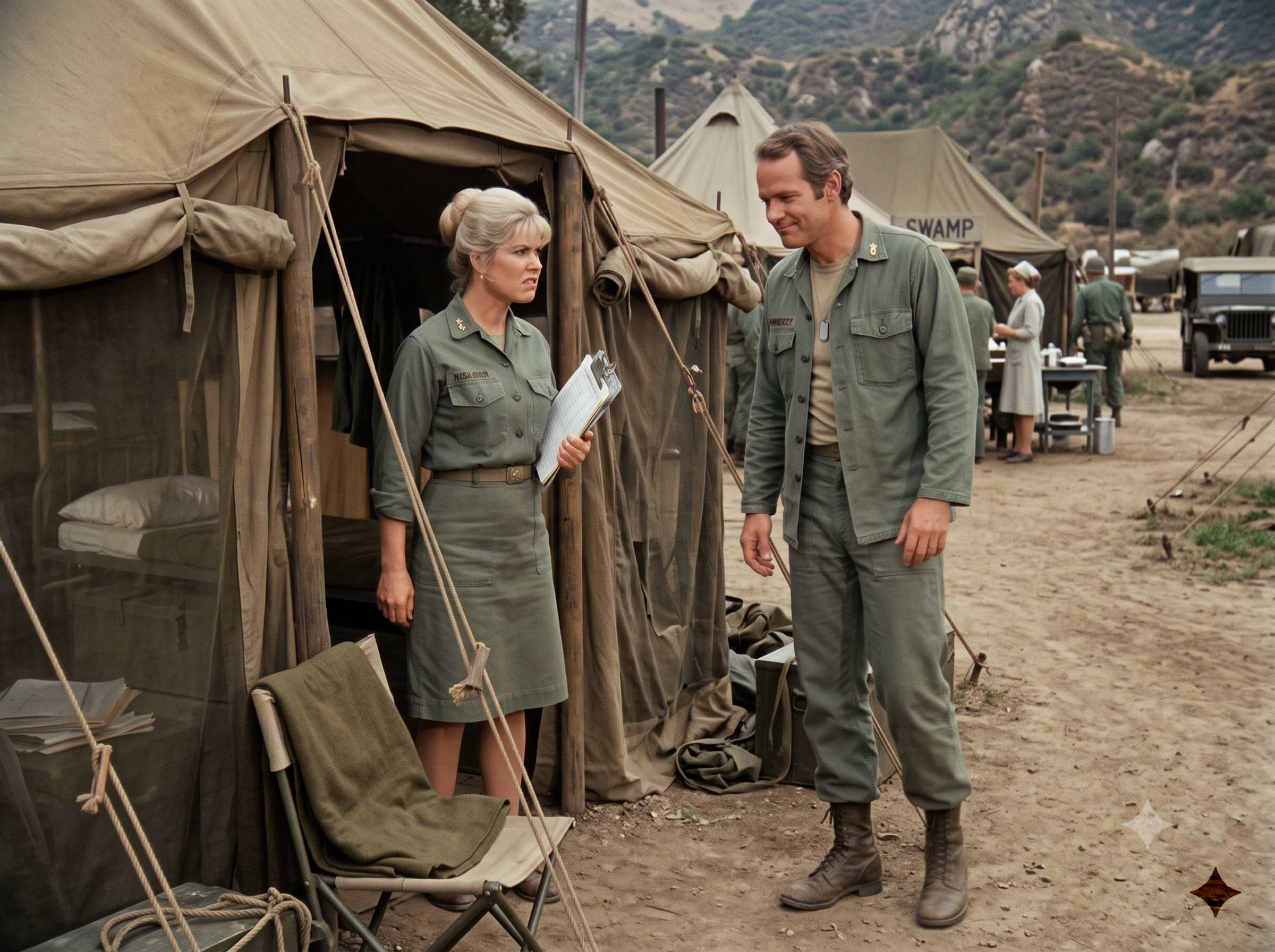
Major Margaret Houlihan stood just outside her tent, the heavy canvas flap tied back to let in whatever meager breeze might wander through the compound. Beside her, a folding chair sat empty, draped with a scratchy wool blanket that had seen too many cold Korean nights.
Margaret wasn’t resting. She rarely allowed herself the luxury out in the open.
She stood perfectly straight, a beacon of military bearing in a sea of rumpled beige. Her uniform was as pressed as the terrible camp laundry permitted, her blonde hair pinned back flawlessly.
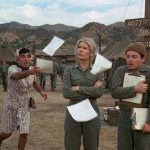
In her hands, she gripped a wooden clipboard holding a stack of medical charts and duty rosters.
She was staring down at the top sheet of paper, and her knuckles were turning white.
It was supposed to be a simple post-op rotation schedule. Instead, it was a mess of cross-outs, scribbled notes, and a highly inappropriate cartoon drawn in the margins that looked suspiciously like Colonel Potter’s horse.
It was infantile. It was maddening. It was entirely unauthorized.
Margaret took a sharp, steadying breath. She could feel the familiar, hot spark of indignation flaring in her chest.
She was the Head Nurse. She was trying to maintain a shred of discipline in a surgical hospital that frequently resembled a lunatic asylum.
She squared her shoulders, fully prepared to march directly across the compound, storm into the Swamp, and deliver a blistering lecture on military decorum that they would hear all the way in Seoul.
But before she could take a single, purposeful step forward, a shadow drifted across the sunbaked dirt path.
Captain B.J. Hunnicutt was walking by.
He wasn’t marching, and he certainly wasn’t hurrying. B.J. possessed an easy, loping stride that seemed entirely out of place in a war zone.
He wore his dusty fatigues like second skin, his jacket hanging open over his olive undershirt, his dog tags resting casually against his chest.
He looked exhausted, his shoulders carrying the invisible weight of the lives they had all spent the last thirty-six hours trying to save.
As he passed her tent, B.J. paused.
He didn’t snap to attention or offer a mocking salute. He just stopped his easygoing stride and turned toward her.
He took in the rigid posture, the flashing eyes, and the death grip she had on the clipboard.
Instead of wisely continuing on his way to avoid the impending explosion, B.J. leaned in slightly.
He didn’t invade her space, but he closed the distance just enough to make the moment private.
“Major,” B.J. said, his voice a low, gravelly drawl that cut through the ambient hum of the camp. “If you glare at that piece of paper any harder, I think it’s going to surrender.”
Margaret’s head snapped up instantly.
Her eyes narrowed, and her mouth opened to fire off a textbook reprimand. She was fully loaded, her pride and her exhaustion demanding an outlet for the frustration.
“Captain Hunnicutt,” Margaret began, her voice tight, icy, and carrying the full weight of her rank.
She intended to tell him exactly what she thought of surgeons who treated official Army documents like a canvas for their juvenile humor. She intended to remind him of the chain of command.
But the words died in her throat.
She looked at B.J., really looked at him, and the anger faltered.
He wasn’t smirking. He wasn’t winding her up the way Hawkeye Pierce would have been.
B.J. was just looking back at her with eyes that were incredibly warm and deeply tired.
There was a natural friendliness in his face, a gentle, grounded empathy that didn’t demand anything from her. He offered a slow, dryly funny smile that didn’t mock her anger; it simply acknowledged the shared absurdity of their lives.
He was looking at her not as a commanding officer, but as a fellow human being who was just as profoundly weary as he was.
“He spelled ‘equestrian’ wrong, didn’t he?” B.J. asked softly, nodding toward the ruined roster.
Margaret blinked. The perfectly crafted military lecture crumbled entirely.
She tried to maintain her proud composure. She tightened her jaw and tried to summon the righteous fury back to the surface. She was Major Houlihan, and she did not find this amusing.
But her defenses were worn too thin today.
Despite her best efforts, the corners of her mouth betrayed her.
A subtle, warmly amused smile broke through her strict facade. It was a quiet rebellion against her own discipline, softening the hard lines of her face and revealing the deeply tender woman buried beneath the brass.
She looked down at the clipboard again, shaking her head. The anger evaporated, leaving behind a bittersweet affection for these impossible, brilliant people.
“He spelled it with a ‘U’ and three ‘E’s, Captain,” she murmured, her voice losing its brassy edge entirely.
B.J. chuckled. It was a soft, genuine sound that seemed to make the dusty air around them feel a little lighter.
“I’ll be sure to inform him that his penmanship is a danger to the war effort,” B.J. replied easily.
He didn’t push the joke any further. He didn’t try to wring a laugh out of her or overstay his welcome at her tent flap.
He just stood there for another second, sharing the quiet, unscripted moment in the middle of the dirt path.
“It’s a long war, Margaret,” B.J. said gently, his tone shifting from humorous to quietly sincere.
He looked at the dark circles under her eyes, recognizing the same toll that looking in the mirror showed him every morning.
“Try not to let the paperwork be the thing that takes you down,” he added, his voice carrying a genuine note of protective concern. “We need you in one piece.”
Margaret looked up at him.
The harsh Korean sunlight suddenly felt a little less unforgiving. The distant roar of a jeep starting up in the motor pool faded into the background.
She saw the deep fatigue etched into his features, matching her own perfectly. They were thousands of miles from the lives they knew, fighting a daily tide of tragedy, surviving on bad coffee, dark humor, and each other.
“I’ll keep that in mind, B.J.,” she said softly.
It was rare for her to use his first name out here in the open compound. It was a small offering of a truce, a quiet acknowledgment of the deep, unspoken respect they shared over the operating tables.
B.J. gave her a slow nod.
His warm smile remained as he turned, his boots scuffing softly against the dirt as he resumed his easygoing stride toward the mess tent.
Margaret stood alone by the canvas doorway, watching him walk away.
The camp continued its restless buzzing around her. Nurses hurried past, orderlies shouted across the compound, and the dust continued to swirl in the dry air.
She looked back down at the ruined roster in her hands.
She didn’t feel the urge to scream anymore. She didn’t feel the need to march into the Swamp and demand order in a place that defied it.
Instead, she just felt a profound, bittersweet ache for this terrible, wonderful place, and the makeshift family she was trapped here with.
She ran a thumb gently over the margin of the paper, the subtle smile lingering on her lips.
Margaret sighed, adjusted her grip on the clipboard, and turned back to the unending work of the 4077th. The war was still going on, but for this one brief minute, the burden felt just a little bit lighter to carry.
Sometimes, the strongest medicine at the 4077th wasn’t found in the pharmacy, but in a passing smile on a dusty path.