The Sound of Ordinary Laughter
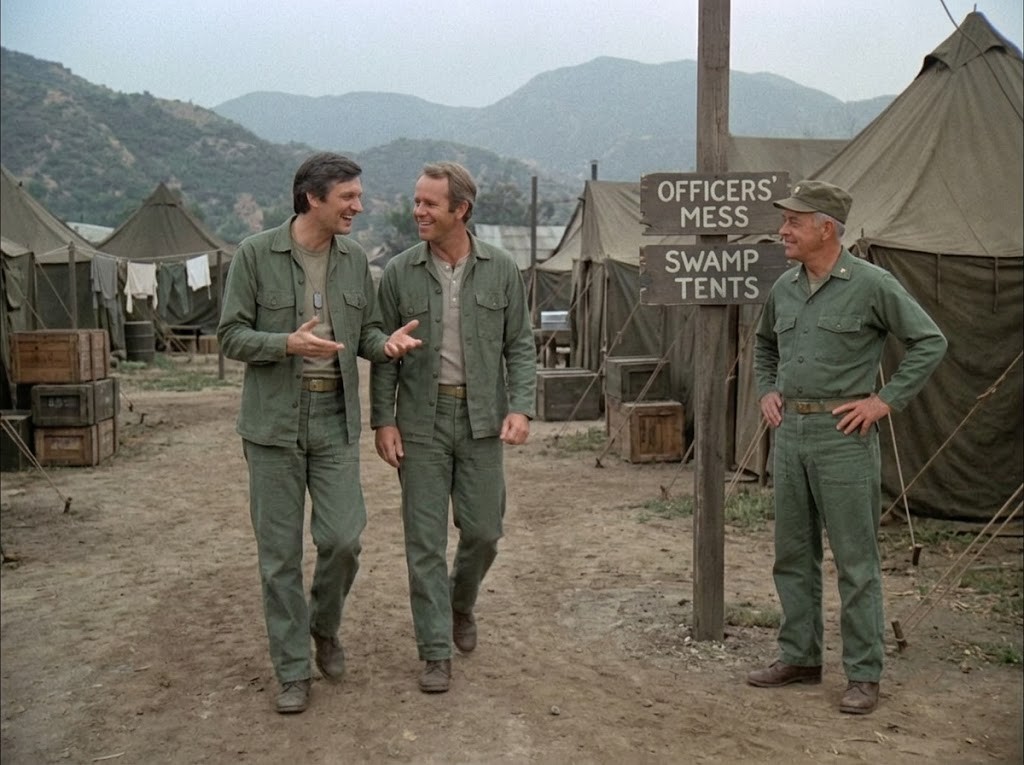
Sometimes, the best thing a person could look for in the middle of a Korean compound wasn’t a sudden truce or a clean pair of socks. It was just the sound of two tired men forgetting, even for thirty seconds, exactly where they were.
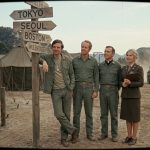
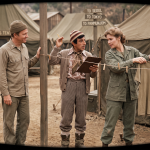
Colonel Sherman Potter stood just outside the command tent, his hands resting squarely on his hips. The morning sun was trying its best to cut through the heavy, dusty haze of the valley, casting long shadows across the dirt paths of the 4077th. Nearby, the wooden signpost pointed its weathered arrows toward the “OFFICERS’ MESS” and the “SWAMP TENTS,” looking just as weary as the rest of the camp.
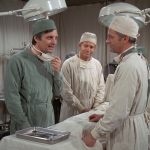
It had been a brutal seventy-two hours in the operating room, the kind of session where the smell of ether seemed to seep directly into a man’s bones. The surgeons had worked until their hands shook, operating under the relentless drone of generators and the distant, sickening rumble of artillery. But the session was finally over, the post-op ward was temporarily stable, and a rare, fragile quiet had settled over the compound.
That was when Potter heard it—a sharp, genuine burst of laughter cutting through the morning air.
Walking down the dirt path toward him were Captains Hawkeye Pierce and B.J. Hunnicutt. They were still clad in their faded olive drabs, dog tags dangling loosely, their boots caked with the stubborn mud of the camp. By all accounts, they should have been face-down on their cots, dead to the world. Instead, they were walking side-by-side, sharing a private joke that seemed to lift the weight right off their shoulders.
Hawkeye was gesturing with both hands, his face animated, an exhaustion-fueled grin lighting up his features. B.J. walked right beside him, his trademark mustache twitching as he let out a warm, rolling chuckle that countered Hawkeye’s frantic energy perfectly.
Potter couldn’t help but smile, a soft, fatherly expression softening his stern features. He had managed men for over thirty years in more army camps than he cared to count, but he had never seen a pair quite like these two. They were a pair of rule-breaking, martini-swilling scoundrels, but when the chips were down, they possessed more heart and healing skill than the entire Pentagon combined.
“I’m telling you, Beej, it’s a foolproof plan,” Hawkeye was saying as they approached the signpost, his voice carrying clearly in the crisp air. “If we can just convince Klinger to dress up as a mailman from Mill Valley, California, your brain might actually believe you’ve gone home for twenty minutes. It’s a psychological placebo.”
“An excellent theory, Hawk,” B.J. replied, his eyes crinkling with genuine amusement. “Except for the part where Klinger’s beard doesn’t exactly scream ‘California sunshine.’ Plus, I think he’s currently hoarding a shipment of silk scarves from Seoul.”
Potter watched them, his hands still on his hips, a dry remark forming on his lips to keep them on their toes. It was a comforting, familiar routine—the old regular army colonel pretending to be tough, and the two conscripted docs pretending to be entirely unbothered by authority.
But just as Hawkeye took another step, his foot caught the edge of a stray wooden supply crate half-buried in the dirt. He stumbled forward, his animated gesture turning into a sudden scramble for balance.
B.J. lunged automatically to catch his arm, his smile instantly vanishing into an expression of sharp, protective concern. At the same moment, the distant, unmistakable sound of a chopper’s rotor blades began to echo faintly from over the eastern ridge, a sound that always meant only one thing.
—
The laughter vanished from the compound as quickly as a morning mist under a harsh sun. Hawkeye caught his balance, gripping B.J.’s forearm tightly for a second, his eyes immediately darting up toward the jagged gray peaks of the mountains.
Colonel Potter’s hands dropped from his hips, his posture instantly shifting from a relaxed father figure to a commanding officer. The fragile peace of the morning fractured in an instant, replaced by the muscle memory of a hundred previous alerts.
“Radar!” Potter called out instinctively toward the office tent, even before the young corporal could step outside with his clipboard.
But before the panic could settle into their chests, the faint chopping sound changed pitch. It wasn’t the heavy, rhythmic thumping of a medical evacuation chopper carrying a fresh wave of casualties. It was lighter, steadier, and accompanied by the wheezing groan of an old engine.
From behind the mess tent, Corporal Radar O’Reilly appeared, blinking into the sunlight, his oversized glasses sliding down his nose. He wasn’t running; he was walking, a look of profound relief on his young face.
“It’s just the supply chopper, Colonel,” Radar announced, his voice cracking slightly. “The one with the winter coats and the spare gaskets for the generator. No incoming. None at all.”
A collective, invisible breath was released across the entire compound. Hawkeye let go of B.J.’s arm, letting out a long, shaky sigh that turned back into a self-deprecating smirk. He dusted off his trousers, trying to regain his casual composure.
“Well,” Hawkeye muttered, his voice dropping back into its familiar, rhythmic cadence. “My heart just did a tap-dance on my ribcage, and I think I owe it an apology. Remind me never to skip breakfast again, Beej. The adrenaline is much too spicy on an empty stomach.”
B.J. let out a soft laugh, slapping Hawkeye on the back. “Don’t worry, Hawk. If your heart stops, I’ll personally perform a massage right here in the dirt. But only if you promise to stop talking about Klinger in a mailman outfit.”
Colonel Potter walked over to join them, his boots crunching softly on the gravel. The sternness had left his face, replaced once again by that quiet, profound warmth that kept the 4077th from falling apart at the seams.
“You two look like a couple of unmade beds,” Potter said, though his tone was entirely devoid of malice. “If I didn’t know better, I’d say you were plotting a mutiny against the mess tent’s latest attempt at creamed chipped beef.”
“Worse, Colonel,” Hawkeye said, offering a mock salute that wouldn’t have passed inspection in any standard army base. “We were discussing the absolute necessity of a three-day sleep. Or at least a two-day nap followed by a very long sitting session.”
“Go on, get some rest, both of you,” Potter said softly, placing a hand on each of their shoulders for a brief, heavy moment. “The post-op is quiet. Major Houlihan has the floor covered, and even Winchester is currently horizontal and snoring loudly enough to wake the dead. That’s an official order from the old man. Clear out.”
“You don’t have to tell me twice, Colonel,” B.J. said, his expression softening with immense gratitude. He looked over at Hawkeye. “Come on, roomie. Let’s go see if the Swamp is still standing.”
As the two younger doctors turned and walked toward their tent, Potter stood by the signpost, watching them go. He watched the way they leaned into each other slightly, a silent, unspoken support system forged in the heat of a terrible war. They would sleep for a few hours, the sirens would inevitably wail again, and they would stand over the operating tables for another marathon session, saving lives with jokes on their lips and sorrow in their eyes.
But for right now, the sun was shining, the chopper was only bringing coats, and his boys were safe. Potter turned back toward his office, a quiet sense of pride warming his chest, knowing that despite the madness surrounding them, the humanity of the 4077th remained entirely unbroken.
—
Because in the end, it wasn’t the uniform or the place that kept them going—it was the family they found in each other.