A Silent Truce in the Swamp
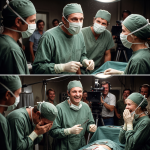
The operating room was finally quiet, the relentless click-clack of surgical instruments replaced by a heavy, enveloping silence. Behind Hawkeye Pierce’s eyes, the bright surgical lights still burned, an imprint of twelve grueling hours spent fighting for lives. The smell of ether and antiseptic still clung to his fatigue shirt, refusing to be washed away by the humid Korean night.
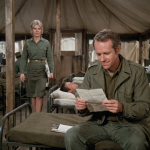
He slumped onto his cot, the faded canvas groaning under his weight, and just breathed. This was his first real moment of peace. His first opportunity to be Ben Pierce from Maine, and not Captain Hawkeye of the 4077th MAS*H, for one blessed, stolen minute.
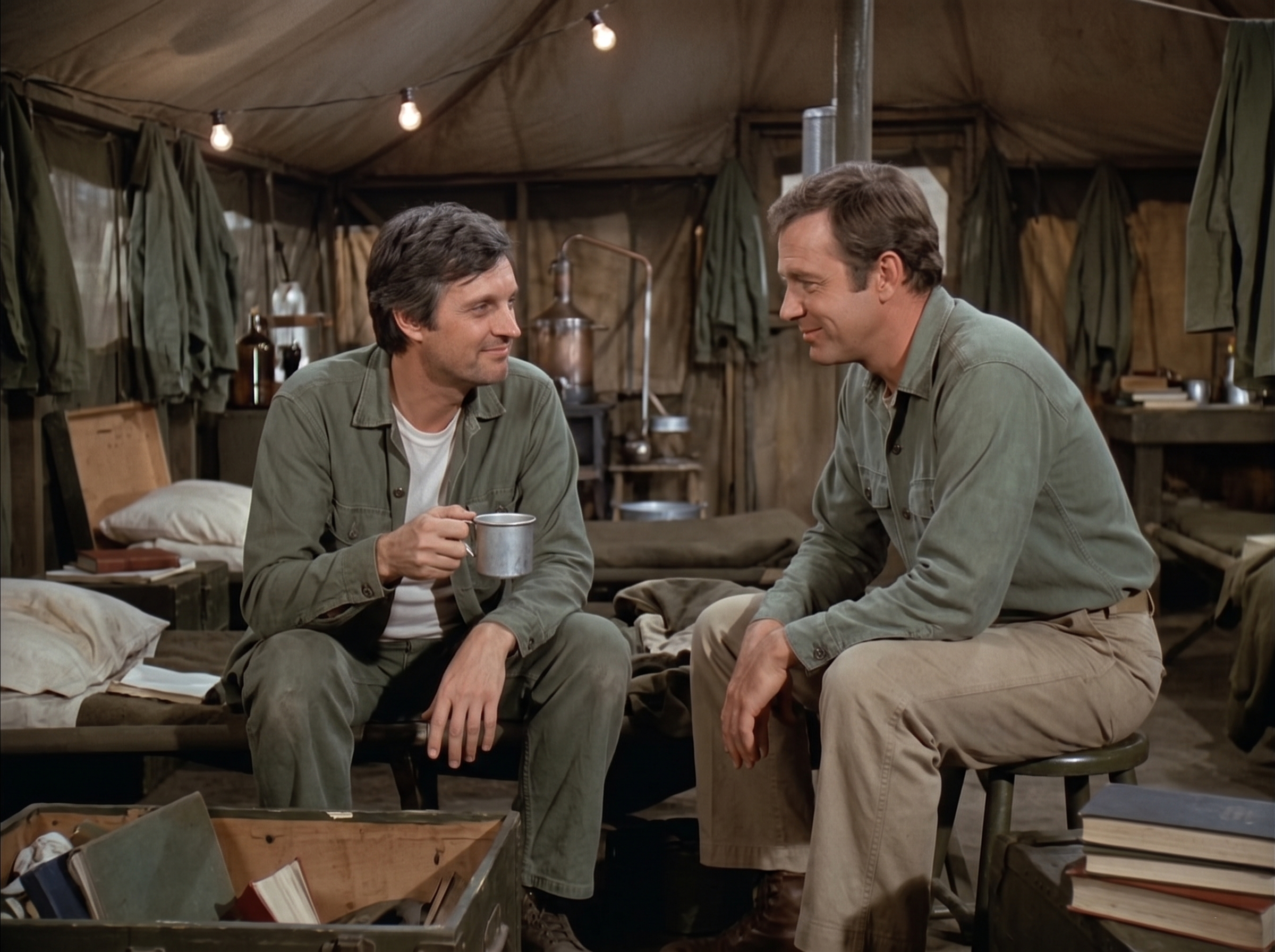
His fingers, slightly trembling from fatigue, fumbled for a standard-issue cigarette. A battered metal coffee mug, steam long since gone, sat forgotten beside his worn boots. He needed this quiet. Across the small, cluttered space of the Swamp, B.J. Hunnicutt watched him with an expression of steady, quiet understanding.
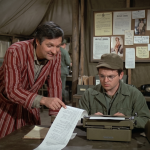
B.J. sat on his own stool, his foot locker (filled with books) forming a makeshift table beside him. The only illumination came from the single, warm-toned incandescent bulb hanging from the tent’s center pole, casting soft, gentle shadows over the space. Outside, the night sounds of the Korean countryside were muffled by the heavy olive canvas. The still, their shared masterpiece of makeshift engineering, stood in the far corner, a silent, comforting sentinel.
“Another day, another victory for the human spirit,” Hawkeye said, his voice a dry rasp, barely above a whisper. He made a small, ironic gesture with his cigarette. His usual quick wit was strained, a thin veil over a bone-deep exhaustion that no amount of coffee or sarcastic jokes could touch.
B.J. didn’t smile, and he didn’t offer a sarcastic retort. He just watched Hawkeye, his steady gaze holding a different kind of weight. Today had been brutal, and he knew Hawkeye was fighting a private battle, even if he hid it well. The silence between them, usually so easy and companionable, was thick tonight, full of unspoken patients and a relentless, running tally of loss.
“You know,” B.J. said finally, his voice quiet. He looked at Hawkeye, his expression grave. “I was thinking about the letter I got from Peg this morning. And I was wondering…” He paused, almost afraid to voice the thought, “Do you think we’ll ever truly leave this place, Hawkeye?”
He looked directly at his friend. “Not just when the war ends. Not just when the army says we can go home.” B.J. leaned forward, the question impossibly heavy in the small, warm tent. “But do you think we will ever stop smelling it? Will we ever stop hearing the choppers? When does all this finally stop inside our heads?” It was the one question Hawkeye Pierce, the brilliant, jokester surgeon, never wanted to answer, and the mask was slipping.
Hawkeye didn’t move. He just stared at the glowing red coal of his cigarette, watching the smoke curl and twist in the warm light of the hanging bulb. The question B.J. had asked wasn’t about transportation; it was about survival. It was the terrifying question they all whispered to themselves in the dark, the one that made their stomachs turn.
He finally looked up, and for a fleeting second, the weary, haunted look of the operating room was visible beneath his tired expression. His voice was quiet, stripped of its protective layer of sarcasm. “Leave it behind, B.J.?” He made a quick, dismissive gesture with his mug, but the humor was absent. “Oh, the army will provide transportation. They’ll put us on a boat or a plane, and the headlines will celebrate the homecoming of heroes.”
His eyes held a flicker of a different fear. “But I’m worried about the ‘finest surgeon from Boston,‘” he admitted, “the part of me that is just an incredibly precise set of hands. I’m worried I’ll just be a person who knows how to cut and sew, and I won’t know how to feel anything else. I won’t know how to not be in a MAS*H.“
It was a raw admission, a glimpse into the emotional erosion Hawkeye was fighting so hard to prevent. The weight of his own words seemed to press down on the cramped tent.
B.J. didn’t offer a platitude. He didn’t tell Hawkeye he was being dramatic. Instead, he simply leaned forward and put a strong, steady hand on Hawkeye’s shoulder. “That’s not going to happen, Hawk.” He held the connection, grounding Hawkeye, making sure he felt the human touch, not just the ghost of surgical instruments. “Because you do feel it. You feel it all. And it’s that feeling that makes you the doctor you are, and the friend I need.“
B.J. gently broke the moment, his hand releasing Hawkeye’s shoulder. He nudged the foot locker with his books. “And I’ve told you, you need to read fewer tragedies and more of these trashy novels,” he gestured to the stack with a small grin, the familiar, grounded look that was always such a comfort. “Besides, the stories are so bad they actually make this war look good in comparison.”
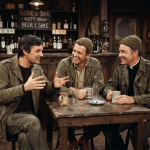
Hawkeye chuckled, a genuine, albeit quiet, laugh this time. The joke was simple, stupid, and perfect. The tension eased, dissolving into the familiar rhythm of their friendship. They shared a knowing grin (matching the mood in the image). “I’ll consider it, B.J. Although I’m not sure my literary palate can handle anything other than the classics of the Swamp and the poetry of our resident still.” He gestured with his cigarette toward the homemade contraption in the corner. “Which is currently the only thing keeping me sane.“
B.J. settled back onto his stool, picking up his forgotten book, but he didn’t open it. The deep vulnerability had passed, replaced by the warm comfort of shared experience. They were back to being the surgeons of the 4077th, finding solace in small, stolen moments. The connection was deeper now, the shared silence comfortable and safe.
The overhead light flickered once, and a single moth batted against the bulb. Hawkeye took one last drag from his cigarette before putting it out. “I think I might actually be looking forward to that terrible book,” he muttered. A quiet peace settled over the Swamp, the silence between them now warm and easy. They would be ready for tomorrow, ready for the triage and the operating room, because they had moments like this. They had each other.
It was in moments like these, under the flickering lights of the Swamp, that the worst of times found the best of friends.