The Weight of a Paragraph
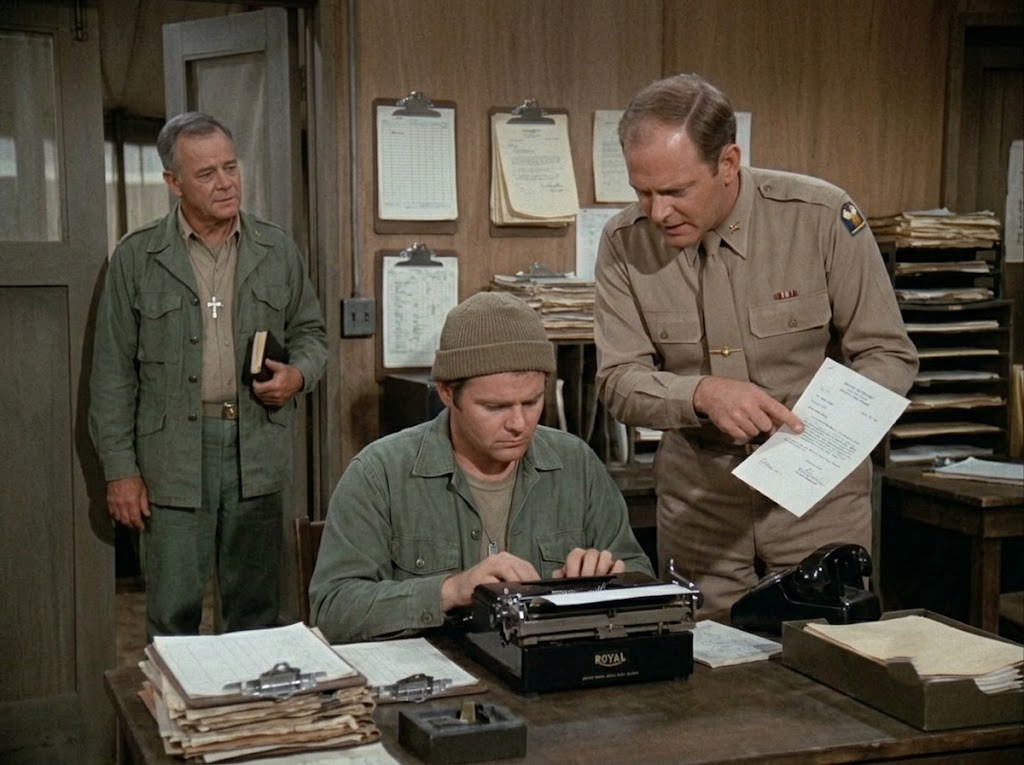
The rhythmic, metallic clack of the Royal typewriter was usually the heartbeat of the 4077th clerk’s office. Today, however, each strike felt heavy, like a small hammer hitting an anvil in the quiet of the Korean afternoon.
Radar O’Reilly kept his wool beanie pulled low, his eyes fixed firmly on the paper roller. His fingers moved with a practiced, mechanical speed, but his shoulders were unusually tense beneath his olive-drab fatigues.
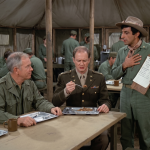
Behind him stood Colonel Potter, pointing a firm, weathered finger at the official document in his hand. The Colonel’s face was etched with a mixture of stern military authority and deep, fatherly concern.
“Right there, Radar,” Colonel Potter muttered, his voice dropping an octave as he indicated a specific line on the paper. “That’s the wording the brass is looking for, but it’s not the whole truth, is it?”
A few paces away, Father Mulcahy stood quietly by the open doorway, clutching a leather-bound book tightly against his chest. The silver cross pinned to his collar caught the dim indoor light, a silent witness to a conflict that paper forms could never truly capture.
The office was crowded with the usual clutter of a makeshift war zone—stacked clipboards, overflowing wooden inbox trays, and bundles of official correspondence. Yet, the air felt strangely still, thick with the exhaustion of a long week in the operating tents.
The document in Potter’s hand was a formal commendation report for a young corporal from Iowa who had done something remarkably brave during the last heavy push. But the army regulations required a cold, clinical description that stripped away the boy’s humanity.
Radar stopped typing mid-word, his fingers hovering over the keys as if afraid that the next letter would seal an unwelcome fate. He looked down, his jaw tight, refusing to meet the Colonel’s gaze.
“He’s just nineteen, Sir,” Radar whispered, his voice cracking slightly under the strain. “The way they want it written… it makes it sound like he was a machine, not a kid who was just terrified and trying to save his buddies.”
Colonel Potter sighed, the lines around his eyes deepening as he stared at the typed lines. He knew the bureaucracy demanded sterile facts, but he also knew the human cost behind every syllable.
Father Mulcahy stepped forward a single, gentle pace, his expression soft with a profound, unspoken sorrow. “Sometimes, Colonel, the official record leaves very little room for the soul.”
The silence stretched between the three men, punctuated only by the distant, faint thud of artillery miles away over the hills. Radar’s hands began to tremble slightly against the cold metal of the typewriter frame.
It was in that exact moment that Colonel Potter lowered the paper, his expression hardening into a look that meant he was about to make a choice that wouldn’t please the generals in Seoul.
“Pull the sheet out, Radar,” Colonel Potter said quietly, his tone leaving no room for argument.
Radar blinked, looking up at his commander with a mixture of surprise and sudden anxiety. “But Sir, Headquarters explicitly stated that the regular form must be submitted by the evening courier, or the boy won’t get his transfer home.”
“I know what they said, Radar,” Potter replied, placing the paper flat on the desk beside a stack of old clipboards. “But I won’t have a boy’s finest, most agonizing hour reduced to a checklist of tactical jargon.”
Father Mulcahy smiled faintly, a look of quiet relief washing over his face as he stepped fully into the room. “The truth often requires a few more words than the army allows, Radar.”
Radar carefully rolled the paper out of the carriage, the clicking sound loud in the small office. He set it aside and inserted a fresh, blank piece of stationery, his hands steadying now that a decision had been made.
“Alright, Son,” Potter said, leaning over the desk slightly, his fatherly warmth completely replacing his previous sternness. “We’re going to write an addendum. We tell them about the mud, we tell them about the fear, and we tell them exactly how many lives that boy carried on his back.”
For the next hour, the small office became a sanctuary of shared memory and quiet dedication. Colonel Potter paced the floor, dictating lines that bypassed the cold regulations and spoke directly to the heart of what happened on the line.
Father Mulcahy offered a word here and there, softening the sharp edges of military terms with a gentle grace that only a chaplain could provide. Radar’s fingers flew across the keys, no longer hesitant, but proud to be the instrument of a soldier’s true story.
They didn’t use modern phrases or grand, cinematic descriptions of battlefield glory. They spoke of a tired kid from the Midwest who simply refused to let his friends die in the dirt.
When the final page was typed, Radar carefully pulled it from the Royal and handed it to Colonel Potter, who signed his name with a bold, uncompromising stroke of his pen.
The afternoon sun began to dip below the horizon, casting long, warm shadows across the wooden floor and the neat stacks of paper. The tension that had filled the room earlier had completely dissolved, replaced by a deep, weary satisfaction.
It was a small victory against a vast, uncaring machine, but in the 4077th, those were the only victories that truly mattered.
Colonel Potter handed the completed file back to Radar, tapping the top of the desk with a gentle, appreciative nod. “Get that to the courier, Radar. Let’s make sure they remember who that boy really is.”
“Yes, Sir,” Radar said, a genuine smile finally breaking across his face as he carefully placed the document into the outgoing tray.
Father Mulcahy stepped out into the compound, his heart a little lighter as the evening chill began to settle over the camp. Behind him, the steady, rhythmic clacking of Radar’s typewriter started up once again, filling the tent with its familiar, comforting sound.
In a place where life was measured in broken pieces, they always found a way to piece together a little bit of humanity.