The Music of a Quieter Home
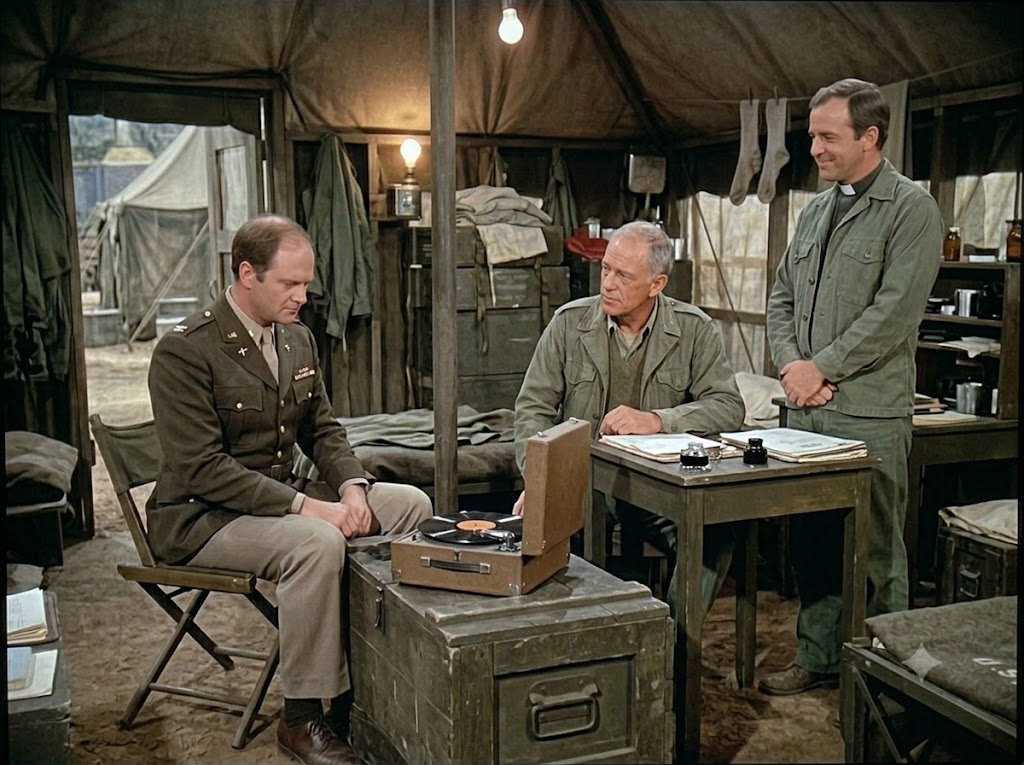
The mud outside the 4077th never truly dried, but inside Colonel Potter’s tent, the world occasionally stopped spinning just long enough for a man to hear his own thoughts. It had been an exhausting forty-eight hours in OR, the kind of marathon that leaves your bones aching and your mind drifting back across the Pacific.
When a surprise care package arrived from Boston, it wasn’t filled with the usual tinned meats or woolen socks. Instead, Charles Emerson Winchester III found himself holding a pristine, heavy vinyl record—a piece of home wrapped in layers of protective brown paper.
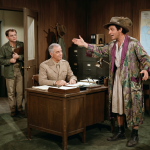
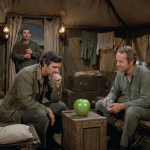
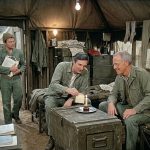
There was no record player in the Swamp that hadn’t been abused by Hawkeye’s jazz or BJ’s country tunes, so Charles had marched with rigid dignity straight to the administrative tent. Colonel Potter had willingly offered up his old, portable record player, setting it atop a sturdy green footlocker.
As the needle gently touched the spinning black disc, the scratchy but unmistakable notes of a classical melody began to filter through the canvas walls. Charles sat perfectly erect on a folding wooden chair, dressed in his formal class-A uniform jacket, his eyes cast down toward the floorboards.
Colonel Potter leaned forward at his desk, his spectacles set aside, listening with the quiet, intense focus of a man who appreciated any reminder of civilization. Standing just behind him, Father Mulcahy clasped his hands loosely, a warm, gentle smile gracing his face as the music filled the cramped room.
For a few minutes, the war felt a thousand miles away. The three men remained perfectly still, anchored by the melody, each of them transported back to a porch in Missouri, a parish in Philadelphia, or a concert hall in Boston.
But the 4077th was never a place where peace lingered without interruption. Just as the music reached its delicate, soaring crescendo, a sudden, heavy metallic thud echoed from the compound outside, followed by the frantic shouting of voices near the helipad.
The needle jumped violently across the vinyl, creating a harsh, scraping screech that shattered the beautiful melody. Charles flinched, his knuckles turning white as he gripped his knees, while Colonel Potter’s eyes locked onto the tent door, his fatherly warmth instantly replaced by the grim readiness of a commander.
—
The sudden silence in the tent was heavy, broken only by the rhythmic, empty clicking of the record player’s arm swinging aimlessly at the end of its track. Father Mulcahy’s smile faded into a look of quiet concern, his eyes darting between the door and the crestfallen aristocrat sitting across from him.
“Incoming?” Charles asked, his voice uncharacteristically quiet, lacking its usual defensive arrogance.
Colonel Potter stood up slowly, putting his cap back on his head with a practiced, weary motion. “No, Major. Sounds like Klinger backed the supply truck into the generator housing again. But duty calls either way.”
The Colonel walked over to the footlocker and gently lifted the arm of the record player, stopping the empty friction. He looked down at Charles, whose face remained a mask of profound disappointment, looking less like a pompous surgeon and more like a homesick boy from Massachusetts.
“Don’t pack it up just yet, Charles,” Potter said softly, placing a steady, calloused hand on Winchester’s shoulder. “The music was doing this old tent some good. Keep it playing. The Father here could use a little culture.”
With a nod to Mulcahy, Potter stepped out into the bright, muddy compound, leaving the two men alone in the dim, golden light of the tent.
Father Mulcahy stepped forward, his boots clicking softly against the dirt floor. He looked at the scratched surface of the record, then at Charles, who was carefully lifting the vinyl by its edges, inspecting the damage with a heavy heart.
“A beautiful piece, Charles,” Mulcahy offered gently, his voice a soothing balm in the quiet room. “Mozart, if I’m not mistaken?”
“Mozart’s Clarinet Concerto in A major,” Charles murmured, his voice thick with a rare vulnerability. “My mother and I used to attend the symphony every autumn. The air in Boston would be crisp… the leaves turning. You could smell the woodsmoke from the old brick chimneys.”
He carefully wiped a speck of dust from the record with the sleeve of his uniform. “I thought, perhaps, if I could just hear it clearly… I could pretend the mud and the misery didn’t exist for twenty minutes.”
Mulcahy smiled warmly, pulling up a small wooden crate to sit near the footlocker. “We don’t need twenty minutes to escape, Charles. Even a single note can carry us precisely where we need to be. Try it again. A minor scratch cannot ruin a masterpiece.”
Charles looked at the priest, seeing no judgment in his eyes, only the deep, enduring empathy that held the camp together through its darkest hours. Slowly, deliberately, Charles placed the record back on the turntable. He guided the needle past the scratched section, setting it down with an incredibly steady hand.
The music breathed back to life, filling the canvas room once more with its sweet, melancholic grace. Charles closed his eyes, leaning back, a faint, contented sigh escaping his lips as the melody washed over them.
Father Mulcahy stayed right there, listening beside him in the quiet, golden warmth, as the 4077th continued to hum its chaotic rhythm just outside the door.
—
Sometimes, the greatest medicine in Korea didn’t come from a bottle, but from a scratchy record and the quiet understanding of a friend.