The Toledo Illusion and the Afternoon Report
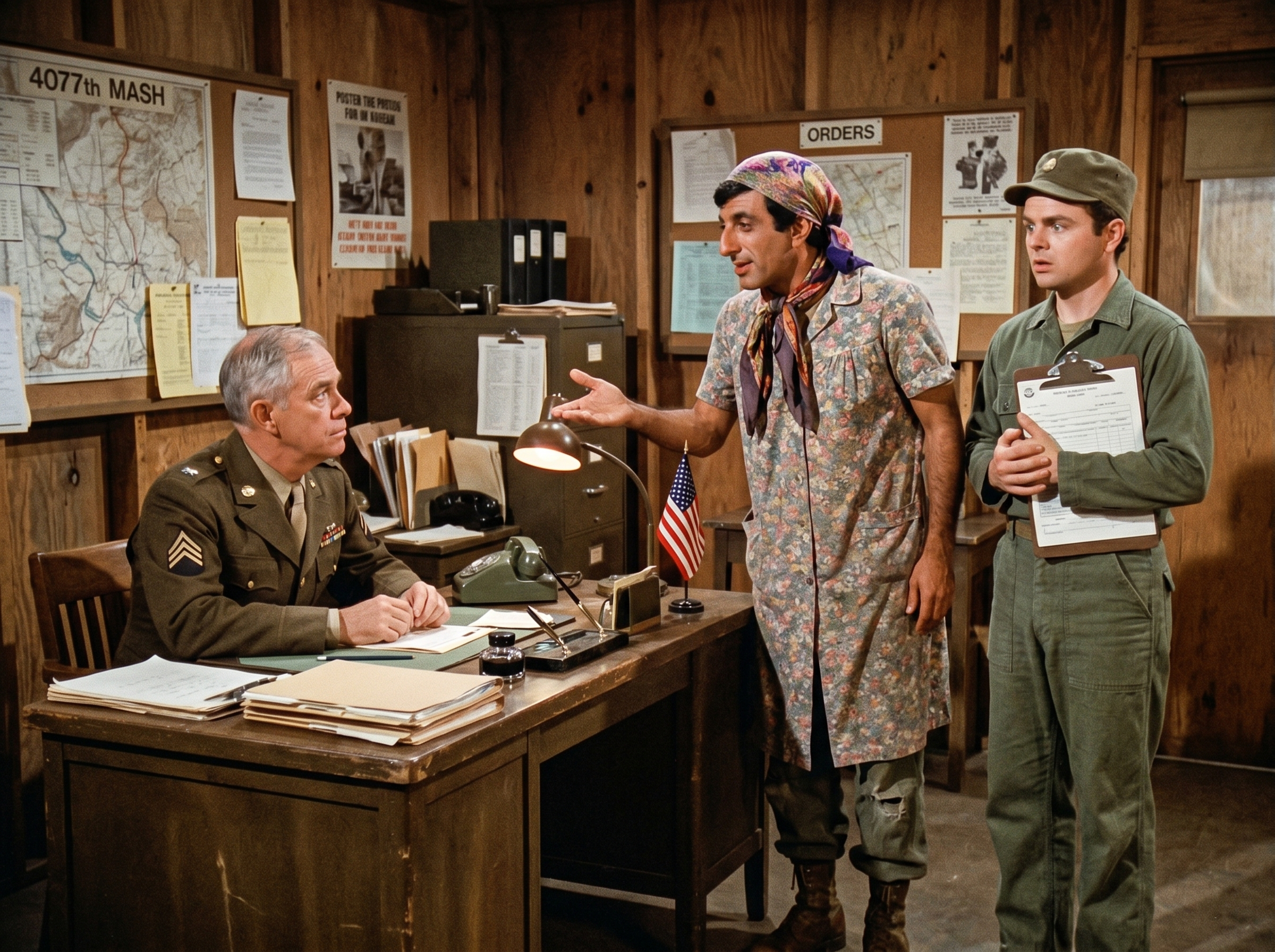
The war never truly stopped at the 4077th; it only occasionally paused to catch its breath.
It was late afternoon, that quiet, golden hour between the day’s chaos and the evening’s chill. Inside the commanding officer’s office, the air was heavy with the smell of old canvas, stale coffee, and mimeograph ink.
Colonel Sherman T. Potter sat behind his battered wooden field desk, bathed in the soft, practical glow of a small desk lamp. The light cast warm shadows against the walls, highlighting the faded map of the Korean peninsula and the endless stacks of military bureaucracy he was currently battling.
He had just dipped his pen into the glass inkwell, prepared to sign away another requisition form for tongue depressors, when the door swung open.
Enter Corporal Maxwell Q. Klinger, followed closely by a visibly trembling Corporal Walter “Radar” O’Reilly.
Potter didn’t immediately look up. He let out a long, slow sigh, the kind of sigh that only a career army man with decades of command experience could produce. When he finally raised his eyes, he was met with a spectacle that would have stunned any other commander in the United States Army.
Klinger stood front and center, dressed in a faded, floral-print house dress that clung awkwardly to his hairy frame. A brightly colored, patterned headscarf was tied tightly under his chin, framing his face in a bizarre portrait of domestic despair.
He struck a theatrical pose, one combat-booted foot slightly forward, his right hand extended toward Potter in a grand, pleading gesture. His eyes gleamed with a sly, desperate hope.
Radar stood rigidly at attention right beside him, wearing his standard fatigues and cap. He was clutching a metal clipboard to his chest like a medieval shield. His signature wide-eyed, innocent gaze darted nervously between the Colonel and Klinger, looking terrified of whatever was about to happen.
“Alright, Klinger,” Potter said, his voice a calm, gravelly deadpan. He leaned slightly forward, resting his forearms on the desk, a portrait of fatherly exasperation. “I’ll bite. Who are we today? A displaced duchess? A grieving widow from the old country? Or did you just lose a fight with a drapery salesman?”
“Colonel, I beg of you to look upon a broken woman!” Klinger cried out, his voice dripping with exaggerated agony. He placed his hand dramatically over his heart. “I am Madame Zora, a simple fortune teller from the wandering caravans of Toledo. And the spirits have spoken, Colonel! They have shown me a terrible vision!”
Potter didn’t blink. “Is that so?”
“Yes, sir!” Klinger proclaimed. “The spirits say that if I am not immediately discharged and returned to the banks of the Maumee River, a great curse will fall upon this entire camp! I’m a hazard to military operations, sir! I am practically radiating bad juju! Just look at the documentation!”
Klinger nudged Radar sharply with his elbow.
Radar jumped, swallowing hard. “Uh, yes, sir. I have the, um, the spiritual affidavits right here.”
Radar fumbled with the clipboard, his fingers shaking slightly as he held out a stack of heavily stamped, utterly incomprehensible army forms.
Potter reached across the desk and took the clipboard. He looked at the paperwork, then back at Klinger’s ridiculous outfit. It was the same song and dance, a daily routine of comedic deflection.
But as Potter flipped past the first page of Klinger’s forged “Section 8” request, his eyes caught something else.
Tucked underneath the joke forms was a crumpled, pale blue piece of civilian stationery.
Potter’s face changed. The dry, amused exasperation vanished, replaced instantly by the sharp, serious focus of a commanding officer. The silence in the room suddenly grew heavy.
Potter looked up, his eyes locking onto Klinger’s.
“Radar,” Potter said quietly, his voice dropping an octave. “Shut the door.”
Radar quickly stepped backward and pushed the wooden door shut. The click of the latch sounded unnaturally loud in the small office.
Klinger’s theatrical posture faltered. The outstretched hand slowly dropped to his side. The sly hope in his eyes was instantly replaced by a sudden, nervous vulnerability.
Potter looked down at the pale blue paper again. He smoothed out the creases with his thumb. The handwriting was neat, looping, and distinctly feminine.
“This came in the afternoon mail?” Potter asked, not looking up.
Radar nodded miserably. “Yes, sir. I, uh… I brought it to him right after lunch. That’s when he asked me to type up the… the Madame Zora forms.”
Potter read the letter in silence. The room was so quiet that they could hear the distant, steady thrum of the camp’s power generator and the faint laughter of someone walking through the compound outside.
When Potter finally finished reading, he placed the letter gently on his blotter. He took off his wire-rimmed glasses, folded them, and looked at the corporal standing before him.
Suddenly, Klinger didn’t look like a master of disguise or a brilliant scam artist. Standing there in the floral dress and the brightly colored scarf, he just looked like a tired, frightened young man who was seven thousand miles away from the people he loved.
“Your mother had a heart attack, Max,” Potter said softly.
It wasn’t a question. It was a gentle acknowledgment of the terrifying reality hidden beneath the comedy.
Klinger swallowed hard. His jaw tightened, and he looked up at the ceiling, blinking rapidly to fight back the sudden shine in his eyes. He took a deep, shaky breath.
“My uncle wrote it, sir,” Klinger said, his voice stripped of all its theatrical bravado. It was just Max from Toledo speaking now. “He says she’s at Mercy Hospital. They think she’s going to be okay, but… she’s eighty-two, Colonel. She’s tiny. And she’s scared. And I’m…”
He trailed off, waving a hand vaguely at the walls of the office, at the Korean maps, at the dirt floor.
“And I’m here,” Klinger finished, his voice cracking just a fraction. “Wearing a dress, hoping the army thinks I’m crazy enough to send home. But the truth is, Colonel… I think I actually am going crazy. Because I can’t be there to hold her hand.”
Radar looked down at his boots, his own eyes watering. He had known what the letter said. He had played along with the Madame Zora routine because he knew it was the only way Klinger knew how to cope with the helplessness.
Potter sighed, a deep, heavy sound that seemed to carry the weight of every soldier he had ever commanded. He stood up from his desk and walked around to the front.
He stood in front of Klinger, looking at the ridiculous floral fabric, the scuffed combat boots, and the raw pain on the corporal’s face.
“Max,” Potter said gently, his tone purely fatherly. “When I was stationed in France during the first war, I got a telegram that my little sister was sick. Pneumonia. I spent three days trying to figure out a way to steal a biplane and fly across the Atlantic. I would have done anything. I felt exactly the way you feel right now.”
Klinger looked at him, his dark eyes pleading for a miracle. “Can you sign the papers, Colonel? Just this once? Tell them I’m hearing voices. Tell them I think I’m an actual geranium. I don’t care.”
Potter placed a firm, steady hand on Klinger’s shoulder. The touch was grounding, a tether to reality in a world turned upside down.
“You know I can’t do that, son,” Potter said quietly. “The army doesn’t care about our broken hearts. And if I send you home on a fake Section 8, it follows you for the rest of your life. I won’t ruin your future because of a temporary crisis.”
Klinger’s shoulders slumped. The last bit of fight drained out of him. He looked down, staring at the floorboards. “Yes, sir.”
Potter squeezed his shoulder once, then turned to his clerk.
“Radar,” Potter said, his voice crisp and authoritative once again.
“Sir?” Radar snapped to attention.
“I need you to get on the horn to Sparky at I-Corps,” Potter ordered. “Tell him the commanding officer of the 4077th needs an emergency, high-priority, trans-Pacific line routed directly to Mercy Hospital in Toledo, Ohio. And tell him if he can’t make it happen, I will personally drive down to Seoul and turn his switchboard into a waffle iron.”
Radar’s eyes lit up with a brilliant, hopeful shine. A massive smile broke across his face. “Yes, sir! Right away, Colonel!”
Potter turned back to Klinger.
“Corporal, you are relieved of all duties for the next twelve hours,” Potter said, his eyes kind but his tone brook-no-argument. “You are going to take that ridiculous rag off your head, you are going to go into the clerk’s office, and you are going to sit by that radio until Sparky gets you a line to your mother. Understood?”
Klinger stared at Potter. His mouth opened, but no words came out. A tear finally escaped, rolling down his cheek and catching in his heavy stubble.
He didn’t bother trying to make a joke. He didn’t offer a salute. He simply reached out and grabbed Potter’s hand, shaking it with both of his own.
“Thank you, Colonel,” Klinger whispered, his voice thick with emotion. “Thank you.”
“Go on now,” Potter said gently, waving him away. “Get out of my office. You’re tracking Toledo dirt on my floor.”
Radar opened the door, practically vibrating with excitement. “Come on, Klinger! I know exactly how to bribe Sparky. It’s gonna take two boxes of cigars and a picture of Betty Grable, but we’ll get you through!”
Klinger turned and followed Radar out of the office. For the first time all day, the floral dress didn’t look like a costume. It just looked like clothes on a man who was finally walking toward home, even if only through a telephone wire.
The door clicked shut behind them.
Colonel Potter stood in the quiet office for a long moment. He listened to the frantic spinning of the rotary phone in the outer room, and the muffled, eager voices of two friends working together to conquer the miles.
Potter smiled faintly. He walked back behind his wooden desk, sat down in his creaky chair, and picked up his pen. The light from the lamp felt a little warmer now. He pulled the endless stack of requisition forms back toward him and went back to fighting the war, one piece of paper at a time.
In a place built on blood and bureaucracy, sometimes the greatest medical miracle was simply a borrowed telephone line and the grace of a good friend.