The Amber Glow of the 4077th
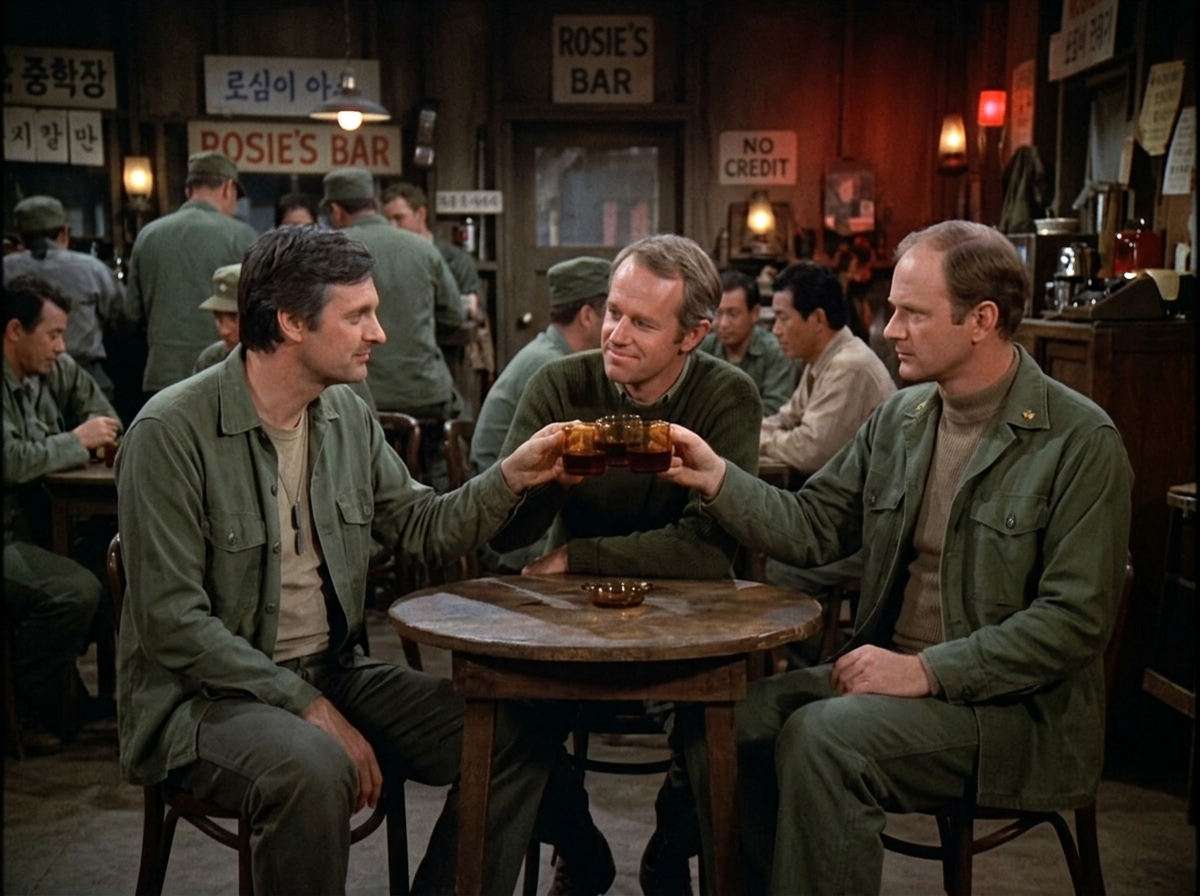
The neon sign for Rosie’s Bar buzzed with a low, erratic hum, a sound that felt as familiar as the ringing in their ears after a twelve-hour shift in the OR. Outside, the Korean mud was thick enough to swallow a boot whole, but inside, the air smelled of stale beer, damp olive drab wool, and the faint, sweet scent of cheap tobacco.
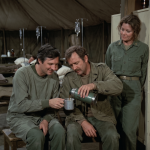
Hawkeye Pierce sat with his shoulders slouched, the heavy fabric of his fatigue shirt feeling like a suit of armor he had worn a lifetime too long. Opposite him, B.J. Hunnicutt leaned his elbows on the rough, round wooden table, his face carrying that specific brand of exhaustion that only a family man three thousand miles from home could wear. Beside B.J. sat Charles Winchester, his uniform still somehow holding a ghost of its Boston tailoring despite the grime of the peninsula, his posture stiff but his eyes heavy with the weight of the day.
It had been a brutal forty-eight hours in the operating tent—the kind of marathon where the faces of the wounded blurred into one continuous, agonizing tapestry. No one had spoken on the short, muddy walk down the road from the 4077th; words required an energy none of them possessed.
Rosie had quietly slid three amber glasses of her nameless, fiery local brew across the scarred wood without a word, knowing better than to ask questions.
Hawkeye raised his glass first, his fingers slightly trembling as the dog tags around his neck clinked against his buttons. “To the miracle of modern science,” he murmured, his voice dry, though his eyes carried that piercing, sharp intellect that refused to be snuffed out by the war. “And to the fact that none of us accidentally sewed our thumbs to a patient today.”
B.J. let out a soft, breathy chuckle, his eyes crinkling at the corners as he brought his glass forward to meet Hawkeye’s. “I’ll drink to that, Hawk. I think my thumbs are the only parts of me that don’t ache right now.”
Charles didn’t move immediately, staring down into the dark liquid with a look of profound skepticism, his jaw set in a firm, tight line. He looked at the modest, oil-lantern-lit room, the “NO CREDIT” sign hanging crookedly on the wall behind him, and the Korean writing on the placards flanking the bar. This was a universe away from the starlit symphony halls of Boston, a truth that seemed to strike him anew every time the scalpel was put down.
“Come on, Charles,” B.J. urged gently, nudging his glass forward just a fraction of an inch in the air. “Don’t leave us hanging. It’s a toast, not a contract.”
Charles sighed, a deep, resonant sound from his chest, and slowly raised his glass, his movements deliberate and dignified despite his fatigue. “If we must indulge in this primitive ritual,” Charles grumbled, though the edge in his voice lacked its usual bite, replaced instead by a quiet, reluctant vulnerability. “Let us at least drink to the swift and permanent departure from this godforsaken mud hole.”
The three glasses met in the center of the table with a soft, hollow clink, three distinct lives trapped in the same surreal pocket of time, holding onto each other without ever admitting it aloud.
But as the rims of their glasses touched, the door to Rosie’s bar creaked open, throwing a sudden shaft of cool night air across the smoke-filled room. Radar O’Reilly stood in the doorway, his oversized cap pulled low, holding a crumpled piece of paper against his chest with a look on his face that made Hawkeye’s glass freeze mid-air.
The silence that followed the creak of the door was heavy, punctuated only by the low chatter of the soldiers at the bar behind them. Radar didn’t move for a long moment, his eyes darting between the three surgeons, his bottom lip tucked slightly inward in that way he did when the weight of the camp was resting squarely on his young shoulders.
Hawkeye slowly lowered his glass back to the table, the humor draining from his face, leaving behind the raw, stripped-down look of a man who spent his life fighting a losing battle against the clock. “Radar,” Hawkeye said, his voice dropping its sarcastic edge completely. “Tell me Colonel Potter isn’t calling us back. Tell me the buses aren’t coming.”
Radar swallowed hard, taking a few hesitant steps closer to their table, his boots clicking softly on the floorboards. “No, sir. No more casualties tonight. The road is clear.”
B.J. inhaled a long breath he seemed to have been holding since yesterday morning, his shoulders dropping an inch. “Then what is it, Radar? You look like you’ve seen a ghost.”
Radar looked down at the crumpled paper in his hand, then up at Charles, who was still holding his glass aloft, his sharp eyes fixed intently on the young clerk. “It’s… it’s a telegram, Major Winchester. It came through San Francisco an hour ago. I tried to find you in your tent, but…”
Charles’s hand didn’t shake, but the color seemed to fade slightly from his cheeks as he slowly set his drink down next to the others. For all his bluster, the mention of a telegram from home was a knife that could cut through any aristocratic defense. He braced his hands on the edge of the round table, his voice remarkably steady but incredibly quiet. “Is it my parents, Corporal?”
“No, sir,” Radar said quickly, sensing the sudden panic in the room. He stepped forward and carefully placed the paper on the table, smoothing it out with his palm. “It’s from Boston General Hospital. The Chief of Surgery. He wanted you to know that the young lieutenant you performed that experimental arterial graft on last week… the one they evacuated to Tokyo… he just arrived in the States. He’s walking, sir. They say he’s going to make a full recovery.”
The tension in the air didn’t shatter; it dissolved, leaving behind a profound, breathless stillness.
Charles stared at the paper, his eyes scanning the typed words over and over again, as if looking for a misprint or a cruel joke. His mouth opened slightly, but no sound came out—the great orator of the 4077th completely silenced by a handful of words on a cheap piece of military stationery.
Hawkeye looked from the paper to Charles, a slow, genuine smile spreading across his face, his eyes shining in the dim lantern light. “An arterial graft in a tent with bugs flying around the lightbulbs,” Hawkeye said softly, shaking his head in disbelief. “You arrogant, brilliant, beautiful Boston Brahmin.”
B.J. reached over, his large hand gently tapping the side of Charles’s glass. “Sounds to me like the Major just earned his drink. Come on, Charles. Drink to the kid.”
Charles looked up, and for a fleeting second, the armor was completely gone. There was no defiance, no superiority, only the deep, humbling realization of a doctor who had reached into the dark and pulled a boy back into the light. His eyes were bright, reflecting the amber glow of the glasses, filled with a quiet, fierce pride that had nothing to do with family lineage and everything to do with humanity.
He raised his glass again, his fingers steady now, his eyes locking onto Hawkeye and B.J. with a profound, unspoken gratitude. “To the lieutenant,” Charles said, his voice thick but resonant. “May he never see a drop of mud again.”
“To the lieutenant,” Hawkeye and B.J. echoed together.
They drank, the harsh liquid burning their throats but warming something deep inside that the winter wind couldn’t touch.
Radar watched them for a second, a small, proud smile on his face, before turning quietly to slip back out into the night to let them have their moment.
At the table, the three men set their empty glasses down, the silence between them no longer heavy with fatigue, but lightened by a shared grace. Hawkeye leaned back, a soft, tired laugh escaping his lips as he looked at B.J. and Charles. They were a cynical, exhausted bunch, trapped in a war they despised, but sitting around that small wooden table at Rosie’s, they were exactly where they were supposed to be.
Because sometimes, in the darkest corners of the world, a toast between friends is the only thing keeping the dark away.