The Silent Post
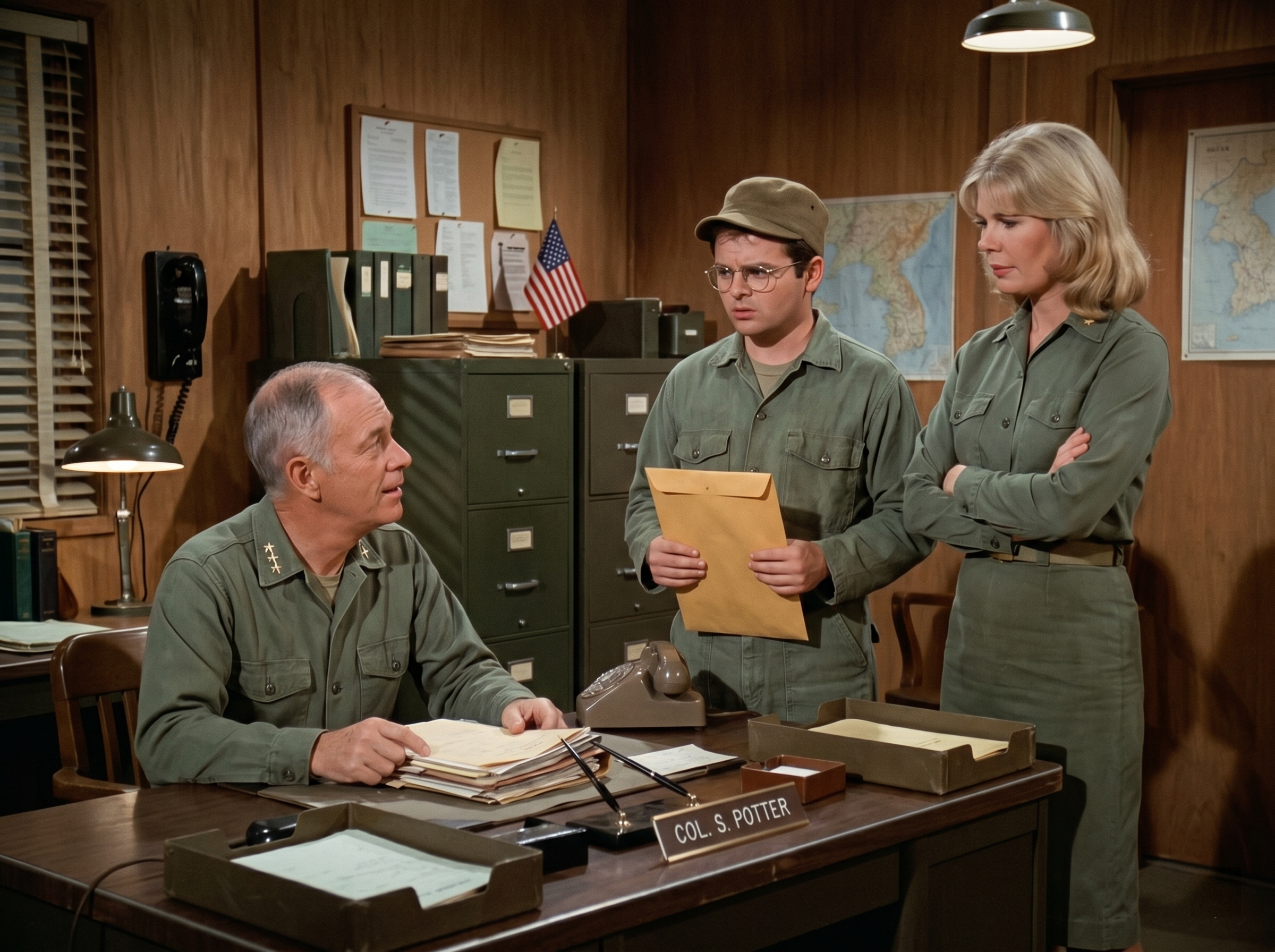
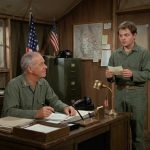
A quiet OR night always felt like a stored-up echo. The 4077th’s compound had a way of collecting silence. But some nights, the quiet in the swamp felt different. This specific Tuesday, that difference landed in Colonel Potter’s office.
Potter sat at his desk, his silver head bent over a stack of medical requisitions. The lamplight fell on papers detailing gauze counts and plasma shortages. He didn’t look up when Radar and Major Houlihan entered, but his jaw clenched slightly. A soldier’s intuition.
Margaret stepped into the office, her arms already crossed over her chest in a gesture that was half-defensive, half-impatient. She was tired. Her exhaustion was etched around her mouth. She didn’t speak, just took her place to Radar’s left, her expression unusually serious, watching the Colonel.
In front of her, Radar stood, clutching a thick, manila envelope against his chest. He looked like he’d been holding his breath since Seoul. His cap was pulled low, his eyes wide behind his glasses, fixed intently on the Colonel.
The envelope wasn’t official. It had no government serial numbers, just a hastily scribbled, familiar address written in pencil. Radar had held it like it was a live grenade. He nudged it forward an inch on the desk.
“Sir,” Radar finally managed, his voice barely more than a whisper. The single syllable hung there, thick with hesitation.
Potter stopped writing. He slowly laid down his pen and looked up, his eyes moving from the stack of papers to the trembling corporal. “Radar? Major Houlihan. Why do you look like you just ate bad powdered eggs?”
“It came in the mail, Colonel,” Radar replied, looking not at Potter, but down at the floor. “From home.” He pushed the envelope another inch toward the ‘Col. S. Potter’ nameplate.
Margaret tightened her arms. “I advised Corporal O’Reilly to bring it immediately, Colonel.” Her voice lacked its usual sharp, command tone.
Potter leaned forward. He saw the penciled writing. His hands, usually so decisive, paused above the object. He could feel the eyes of Margaret and Radar fixed solely on his reaction, both holding their collective breath. He slowly extended his left hand. The silence was louder than a truck convoy.
Potter’s calloused fingers brushed the envelope. He pulled it closer, feeling the unfamiliar, uneven heft of it. He picked up the letter opener, the familiar metal slide sounding unusually loud.
He hesitated again. Then, he sliced the seal.
Inside was another standard brown envelope, unopened, but heavily taped. It had a US return address and was addressed simply to ‘Sherman’.
With a deep breath, Potter tore it open. He didn’t find orders. He didn’t find the news of a transfer. He pulled out a small, tattered photograph and a folded piece of lined paper.
Potter unfolded the paper first. He read it in silence. His expression didn’t change at first. He just blinked, once.
Then, slowly, his eyebrows lifted. His lips thinned, and a dry, quiet sound escaped him—a sound that could have been a sigh or the beginning of a laugh. He looked up at Radar.
“Son,” Potter said, his voice unusually soft. “Is this some kind of joke?”
“No, sir! Swear on my bugle!” Radar exclaimed, finally exhaling and nearly jumping. “It was in the bag, right on top!”
Potter picked up the photograph. He held it so Margaret and Radar could see. It was a faded, grainy snapshot of a young Sherman Potter, in a doughboy uniform, sitting in a messy trench with two other grinning GIs during the *first* World War.
Beneath the picture was an old, folded clipping from a small-town Missouri newspaper, dated 1918.
Potter cleared his throat, reading the note. “This letter… is from my high school history teacher. She’s eighty-nine years old, and she says she was sorting through some old class photos. She wanted to return ‘this particular gem.'”
He tapped the photo. “Look at us. Look at how young we were.” He chuckled, but it was a dry, sentimental sound that seemed to pull air from his lungs. “I had hair. And a belief that we’d finish *this* one in six months.”
The tense atmosphere in the room evaporated instantly. Margaret released her tight grip on her arms, allowing them to fall to her sides. She even smiled, a genuine, quiet look that softened her entirely.
“He looks very dashing, Colonel,” she murmured.
Radar beamed. “We thought… Major Houlihan and me… we thought it was a letter from *your* family. We were worried… you know, after that patient yesterday.”
Potter just stared at the photograph. He traced the face of the young man he barely remembered being. The human, nostalgic moment had eclipsed the medical reports and the war for one minute. The quiet office, image_0.png, felt safe for just that moment.
Finally, Potter set the photo face down on his desk and looked up, his familiar, steady eyes returned. “Major, how are the patients?”
“Stable, Colonel,” Margaret answered quickly, her professional mask slipping back on, but her expression remaining gentle. “Major Pierce and Major Hunnicutt are currently arguing over who has a longer nose hair, so morale is apparently stable as well.”
Potter’s mouth twitched. “God help us.” He picked up his pen. “Dismissed, you two. And Radar—thank your lucky stars that envelope didn’t contain anything else. I would have made you count the sutures by hand.”
“Yes, sir!” Radar grinned, snapping a salute that looked more like an anxious wave.
Margaret followed him out, casting one last look back at the desk. The Colonel had already resumed his work, but his free hand was resting gently on top of the face-down photograph, a quiet anchor in the middle of a very noisy world.
Because sometimes, when you’re freezing and tired and waiting for the next bus, the bravest thing you can do is just remember what it was like to be young.