The Handwriting on the Letter
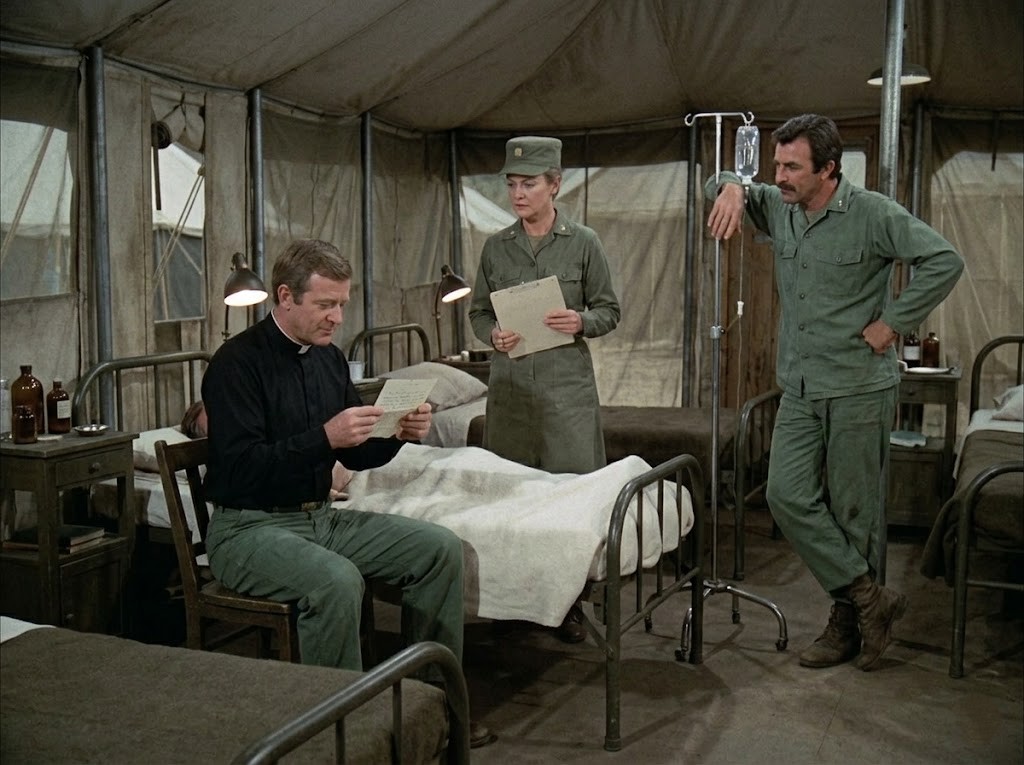
The Swamp had its gin, the Officer’s Club had its cheap scotch, but the post-op tent at three in the morning possessed a very different kind of intoxicating stillness.
It was the hour when the adrenaline of the latest triage finally burned out, leaving nothing but the smell of damp canvas, isopropyl alcohol, and the heavy, collective exhaustion of the 4077th.
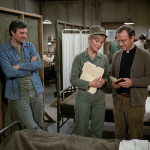
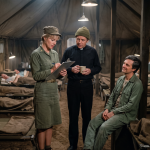
Hawkeye Pierce leaned heavily against a metal IV stand, his shoulders slouched under a faded green fatigue shirt that felt twice as heavy as it had twelve hours ago. His fingers idly tapped the cold iron rod, his eyes fixed on the small cot in the center of the aisle where a young kid from Iowa lay sleeping under a coarse army blanket.
Beside the cot sat Father Mulcahy, looking smaller than usual in his dark clerical collar, his face illuminated by the harsh, yellow glare of a nearby reading lamp.
In his hands, the priest held a single sheet of crumpled stationery, his fingers tracing the edges with a reverence usually reserved for the altar.
Margaret Houlihan stood just a few paces behind them, a clipboard clutched tightly against her chest like a shield, her expression pinned between the strict discipline of a Head Nurse and something deeply vulnerable.
“It’s from his mother,” Mulcahy said softly, his gentle voice barely carrying over the distant, rhythmic hum of the camp’s generator. “The boy was too weak to read it when the mail Jeep arrived, so he asked me to keep it safe until his fever broke.”
Hawkeye shifted his weight, a tired, characteristically dry smirk touching the corner of his mouth, though his eyes remained entirely serious. “If it says anything about the price of corn or how much she misses him at Sunday dinner, Father, you might want to censor it; we don’t need any more tears in here, the humidity is already killing my hair.”
Margaret shot him a sharp, warning glare, but there was no real venom behind it tonight. “Quiet, Pierce. Some things are still sacred, even in this swamp.”
“I’m just saying, Major,” Hawkeye sighed, rubbing the bridge of his nose where his glasses usually dug in. “A little piece of home can be a dangerous thing over here. It reminds you that there’s a world out there where people don’t wear matching green pajamas.”
Mulcahy didn’t look up; he unfolded the paper, the crisp rustle of the page sounding incredibly loud in the quiet tent. “He told me he wanted to hear her voice, Hawkeye. He thought if I read it, it might sound a bit like her.”
The priest cleared his throat, adjusting the paper under the lamp, his brow furrowing as his eyes skimmed the first few lines of the handwritten script.
Suddenly, Mulcahy stopped, his breath catching slightly in his throat, his posture freezing as his eyes locked onto the middle of the page.
Margaret noticed the sudden shift instantly, her professional posture tightening as she took a half-step forward. “Father? Is something wrong with the patient’s family?”
Mulcahy didn’t answer right away, his face turning pale under the yellow lamplight as he stared at the ink, his lips moving silently as if trying to re-read a passage that didn’t make sense.
Hawkeye stepped away from the IV pole, his medical instincts instantly overriding his fatigue as he crossed the floor, his eyes darting from the priest to the sleeping soldier. “Mulcahy, talk to us. Did someone get sick back home? Is it bad news?”
The priest swallowed hard, finally looking up, his eyes shining with a sudden, overwhelming mixture of sorrow and profound awe. “No… no, it’s not bad news, Hawkeye. It’s just… she didn’t write this.”
Margaret frowned, looking down at her clipboard and then back at the letter. “What do you mean she didn’t write it? The boy said it was from his mother.”
“It is from her,” Mulcahy whispered, his voice trembling slightly as he looked at the irregular, shaky loops of the handwriting. “But she didn’t hold the pen. Look at the formatting, the uneven pressure on the paper. This was written by an amanuensis—someone writing on her behalf because her own hands can no longer manage it.”
He looked at the sleeping boy, whose face looked so terribly young against the gray army pillow. “The boy doesn’t know. He left for the front before her illness took her hands. She spent the entire letter talking about the garden, the neighbor’s dog, the upcoming harvest… entirely normal things, written through the hand of a kind neighbor, just so her son wouldn’t worry about her while he was facing down artillery.”
The tent fell into a deep, heavy silence.
Hawkeye looked down at his own mud-stained boots, the witty remark he had been preparing entirely dissolving in his throat. In a place where they spent every day treating the physical wreckage of war, it was easy to forget the quiet, invisible sacrifices being made thousands of miles away in ordinary living rooms.
Margaret closed her eyes for a brief second, a single, controlled breath escaping her nose. When she opened them, the rigid military exterior was completely gone, replaced by the fierce, protective tenderness that made her the backbone of the unit. She reached out, her hand resting gently on Mulcahy’s shoulder for just a moment—a rare, silent gesture of solidarity that spoke volumes.
“Read it, Father,” Margaret said, her voice dropping to a soft, commanding whisper. “Read it exactly the way she would have said it. When he wakes up, he needs to hear his mother, not the war.”
Mulcahy nodded, a small, resilient smile finally breaking through his pale expression. He adjusted his glasses, looked down at the shaky handwriting, and began to read aloud, his voice steadying into a warm, comforting cadence that filled the cold canvas tent.
Hawkeye walked back to the IV stand, leaning his head against the cold metal, listening to the ordinary details of a small-town Iowa life flowing over the sleeping soldier. He caught Margaret’s eye across the cot, and for once, there was no bickering, no rank, and no defense mechanisms—just two tired doctors and a nurse keeping watch over a boy who was, for a few beautiful minutes, safely tucked in at home.
Behind the front lines, the greatest medicine we ever offered was simply reminding them who they were waiting to go home to.