The Postmarked Piece of Peace
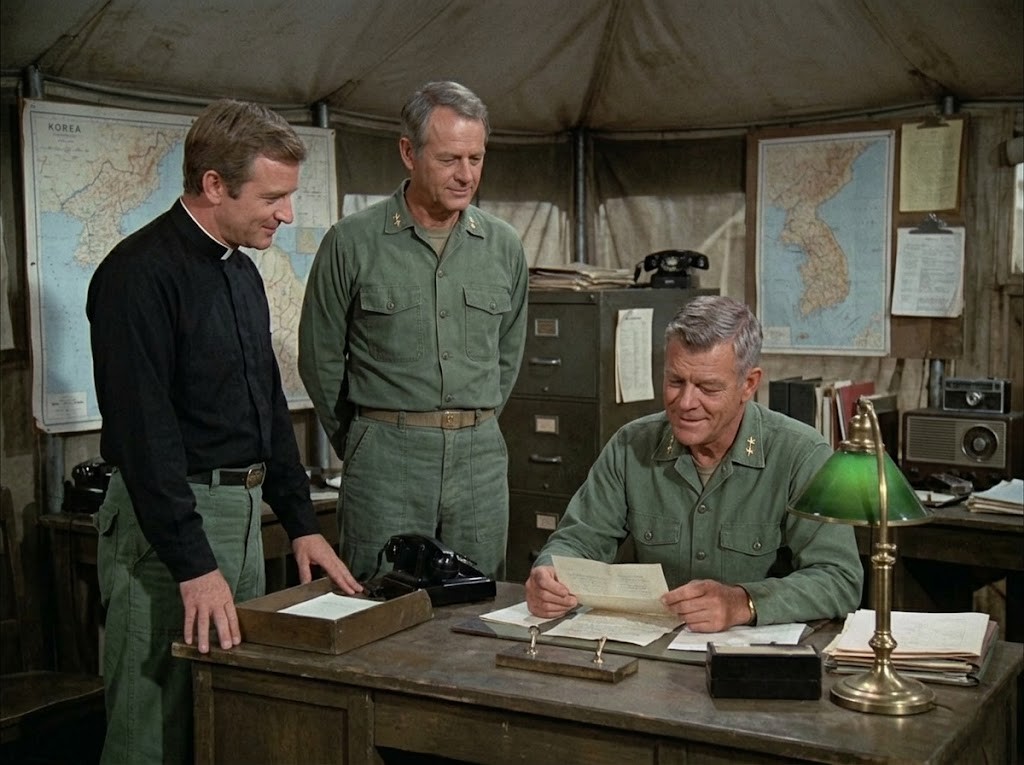
The Korean mud had a way of seeping into everything, including a man’s soul, but inside the swampy green canvas of the commander’s tent, the world occasionally slowed down to a gentle hum.
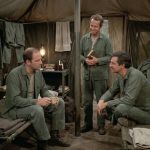
It was a Tuesday afternoon, the kind of quiet day that felt more like a temporary truce with reality than an actual break from the casualties. Outside, the steady drone of a distant generator reminded everyone where they were, but inside, three men stood gathered around a scarred wooden desk, caught in a rare moment of stillness.
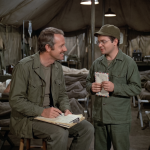
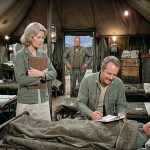
Colonel Potter sat in his worn leather chair, the heavy reading glasses perched on his nose reflecting the soft, warm glow of the green-shaded brass lamp. In his weathered hands, he held a fragile, crinkled piece of white paper—a letter that had traveled thousands of miles across an ocean just to find its way to a coordinates-not-found spot on a map.
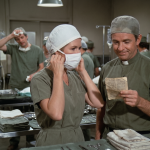
To his right stood Father Mulcahy, his black cassock a sharp contrast to the endless olive drab of the camp, his hands resting gently near a wooden mail tray. To the left, a visiting general stood tall, his hands clasped behind his back, his strict military bearing softening just a fraction as he looked down at the old horse soldier behind the desk.
“Well, I’ll be a blue-nosed mule,” Colonel Potter muttered, his voice a low, gravelly rumble that instantly commanded the room without ever needing to rise above a whisper.
Father Mulcahy leaned in slightly, a warm, soft smile gracing his gentle features as he watched the Colonel’s eyes track across the handwritten lines. “Good news from Missouri, I trust, Colonel?” the priest asked, his tone carrying that familiar, quiet comfort that had anchored so many boys through their darkest nights.
Potter didn’t answer right away; he simply let out a long, slow breath that seemed to carry days of built-up exhaustion out into the humid air of the tent. His thumb traced the edge of the paper, his rough skin catching on the frayed fiber of the stationary.
The general beside him shifted his weight, his eyes fixed on the document with a quiet respect that only old veterans truly understood. “Is it from Mildred, Sherman?” the general asked quietly, using the rare privilege of an old friend’s first name inside the walls of a command post.
Potter’s face softened, the deep lines around his eyes crinkling into a look of pure, unadulterated fondness that he usually kept hidden behind a fierce military discipline. “It’s from Mildred, alright, but she didn’t write it,” Potter said, a mysterious, half-amused grin tugging at the corner of his mouth.
He looked up at the two men, his eyes twinkling under the dim tent light, holding the letter up as if it were a fragile piece of fine crystal. “My granddaughter, Corey, wrote this… or rather, she dictated it to her grandmother, seeing as she’s only just mastering the art of the alphabet.”
Father Mulcahy’s smile widened, his heart instantly warming at the thought of a child’s innocent voice cutting through the heavy fog of a war zone. “Oh, how marvelous. What does the little darling have to say to her grandfather?”
Colonel Potter cleared his throat, adjusting his glasses as he looked back down at the page, his tough exterior melting away into the gentle grandpa he so desperately missed being. “She says she’s been looking after my old hunting hound, Buster, and that she gives him a biscuit every night before bed so he won’t forget my smell.”
The general let out a dry, nostalgic chuckle, his shoulders dropping an inch as the memory of his own home state seemed to flash behind his eyes. “A dog’s memory is a long one, Sherman. He won’t forget.”
“That’s not all,” Potter continued, his voice dropping an octave as his eyes hit the middle paragraph of the letter, his thumb tightening slightly against the paper. “She says she went to the county fair with Mildred last week, and they sat on the bleachers watching the horses.”
The tent fell completely silent, save for the ticking of a small wind-up clock on the filing cabinet behind them and the faint, rhythmic scratching of cicadas outside the canvas walls.
Father Mulcahy noticed the sudden shift in the old man’s demeanor, the way the Colonel’s eyes seemed to fixate on one particular sentence, freezing completely. The warmth in Potter’s face didn’t vanish, but it was suddenly joined by a deep, aching vulnerability that made the gentle priest hold his breath.
“Colonel?” Mulcahy asked softly, stepping a fraction closer to the desk, his hand hovering instinctively as if to offer a silent prayer of support.
Potter looked up, but his eyes weren’t seeing the green canvas, the olive drab filing cabinets, or the maps of the Korean peninsula pinned to the wall behind him. His eyes were swimming with a sudden, heavy moisture that he fiercely tried to blink away, his lips parting but no words coming out.
The general frowned slightly in deep concern, leaning over the desk as he saw a single, heavy teardrop escape the Colonel’s eye and hit the wooden desktop with a soft, distinct patter. “Sherman, what is it? Is something wrong at home?”
“””
The question hung in the warm, stagnant air of the tent, heavy and fragile all at once, as the two men waited for the steady anchor of the 4077th to find his voice.
Colonel Potter took a slow, deliberate breath, swallowing hard as he looked from the general back to Father Mulcahy, his hand trembling just enough to make the paper rustle. “No,” Potter whispered, his voice cracking slightly before he caught it. “No, nothing is wrong. In fact, everything is exactly right.”
He tapped the crinkled page with his index finger, a watery smile finally breaking through his stoic composure like sun breaking through a storm cloud. “Mildred appended a note at the very bottom here… she says Corey insisted on writing her own name at the end, completely unassisted.”
Father Mulcahy let out the breath he had been holding, his face illuminating with pure, empathetic joy. “An independent young lady, just like her grandmother, I imagine.”
“Worse,” Potter chuckled softly, wiping his eyes with the back of his hand in a quick, dismissive motion. “She’s just like me. Stubborn as an army mule and twice as determined to have the last word.”
The general laughed, a hearty, genuine sound that seemed to chase away the lingering ghosts of the morning’s triage. “God help the state of Missouri when that girl grows up, Sherman. She’ll be running the whole county before she’s twenty.”
“She drew a picture at the bottom,” Potter said, turning the paper around so the two men could see the crude, crayon-drawn stick figures scrawled in the margin. “That’s supposed to be me, standing next to Sophie, out in the pasture back home.”
Father Mulcahy leaned down, studying the frantic, colorful scribbles with the kind of intense reverence usually reserved for holy relics. “It’s beautiful, Colonel. Truly. Look at the spirit in those lines.”
“Spirit is one word for it,” Potter grinned, his fingers gently folding the letter back along its original creases with a care that bordered on religious devotion. “Looks more like a pair of intoxicated spiders got into a bottle of ink, but I wouldn’t trade it for a genuine Rembrandt.”
The priest straightened up, his hands folding back over his cassock, his heart full as he looked at the old soldier who spent every waking hour carrying the weight of hundreds of young lives on his shoulders. “It is a reminder, isn’t it? A reminder of what we are all standing in this mud for.”
“A piece of peace,” the general agreed quietly, his eyes drifting to the large map of Korea hanging on the wall, its black lines marking troop movements and battle lines that suddenly felt incredibly small compared to a child’s crayon drawing. “Sometimes we forget what the world looks like without a uniform on it.”
Potter slipped the letter into the top drawer of his desk, sliding it right next to his extra pair of spectacles and a small, faded photograph of Mildred taken on their wedding day. “I don’t forget,” Potter said softly, his voice steadying into that calm, fatherly tone that kept the camp from spinning off its axis. “I just have to tuck it away sometimes so I can get the job done.”
Just then, the screen door of the tent banged open, and the unmistakable sound of Hawkeye Pierce’s cynical laugh drifted inside from the compound, followed by the dry, deadpan reply of B.J. Hunnicutt arguing over the remaining supply of powdered eggs.
The general shook his head, a faint grin on his face as the chaotic reality of the 4077th rushed back in to claim them. “Sounds like your children are getting restless out there, Colonel.”
Potter stood up, smoothing down the front of his olive-drab shirt, the temporary crack in his armor sealed away, leaving behind the unbreakable commander his people needed. “They’re a handful, General. A loud, stubborn, insubordinate handful… but they’re good kids. Every last one of ’em.”
He looked at Father Mulcahy, exchanging a silent look of profound understanding that needed no words—a shared recognition of the grace that had just visited their small, canvas world. “Thank you for delivering the mail, Father. You’ve done a finer job today than any courier the Pentagon ever put on a jeep.”
“It is always an honor to be the bearer of good tidings, Colonel,” Mulcahy said, offering a small, humble bow of his head before turning to exit the tent, his heart light.
The general walked to the door, pausing with his hand on the canvas flap, looking back at Potter who was already reaching for a stack of official supply requisitions. “Give Mildred my love when you write back, Sherman. And tell that granddaughter of yours to keep practicing her drawing.”
“Will do, old friend,” Potter smiled, the green lamp casting a long, protective shadow across the desk as he pulled his chair back in.
As the tent flap closed and the routine noise of the camp swallowed the silence once more, the old Colonel reached down, tapped the drawer where the letter rested, and smiled to himself, ready for whatever the war threw at him next.
Because sometimes, a few scribbled lines from home are the only armor a good man needs to survive the front lines.