The Weight of the Mail and the Warmth of a Mug
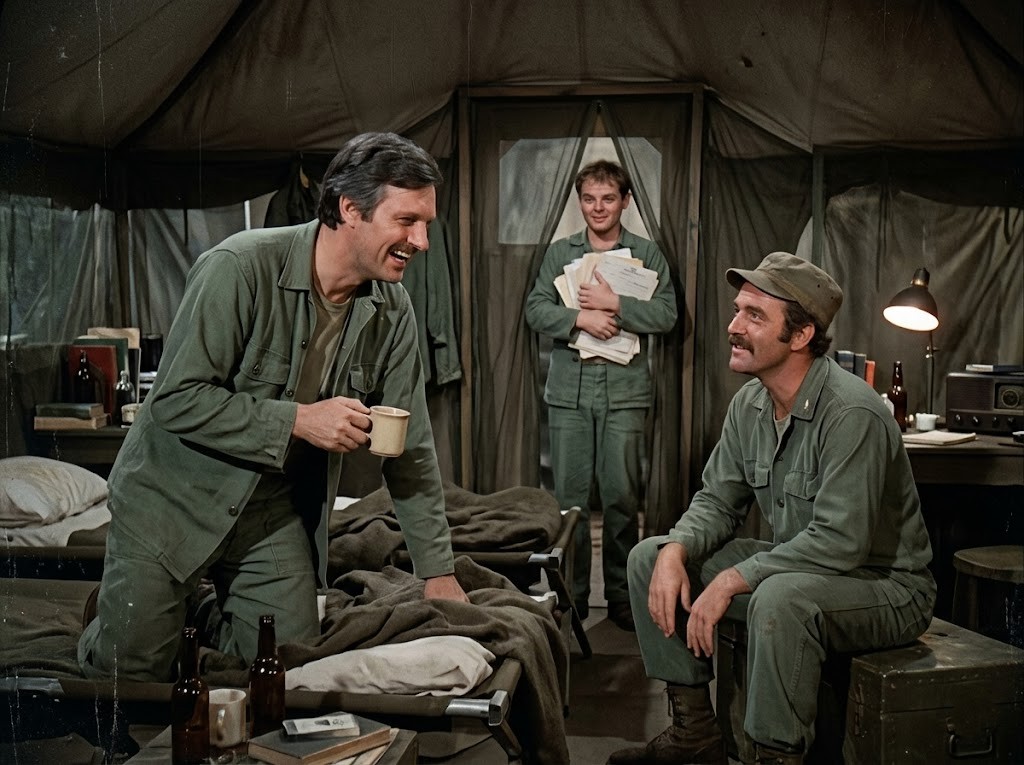
The Swamp always smelled of three things: damp canvas, cheap gin, and the heavy, lingering exhaustion of three shifts in Post-Op.
Some days, the fatigue was so thick you could almost see it hanging in the air, right alongside the smoke from Hawkeye’s stolen cigarettes. But tonight, the air was light, cut through by the sharp, sudden sound of a genuine laugh.
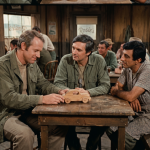
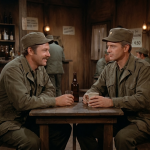
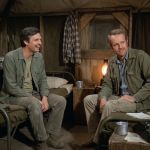
Hawkeye Pierce was leaning over his cot, his long frame bent in a posture of rare, unburdened amusement. In his hand, he held a chipped ceramic mug of lukewarm coffee, his fingers wrapped around it as if it were the only anchor left in Korea. His face, usually lined with the tension of the OR, was bright, his eyes crinkled with a smile that reached all the way to his tired soul.
Across from him, perched on a wooden footlocker, B.J. Hunnicutt smiled back, his mustache twitching with a quiet, grounded warmth. B.J. sat with the easy grace of a man who carried his home in his heart, his dusty combat boots planted firmly on the floorboards. He was listening, really listening, providing the steady counterweight to Hawkeye’s manic energy.
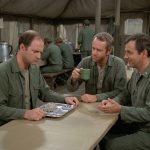
Between them, standing just inside the tent flap, was Radar O’Reilly.
Radar wasn’t laughing; he was looking down at a massive, precariously stacked pile of official-looking documents, letters, and requisitions cradled tightly in his arms. He looked like an earnest, green-clad statue, frozen in the doorway, his eyes wide behind his spectacles as he watched his two superior officers share a moment of pure, uninterrupted humanity.
“I’m telling you, Beej, it’s a medical miracle,” Hawkeye chuckled, gesturing wildly with his free hand, nearly spilling his coffee onto the olive-drab blankets. “The man managed to lose an entire shipment of tongue depressors, but somehow, we just received three crates of left-handed surgical gloves. Do they think we only operate on people from the left side?”
B.J. let out a soft snort, shaking his head. “Maybe they’re planning a very specific offensive, Hawk. Or maybe the supply clerk in Seoul just really hates righties.”
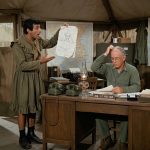
“It’s not funny, sirs,” Radar chimed in, his voice a nervous, high-pitched squeak that broke through their banter. He shifted the heavy stack of papers in his arms, his knuckles white from the strain. “Colonel Potter wants these signed right away. He says if the monthly reports are late one more time, General Hammond is going to personally come down here and turn the 4077th into a laundry unit.”
Hawkeye took a slow, deliberate sip from his mug, his eyes twinkling. “A laundry unit, Radar? Think of the benefits. No more blood, no more shrapnel, just the clean, comforting scent of starch and industrial soap. I might actually get to wear trousers without an expiration date.”
“Sir, please,” Radar pleaded, his chest heaving slightly under the weight of the files. “The Colonel is already on a tirade about the requisition forms for the generator parts. And… and there’s something else in this pile.”
The tone in Radar’s voice shifted, just enough to make B.J.’s smile fade slightly. The young corporal wasn’t just tired from carrying the paperwork; there was a familiar, heavy tightness in his throat that usually only appeared when the helicopters were coming in.
Hawkeye lowered his mug, his laughter dying down into a quiet, observant silence. He looked at the kid standing in the doorway, seeing past the uniform to the boy from Iowa who shouldn’t have to carry the weight of a war in his arms.
“What is it, Radar?” B.J. asked, his voice gentle, his steady gaze fixing on the young clerk.
Radar swallowed hard, his eyes darting between the two doctors. He loosened his grip on the top layer of papers, revealing a small, crumpled envelope tucked deep inside the official army documents—an envelope with a red, white, and blue border, postmarked from Peg’s hometown in California, but addressed to someone else entirely.
The silence in the Swamp deepened, replacing the easy humor of a moment before with the sudden, sharp ache of reality.
Hawkeye set his mug down on a nearby crate, his movements slow and deliberate. He stood up from his cot, his joints popping from the hours spent hunched over a surgical table. He walked over to Radar, his steps soft on the wooden floor.
“Is that from home, son?” Hawkeye asked, his voice losing its sarcastic edge, replaced by the deep, resonant kindness he usually reserved for patients in the recovery ward.
“It’s for Private Henderson,” Radar whispered, looking down at the letter. “The boy in bed three. He’s been asking for it every mail call for three weeks. It came in the pouch with the supply manifests. I… I didn’t want to just leave it in his chart. I thought maybe one of you should give it to him.”
B.J. stood up from the footlocker, his face softening with a profound, paternal understanding. He knew what it was like to live and die by the mail. He knew the agonizing torture of waiting for a scrap of paper that proved the world outside of Korea still existed, that the people you loved were still breathing the air of a peaceful sky.
“Henderson,” B.J. murmured, looking out the tent door toward Post-Op. “He had the abdominal wound from the mortar attack on Tuesday. He’s a tough kid, but he’s been fading today. His spirit’s dragging.”
“The letter’s from his wife,” Radar said, his voice trembling slightly. “It says ‘Return to Sender’ on the back, sirs. But then somebody scratched it out and wrote ‘Forward to 4077th.’ It’s been all over the Pacific.”
Hawkeye gently took the letter from the top of Radar’s pile. His fingers ran over the wrinkled paper, feeling the miles it had traveled, the grease smudges from a dozen postal clerks, and the faint, unmistakable scent of inexpensive dime-store perfume that still clung to the corners.
“Look at this,” Hawkeye said, holding it up so B.J. could see. “It traveled thousands of miles through a global bureaucracy just to find a foxhole in the mud. You see, Beej? There is a god, and he works for the US Postal Service.”
“Or maybe he just took pity on a kid from Ohio,” B.J. replied, a small, tender smile returning to his face. He walked over and clapped a hand on Radar’s shoulder. “Good catch, Radar. You’re a terrible clerk, but you’re a magnificent human being.”
“Thank you, sir,” Radar said, his cheeks flushing pink as he blinked back a sudden wave of emotion. He felt the tension leave his shoulders, the heavy stack of army regulations suddenly feeling much lighter.
Hawkeye turned toward the tent exit, the letter held securely in his hand. The laughter from before was gone, but it had been replaced by something better—a sense of purpose that didn’t involve a scalpel or a bone saw. It was the simple, quiet duty of bringing a piece of home to a boy who was running out of time.
“Come on, Beej,” Hawkeye said, gesturing toward the door with the envelope. “Let’s go play mailman. Radar, tell the Colonel we’ll sign his life away just as soon as we deliver some sanity to bed three.”
“Yes, sir,” Radar said, stepping aside to let them pass.
As Hawkeye and B.J. stepped out into the chilly Korean twilight, the camp was quiet. The generators hummed in the distance, a steady, mechanical heartbeat against the backdrop of the dark mountains. They walked side by side, two men in faded green uniforms, carrying a fragile piece of paper that held more power than all the artillery on the front lines.
Inside the Swamp, the half-empty mug of coffee sat on the crate, still radiating a faint, fading warmth into the empty room.
Behind the jokes and the weariness of the 4077th, it was the small, quiet acts of love that kept the winter from freezing their hearts completely.