A Quiet Afternoon in the Commanding Officer’s Office
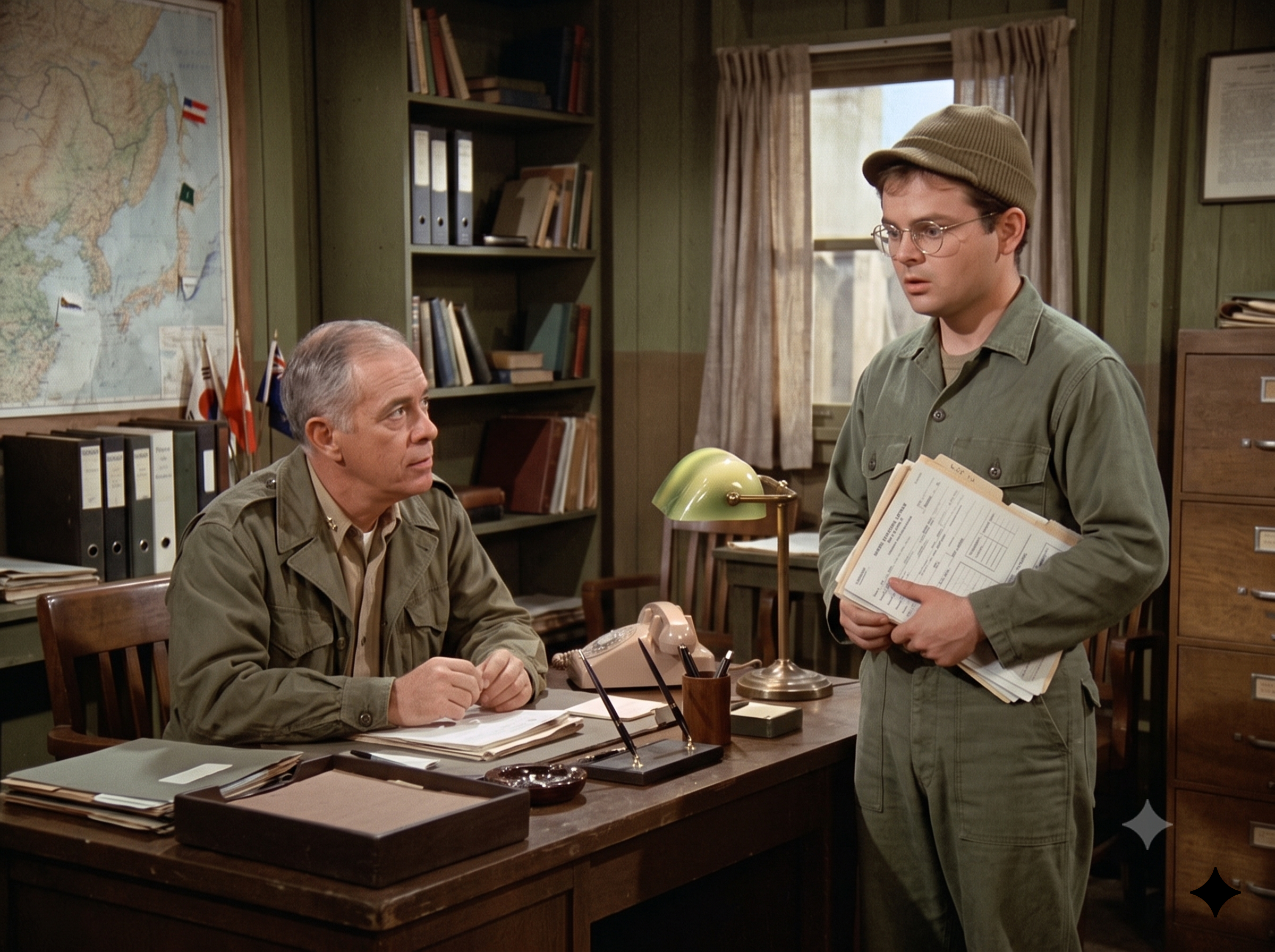
The 4077th Mobile Army Surgical Hospital had two distinct speeds: total, blood-soaked chaos, and a slow, agonizingly quiet waiting game.
Today was the latter. The choppers were grounded by a distant fog bank, and the camp had settled into a rare, lazy afternoon lull. The only sounds in the compound were the persistent, dull hum of the diesel generator and the occasional shout from a volleyball game in the distance.
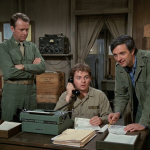
Inside the Commanding Officer’s quarters, the air was warm and smelled faintly of old paper, canvas, and stale cigar smoke. The afternoon light filtered through the dusty window, catching small motes of dust dancing in the air.
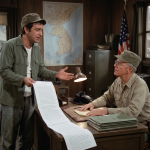
Colonel Sherman T. Potter sat behind his modest wooden desk, his shoulders heavy with the familiar weight of command. He wore his standard olive drab fatigues, the collar open, looking every bit the weary, seasoned cavalryman he was. He was trying to focus on a complex supply requisition form, but his mind kept drifting to a half-finished oil painting waiting in his tent.
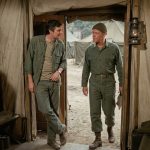
Then, the wooden door to his office slowly creaked open.
It wasn’t a sudden, frantic burst of energy, which usually meant Hawkeye and B.J. had concocted a new scheme, or that Margaret was on the warpath. It was a slow, incredibly hesitant movement.
Corporal Walter “Radar” O’Reilly stood in the doorway. He looked much smaller than usual.
Radar wore his familiar knit cap pulled down just above his wire-rimmed glasses, his uniform practical and lived-in. In his hands, he clutched a massive stack of manila folders, holding them tight against his chest as if they were a shield protecting him from sniper fire.
Potter looked up from his paperwork. His weary, wise eyes instantly locked onto the boy’s nervous demeanor.
“Come on in, son,” Potter said softly, leaning forward slightly into the warm circle of light cast by his green desk lamp. “Don’t let the draft out.”
Radar took a few timid steps forward, his heavy boots scuffing softly against the wooden floorboards. He didn’t speak right away. He simply stood at polite attention across the desk, looking down at his commanding officer with wide, innocent, and deeply worried eyes.
Potter set his pen down beside his rotary phone. He knew his clerk better than anyone in camp. When Radar was bustling, things were fine. When Radar was perfectly still, something was terribly wrong.
“Spit it out, Radar,” Potter said, keeping his voice dry but gentle. “You look like you just accidentally swallowed a live grenade. What’s the matter?”
Radar swallowed hard, his Adam’s apple bobbing. “It’s, um… well, sir. It’s the afternoon mail drop.”
“And?” Potter prompted, raising a gray eyebrow. “Did they run out of grape Nehi in Seoul again? Did Klinger’s mail-order evening gown get lost in transit?”
“No, sir,” Radar whispered, his knuckles turning white as he gripped the edges of the folders. “There’s a letter for you. From the States.”
Radar carefully slid one single, slightly crumpled envelope from the bottom of his stack. He placed it delicately on the edge of the wooden desk, as if it might explode.
Potter’s gaze dropped to the envelope. It had an official Department of the Army seal. It was from a stateside military hospital.
And heavily stamped across the front, in bold, terrifying red ink, were the words: URGENT MEDICAL NOTIFICATION.
Potter felt the blood drain from his face. His heart skipped a painful beat in his chest. Mildred. His daughter. His grandchild.
The silence in the small wooden office suddenly grew deafening.
The stillness in the room was heavy enough to crush a man.
Colonel Potter stared at the envelope, his hands resting flat on the desk. He couldn’t bring himself to reach for it just yet. He had seen enough official telegrams and emergency notifications in two world wars to know that good news rarely arrived in bright red ink.
Across the desk, Radar stood completely frozen.
The young corporal didn’t retreat to the safety of the outer office. He didn’t look away to give the Colonel privacy. He just stood there, his eyes wide with a terrible, empathetic fear. Radar was offering a silent, steady, emotional anchor for the man he looked up to like a father.
“Who is it from, son?” Potter asked. His voice was surprisingly steady, despite the sudden, icy chill blooming in his chest.
“I… I didn’t open it, Colonel,” Radar stammered, his voice trembling slightly. “But the return address says Letterman General Hospital in San Francisco.”
Potter slowly reached out. He picked up the envelope, the paper feeling thin and fragile between his weathered, surgeon’s fingers.
He found his silver letter opener, slid it carefully under the flap, and pulled out a single, typed sheet of military stationary.
Radar visibly braced himself. The boy’s shoulders hiked up toward his ears, waiting for the devastating blow to strike his commander.
Potter unfolded the paper. He adjusted his glasses on the bridge of his nose. He read the first line.
Then, he read the second.
A deep, shuddering breath escaped the Colonel’s chest. The rigid, terrified lines of his face suddenly softened, melting away into profound relief.
He closed his eyes for a brief moment, letting his chin drop toward his chest. When he looked back up, a slow, genuine smile was spreading across his tired features.
“Well, I’ll be double-damned,” Potter whispered.
Radar leaned forward, unable to contain his unbearable anxiety any longer. “Sir? Is it… is it Mrs. Potter? Is she okay?”
Potter opened his eyes and looked at the terrified clerk.
“Mildred is perfectly fine, Radar,” Potter said, his voice rich and heavy with relief. “This isn’t about my family at all.”
Radar blinked rapidly behind his round glasses. “It isn’t?”
“No,” Potter chuckled, tapping the crisp paper with his index finger. “It’s from Dr. Robert Harris at Letterman.”
Radar tilted his head, his brow furrowing in confusion. “Dr. Harris? Who’s that, sir?”
“He’s an old cavalry buddy of mine,” Potter explained. He leaned back in his wooden chair, the springs groaning in protest, and ran a hand over his thinning gray hair.
“We served together in France back in the big one. For the last six months, Bob has been battling a nasty, stubborn case of pneumonia. It was touch and go for a long while. He’s an old mule, but I was worried.”
Potter looked back down at the letter, his eyes shining with a quiet, profound joy in the warm light of the desk lamp.
“This ‘Urgent Notification’ is his dramatic way of letting me know he’s finally been discharged. He beat it, Radar. He’s going home to his wife.”
Radar’s entire posture instantly deflated like a punctured tire.
The massive stack of manila folders slipped dangerously in his grasp. He had to juggle them frantically against his chest to keep the camp’s paperwork from spilling all across the dusty floor.
“Oh, wow,” Radar breathed out, a loud, nervous laugh escaping his lips. “Geez, Colonel. That’s… that’s really swell.”
“Swell indeed, Corporal,” Potter agreed.
He finally noticed the sheer, lingering panic still fading from Radar’s round, youthful face. Potter’s smile softened into something incredibly fond.
He realized in that quiet moment that Radar hadn’t just been acting as a mailman. The boy had seen a scary-looking envelope from a hospital, assumed the absolute worst, and bravely brought it into the office in person so his commanding officer wouldn’t have to face the tragedy alone.
In a war that constantly took things away, this unassuming young kid from Iowa was always trying to hold things together for the people he loved.
“You gave me a bit of a scare there, son,” Potter said gently, leaning forward on his elbows.
“I’m sorry, sir,” Radar apologized, looking down at his boots in embarrassment. “I just saw the red ink and the hospital name and… well, I guess I got pretty scared too.”
“There is absolutely no need to apologize, Walter,” Potter said warmly. He used the boy’s given name—a rare gesture of deep affection and respect.
“I appreciate you standing by. It takes a good, strong man to stand in the room when the bad news comes knocking.”
Radar looked up, a small, proud smile touching the corners of his mouth. “Anytime, sir. I mean… I hope the bad news never knocks again. But if it does, I’m here.”
“I know,” Potter nodded slowly. “I know.”
The heavy, crushing tension in the office had completely evaporated. It was replaced by the familiar, comforting warmth of the 4077th’s strange, beautiful makeshift family. The hum of the camp generator outside seemed a little less grating, and the war felt just a little further away.
“Now,” Potter said, returning to his usual brisk, professional tone. He pointed his pen at the massive stack of paperwork in Radar’s arms.
“Tell me you have some actual good news in that pile, too. Did we finally get those size ten boots for Klinger, or does he have to wear those red pumps through the mud?”
Radar snapped right back into his role as the camp’s most capable clerk, his voice rising back to its usual pitch.
“No, sir on the boots. But I did manage to trade three cases of our creamed corn to the 8063rd for a gross of surgical tape, two bottles of real scotch for the swamp, and a brand new fan belt for your jeep.”
Potter laughed out loud, a rich, booming sound. “Horse trading. You’d have made a damn fine quartermaster in the old cavalry, Radar.”
“Thank you, sir,” Radar beamed proudly. He stepped forward to set the first requisition folder on the desk.
Potter signed the paperwork without even reading it, trusting the boy entirely. As Radar turned to leave, moving with his usual quick, bustling step, Potter called out one last time.
“And Radar?”
The clerk paused at the open door, looking back over his shoulder. “Yes, Colonel?”
“Take an extra ten minutes on your break today,” Potter smiled warmly. “Go get yourself a grape Nehi. Put it on my tab.”
Radar’s smile widened, pure and bright against the grim reality of the war waiting just outside their door.
“Wow! Thanks, Colonel!”
As the wooden door clicked shut, Potter sat alone in his office once more. He looked at the letter from his old friend, then at the meticulously organized requisition forms Radar had left behind on his desk. He let out a long, contented sigh, picking up his pen, feeling incredibly lucky to be precisely where he was.
In a place surrounded by so much pain, the greatest medicine they ever had was simply each other.