The Toledo Illusion
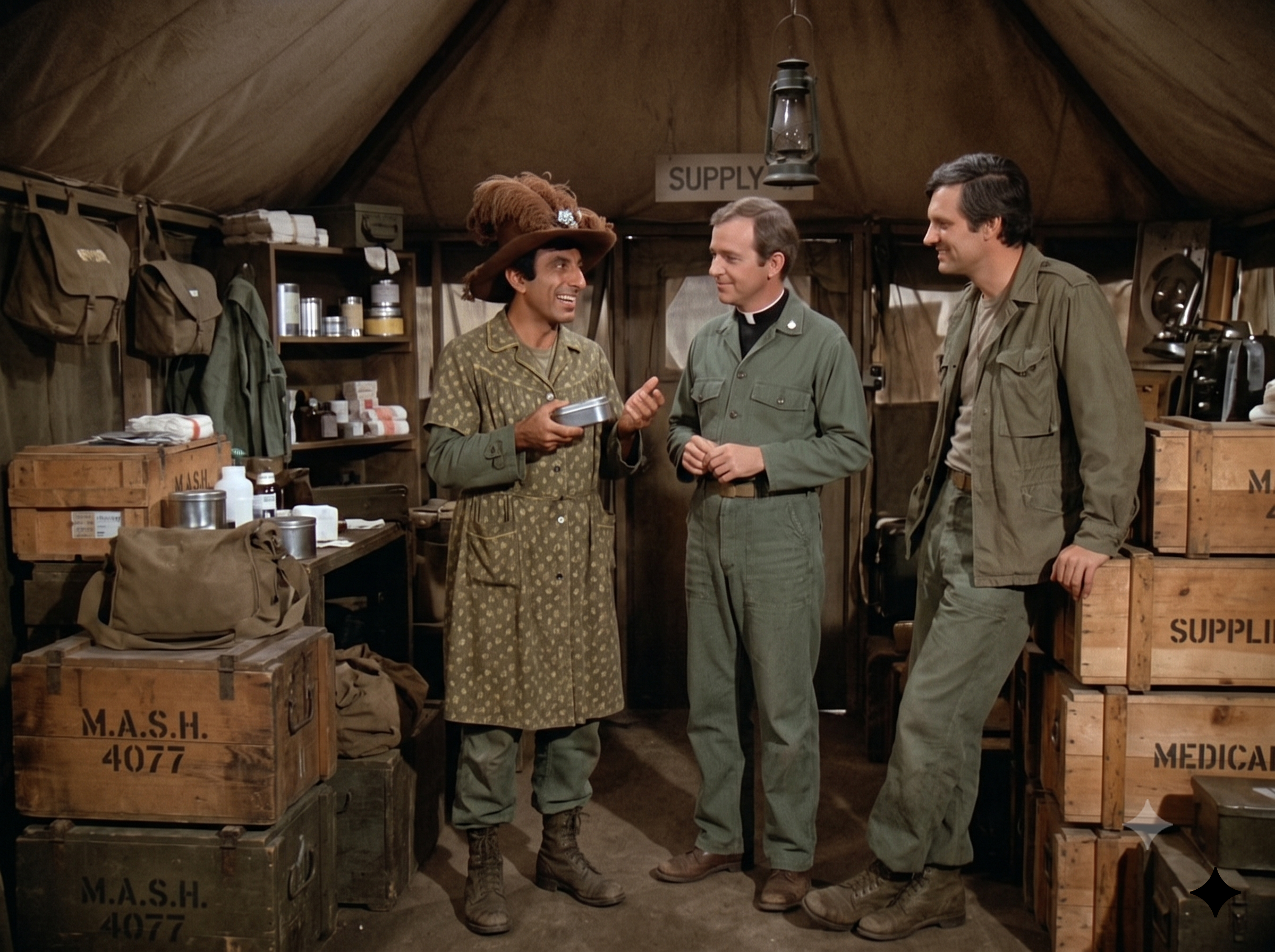
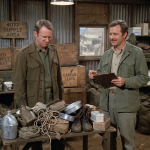
The Supply tent of the 4077th Mobile Army Surgical Hospital was a sanctuary of organized, dusty chaos. It smelled permanently of rough canvas, pine wood, dried mud, and a faint, lingering trace of iodine.
Shadows stretched long across the dirt floor, cast by the soft, warm glow of a single camp lantern swinging gently overhead.
Captain B.J. Hunnicutt was currently using this clutter as a tactical hideout. He leaned comfortably against a towering stack of wooden crates boldly stamped with “M.A.S.H. 4077” and “MEDICAL SUPPLIES.”
B.J. was running on three hours of sleep and a dozen cups of motor-oil coffee. He had retreated to the quiet of Supply just to escape the relentless noise of the compound. His posture was relaxed, his hands resting casually at his sides, and a calm, knowing smile played across his face.
Standing nearby was Father Francis Mulcahy. The chaplain had wandered in looking for extra writing paper for the post-op patients, bringing his usual quiet grace into the drab room.
Dressed in his standard green fatigues with his white clerical collar peeking out, Mulcahy stood with his hands politely folded. He looked incredibly patient, observing the room with a soft smile and a look of gentle, mild confusion.
The cause of Mulcahy’s confusion, and B.J.’s amusement, was standing right in front of them.
Corporal Maxwell Klinger held center stage, striking a theatrical posture that demanded full attention. In a camp drowning in olive drab, Klinger was a beacon of eccentric, defiant color.
He was dressed in a faded, olive-and-yellow floral duster coat that looked like it had been repurposed from a grandmother’s curtains. It was worn over his standard military undershirt.
But the true masterpiece was perched on his head. It was an enormous, wide-brimmed brown hat, adorned with massive, sweeping ostrich feathers that threatened to hit the low canvas ceiling every time he moved.
Muddy, practical combat boots anchored the ridiculous outfit firmly to the Korean dirt. It was a perfectly lived-in, period-appropriate masterpiece of rebellion.
“Gentlemen,” Klinger announced, his voice hushed with sly, expressive hope. “You are looking at the turning point of the Korean War.”
B.J. didn’t move from his crate. “Did they sign a truce, Max, or did you just find a matching pair of pumps for that hat?”
Klinger ignored the dry punchline. He held up his hands, cradling a small, rectangular silver tin. He treated the little metal box as if it contained the crown jewels.
“Right here, in my very hands, is my golden ticket,” Klinger whispered reverently. “The grand illusion that will finally prove, beyond a shadow of a doubt, that my mind has completely snapped its moorings.”
Father Mulcahy tilted his head, his smile never wavering. “I must admit, Maxwell, the hat alone makes a rather compelling argument. But what exactly is in the box?”
Klinger tapped the lid of the silver tin with a dramatic flourish. “I traded two pairs of pristine silk stockings and a slightly used bottle of Winchester’s aftershave for this, Father. It was smuggled in from Seoul, passed through the hands of three different black-market generals.”
He looked back and forth between the doctor and the priest. The theatricality was heavy, but beneath it, there was that familiar, frantic exhaustion. Klinger just wanted to go home.
“When Colonel Potter sees what I am about to do with the contents of this tin,” Klinger declared, placing his thumb on the lid, “he will have no choice but to stamp my Section 8 and put me on the first plane to Ohio.”
Klinger popped the lid of the small silver tin with a sharp, metallic click.
B.J. pushed off the crate just a fraction, leaning forward to peer inside. Mulcahy stepped a half-pace closer, his hands still politely clasped together.
Inside the prized metal box sat a small, irregularly shaped, incredibly dark lump. It looked less like a ticket to freedom and more like a piece of petrified wood.
“Is it a meteorite?” B.J. asked mildly, his calm smile remaining firmly in place. “Because if you’re claiming to be a spaceman, Klinger, Radar already has the comic books to prove he thought of it first.”
Klinger sighed, a heavy, dramatic exhalation that caused the giant feathers on his hat to flutter in the stagnant tent air.
“No, Captain,” Klinger said. “It is not a meteorite.”
Mulcahy leaned down slightly, squinting at the object. “It looks remarkably like a piece of charcoal, Maxwell. Are you planning to eat it to prove your insanity?”
Klinger looked down at the tin. For just a second, the theatrical posture faded. His shoulders dropped slightly beneath the heavy floral fabric of his coat.
“It’s a stuffed grape leaf, Father,” Klinger said quietly. “A genuine, homemade, Toledo-crafted dolma. Straight from my mother’s kitchen.”
B.J. raised an eyebrow, his eyes crinkling at the corners. “Max, if that’s a grape leaf, it must have come from a vineyard in the Jurassic period. The thing is entirely fossilized.”
Klinger nodded, staring at the little dark lump with a strange mix of pride and heartbreak. “It took four and a half months to get here. The mail boat must have taken a scenic detour through the Sahara Desert.”
He looked back up, the sly hope returning to his eyes, though it was softer now, tinged with genuine homesickness.
“Don’t you see the genius of it, Captain?” Klinger asked, gesturing expansively with his free hand. “I march into Colonel Potter’s office. I look him dead in the eye, and I chew on this petrified rock until my teeth crack.”
He held the tin up higher. “Anyone who willingly eats a four-month-old, rock-hard grape leaf in front of a commanding officer has to be certifiably insane!”
B.J. let out a low, warm chuckle. He saw right through the elaborate act. Klinger wasn’t holding a prop for a psychiatric discharge; he was holding a piece of home.
“It’s a bold strategy, Klinger,” B.J. said gently, offering his dry, steady support. “But I think the Colonel might just refer you to Major Winchester’s dentist friend in Tokyo instead of the psychiatrist. And we both know Charles would never let you live that down.”
Mulcahy watched Klinger closely. The chaplain saw the way Klinger’s thumb was now gently, unconsciously brushing the smooth edge of the silver tin.
“It was very kind of your mother to send it, Maxwell,” Mulcahy said, his voice carrying that familiar, gentle grace. “She must miss her son terribly to go to such lengths.”
The supply tent went quiet for a long moment. The distant, heavy sound of a supply truck grinding its gears out in the compound drifted through the canvas walls, a harsh reminder of exactly where they were.
Klinger closed the tin with a soft snap. He held it in both hands, resting it against his chest.
“She packed it in olive oil,” Klinger muttered, breaking the silence. “The oil leaked out somewhere over the Pacific Ocean. Ruined a half-dozen letters and a photograph. But the tin survived.”
He looked at the two officers. In the soft, faded camp light, the feathered hat looked a little less absurd. It just looked like a man trying desperately to hold onto his own identity in a place that tried to turn everything into identical shades of green.
“I can smell the garlic when I open it,” Klinger admitted, his voice dropping its usual boisterous volume. “Just for a second. Right before the smell of the canvas and the iodine takes over again.”
B.J. pushed fully off the wooden crate. He walked over and stood beside the corporal, his presence a simple, grounding comfort.
“Don’t eat it, Max,” B.J. said warmly. “Keep it. It’s too valuable to waste on a stunt that Potter will just see right through anyway.”
“I agree,” Mulcahy suggested mildly, a soft, understanding smile on his face. “Keep it in your pocket, Maxwell. A little piece of Toledo to carry with you. It might not get you that discharge, but it is a wonderful reminder of what is waiting for you when this is all over.”
Klinger looked down at the silver tin, weighing it in his hand. Then, he slipped it carefully into the deep, patched pocket of his floral coat.
He reached up and adjusted his magnificent feathered hat, standing a little taller. The sly, theatrical Klinger returned in an instant, wrapping himself back in his eccentric, protective armor.
“You’re right, Father,” Klinger said brightly, his energy returning. “I’ll save it. Maybe I can convince Frank Burns it’s a rare North Korean truffle.”
B.J. laughed, clapping Klinger lightly on the shoulder. “Now that, Klinger, is a medical experiment I would gladly supervise.”
The warm light filled the dusty supply room, settling over the wooden crates, the canvas bags, and the three men standing among them. For a brief, quiet moment, the war felt miles away, held safely at bay by a ridiculous hat, a dry joke, and the quiet comfort of friends.
Sometimes the greatest act of survival isn’t escaping the war, but finding a way to carry a little piece of home right through the middle of it.