The Arithmetic of Hope
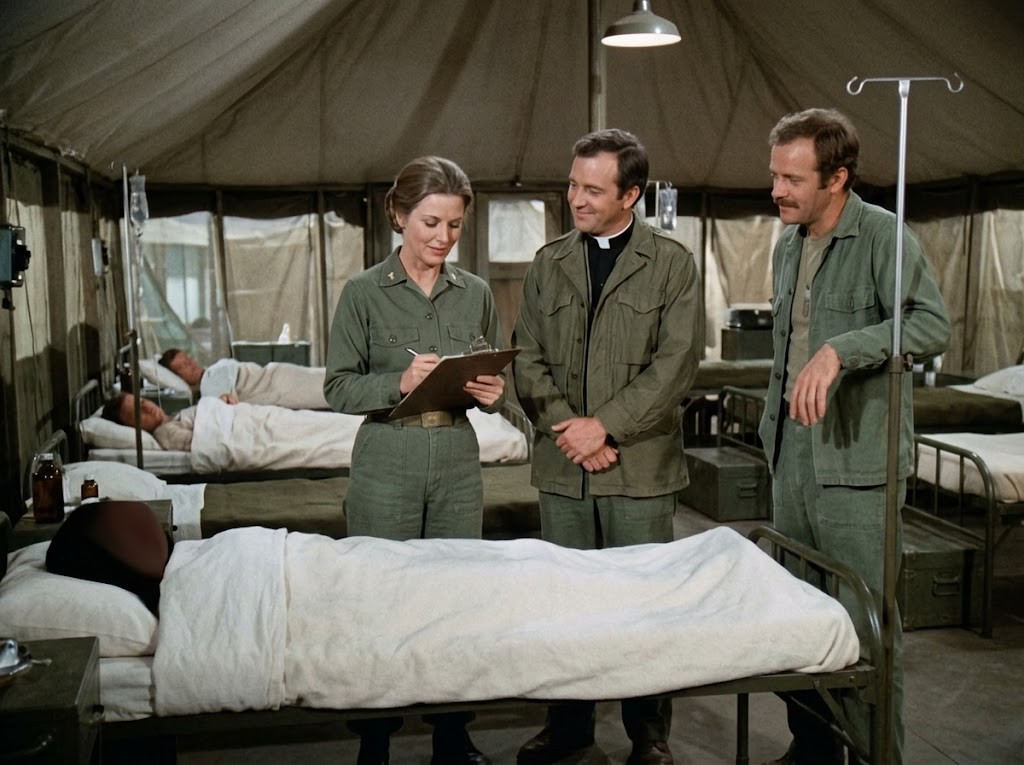
The mud outside the tents always has a way of tracking into the soul, but inside the post-op ward of the 4077th, the world narrows down to the steady beep of a pulse and the smell of clean linen.
The latest session in the operating room had lasted fourteen grueling hours. Everyone was operating on a dangerous combination of pure adrenaline and instant coffee that tasted suspiciously like battery acid.
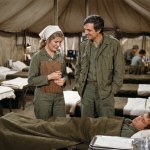
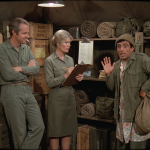
Margaret Houlihan stood near the center of the canvas ward, her posture instinctively rigid, holding a heavy wooden clipboard like a shield against the exhaustion pressing down on her shoulders. Her hair was tucked back neatly, but the faint purple shadows under her eyes told the real story of the night they had all just survived.
Beside her, Father Mulcahy stood with his hands loosely clasped in front of him, a gentle, tired smile playing on his lips. He was always there when the smoke cleared, offering a quiet presence that didn’t demand anything from the boys lying in the cots.
“Corporal Miller’s fever is down to ninety-nine point two, Father,” Margaret said, her voice dropping into that soft, fiercely protective register she only used when the doors were shut and the brass wasn’t looking. She made a neat, precise notation on the chart. “He spent the last three hours asking for his mother’s peach cobbler, which I take as an excellent clinical sign.”
“Ah, the healing power of home cooking,” Mulcahy murmured, his eyes reflecting the warm, dim glow of the overhead utility lamp. “I often think half the recovery in this place is just the sheer willpower to get back to a decent Sunday dinner.”
B.J. Hunnicutt leaned his lanky frame against a tall metal IV stand nearby, one hand resting casually on the pole while his other arm draped comfortably over his hip. His green fatigue jacket was rumpled, his mustache slightly askew from hours behind a surgical mask, but his eyes were remarkably bright.
“Personally, I’d settle for a grilled cheese that didn’t require a tetanus shot first,” B.J. chimed in, a faint, dry smirk tugging at the corner of his mouth. “But Miller’s a tough kid. He told me before he went under that he has a girl back in Ohio who promises to marry him the second he steps off the train, provided he still has all ten toes to dance with.”
Margaret looked up from her clipboard, a flicker of genuine tenderness softening her sharp features as she gazed down at the silent patient resting in the foreground cot. “He keeps them all, Captain. Thanks to a very stubborn piece of arterial repair by a couple of sleep-deprived surgeons.”
The ward was quiet, save for the rhythmic, heavy breathing of the recovering soldiers in the background cots, their young faces pale against the white pillows. It was one of those rare, fragile moments of peace where the war felt like it was pausing to catch its breath.
Then, the clipboard in Margaret’s hands trembled slightly. Her eyes fixed on a line she had just read further up on the chart—a notation from the triage intake desk that had been overlooked in the mad scramble of the midnight push.
“Wait,” Margaret whispered, her pencil halting mid-air as the warmth drained completely from her face. “This can’t be right.”
B.J.’s casual posture instantly vanished; he straightened up from the IV pole, his eyes locking onto Margaret’s sudden stiffness. Mulcahy’s hands tightened together, the gentle smile fading into a look of deep, anxious concern as a heavy, breathless tension gripped the small circle.
—
“What is it, Margaret?” B.J. asked, his voice instantly shifting from the easy-going camp humor to the grounded, steady tone of a physician who knew how fast a quiet room could turn into a crisis.
Margaret didn’t answer immediately. She double-checked the name on the metal bed tag, then compared it to the carbon-copied manifest attached to the back of the clipboard.
“The intake sheet lists him as Miller, Robert J.,” Margaret said, her voice tight, cracking slightly under the weight of the realization. “But the serial number on his dog tags doesn’t match the medical transfer file we received from Seoul. Look at the date of birth listed here, B.J.”
B.J. leaned in, stepping closer to the bed as Mulcahy moved with him. B.J.’s eyes scanned the faded purple ink of the military stamp.
“March 14, 1934,” B.J. read aloud softly. He paused, the math running through his head with cruel efficiency. “He’s barely seventeen. He must have used his older brother’s papers to enlist.”
“Dear me,” Father Mulcahy sighed, looking down at the sleeping boy whose face now seemed even smaller, even more innocent under the harsh light of the single bulb. “A child. Just a child playing a man’s game in the worst possible place.”
“He’s not the first, and God help us, he won’t be the last,” Margaret said, her professional armor locking back into place, though her fingers gripped the clipboard so tightly her knuckles turned white. “The problem isn’t just his age. The transfer file states that his brother—the real Robert Miller—is currently listed as missing in action near the Chosin Reservoir. If the bureaucracy catches up to this boy while he’s in our post-op, they won’t send him to a convalescent hospital. They’ll classify him as an illegal enlistment and tie him up in a court-martial stockade before he even heals.”
The silence returned to the tent, heavier this time, thick with the shared frustration of good people trapped inside a massive, unfeeling machine.
Just then, the canvas flap of the tent rustled, and Hawkeye Pierce stumbled in, looking like a man who had been thoroughly run over by a tank and then backed up over for good measure. His purple robe was missing its belt, his hands were shoved deep into his pockets, and his hair looked like a bird had tried to nest in it during the night.
“Did somebody say ‘court-martial’?” Hawkeye asked, his voice laced with his trademark dry wit, though his eyes were heavy with fatigue. “Because if we’re handing them out, I’d like to sign up for three. I hear the accommodations in the stockade include actual pillows and a complete lack of incoming artillery.”
“It’s not a joke, Pierce,” Margaret said, though there was no heat in her reprimand. She handed him the chart.
Hawkeye took his hands out of his pockets, his cynical smile evaporating as he read the lines. He looked at the boy in the bed, then at B.J., then at the Father. The sharp, rapid-fire banter that usually protected him from the tragedy around him suddenly felt useless.
“Seventeen,” Hawkeye murmured, running a tired hand over his face. “When I was seventeen, my biggest worry was whether I could borrow my father’s Chevy to take a girl to the diner for a chocolate malt. This kid is collecting shrapnel for a name that isn’t even his.”
“We have to fix the paperwork,” B.J. said quietly, looking toward the door where Radar’s office lay across the compound. “If Radar gets his hands on the master company clerk stamps, a simple typo in the serial number could keep this kid in a medical transport channel until he’s safely on a ship back to Ohio.”
“Alter military records?” Margaret looked at B.J., her strict adherence to Army regulations warring visibly with the fierce, maternal protection she felt for every soldier in her ward. She looked down at the boy, who let out a soft, whimpering sigh in his sleep, turning his head slightly toward the warmth of the lamp.
Margaret swallowed hard, her shoulders dropping an inch. She looked at Father Mulcahy. “Father… what does the moral ledger say about a typo?”
Mulcahy smiled, a warm, radiant expression that seemed to push the chill out of the canvas tent. “I believe, Major, that the Recording Angel is remarkably forgiving when it comes to bad penmanship in the service of mercy.”
Margaret nodded once, a sharp, decisive movement. She turned to B.J. “Take the chart to Radar. Tell him the ink faded on the carbon copy. Make sure the boy’s real name gets onto the discharge-to-home order.”
“You’re a good man, Major,” Hawkeye said softly, offering her a rare, completely unironic smile of deep respect.
“I’m a Major in the United States Army Nurse Corps, Captain,” Margaret replied, her voice steady, though her eyes glistened. “And right now, my patient needs a ticket home, not a lecture from a supply sergeant.”
B.J. took the clipboard, tapping it gently against his palm with a look of quiet satisfaction. “Consider it done. I’ll make sure Radar uses the good ink.”
As B.J. walked out toward the office, Hawkeye stepped up beside the bed, gently adjusting the blanket around the young soldier’s shoulders. The boy didn’t wake, his breathing deep and even, completely unaware of the quiet conspiracy of love and defiance that had just saved his future.
Father Mulcahy placed a hand gently on Margaret’s arm, and for a long moment, the three of them just stood there under the single lamp, watching over the quiet room. Outside, the distant, low rumble of artillery echoed through the mountains, a grim reminder of the world they were fighting to keep at bay. But inside the tent, for one small boy from Ohio, the war was already over.
In a place where the world was tearing itself apart, the finest medicine they ever offered was simply remembering how to be human.