A Lavender Letter in the Mud
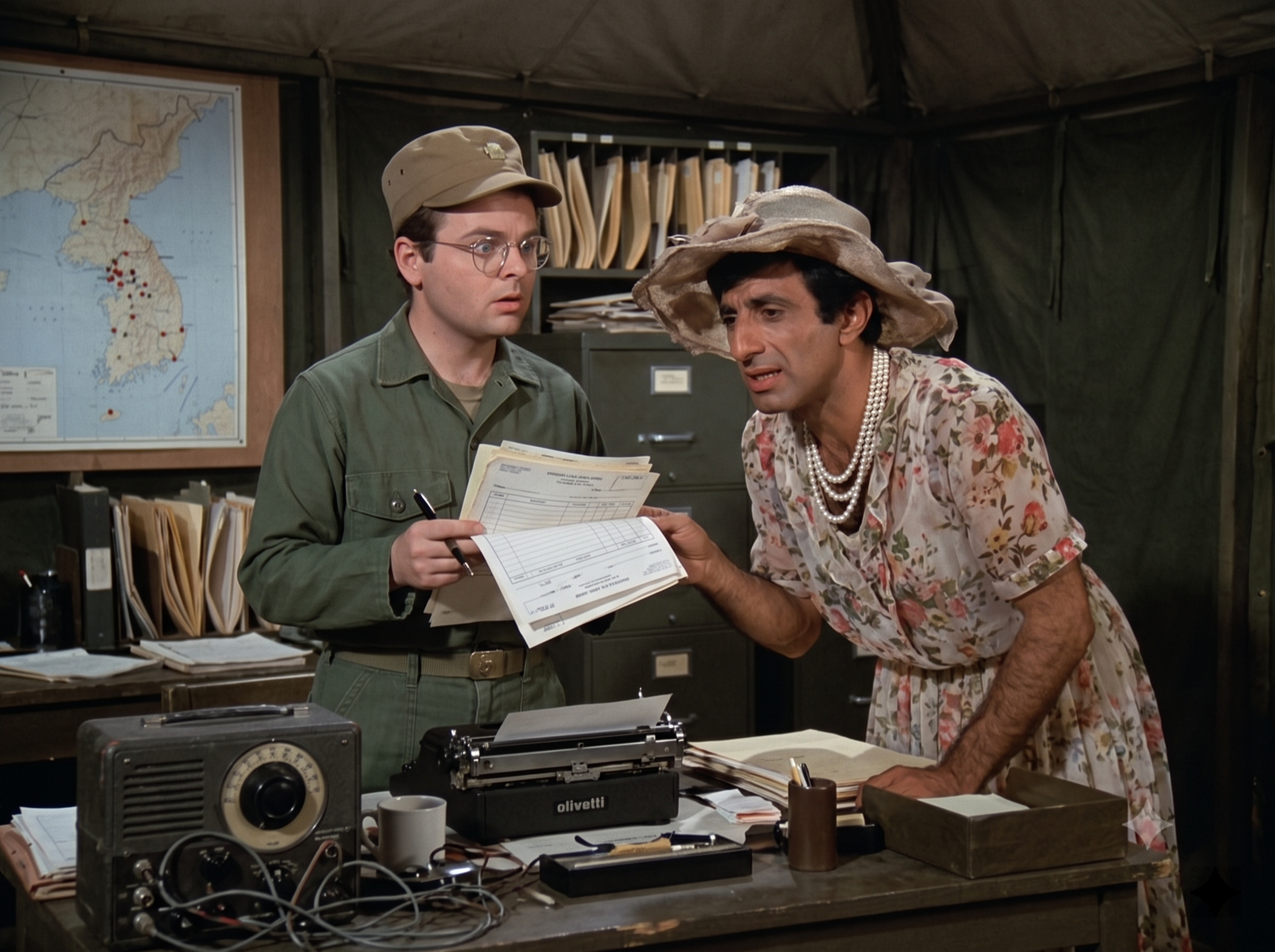
If the air in Colonel Potter’s office had a flavor, it would be stale coffee, paper dust, and a faint, underlying metallic hint of surgical soap. But on this Tuesday, the typical administrative smog was cut by something else: the subtle, impossible aroma of lavender.
It was an ordinary morning, which of course meant everything was breaking. A shipment of antibiotics was stuck in Seoul, a generator was wheezing like a terminally ill locomotive, and Captain Pierce was threatening to go on strike if the Swamp didn’t get a new lightbulb.
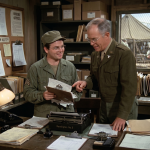
In the midst of it all, Radar O’Reilly was holding down the fort. His face was a picture of bewildered focus, his round glasses perched perfectly on his nose. He held the clipboard that ran the entire 4077th, standard issue. He had his pen ready, a simple soldier surrounded by his filing cabinets and the big, tactical map of Korea pinned to the canvas wall, showing a war that never seemed to move.
His desk was a cluttered battlefield of forms, a typewriter, and an old military-grade radio that spat static more often than it received orders. That was normal. That was the script.
What was *not* normal was the sheer floral spectacle standing on the other side of that desk.
Klinger was wearing the dress. It was a charming, light fabric, covered in a detailed pattern of roses and smaller lavender sprigs. He had the matching wide-brimmed straw hat with a bow, perfectly positioned. To complete the look, a multi-strand pearl necklace.
It wasn’t a joke. It was his latest, most earnest attempt to convince the Colonel that a man wearing a floral dress was clearly unfit for command. Klinger stood there, hand resting on the desk, peering intently at the paperwork in Radar’s hands.
Radar felt his ear twitch. He knew this sign. Klinger was holding something back.
“Klinger,” Radar said, his voice quiet. He didn’t want the noise from outside to overwhelm them. “The morning report is done. I have the supply requisition. This is…”
Klinger leaning closer, his eyes intense beneath the hat brim. His voice was hushed, but urgent. “This isn’t about supply, Radar. It’s about *her*.”
He pointed a manicured, pearl-braceleted hand directly at the document Radar was trying so hard to ignore. It was a personal letter. The envelope was a light, lavender color. It was handwritten, in delicate, script handwriting. And it was postmarked from Toledo.
The letter was addressed to Corporal Maxwell Klinger.
The office felt very small. The typewriter, usually a clattering, noisy thing, was silent.
Radar felt the panic begin. He saw the color of that paper. He recognized the smell—real lavender, not the cheap stuff from the supply train. It was personal. In a war zone, personal was rare.
He didn’t know how Klinger had gotten a private letter from home passed through the army mail without a censor’s stamp. But Klinger was resourceful.
Klinger was still leaning in, his face serious, almost protective. He had placed his other hand gently on Radar’s arm. “You saw the color, didn’t you, Kid?”
Radar nodded, the glasses magnifying his wide, nervous eyes. “Yeah, I saw it.”
“It’s from my Aunt Rose,” Klinger said. His voice was different. Less theatrical. Less desperate for a Section 8. Just a man.
“She… she wrote it to *me*.”
He stopped, struggling with the simple sentence. His gaze went down to the table, near the typewriter.
“The papers said Toledo had another flood. The whole neighbourhood.”
Klinger didn’t look at Radar. He was looking at the map of Korea, then back at the desk.
“That whole place we knew… Aunt Rose’s deli, the market… maybe they’re gone, Radar. Maybe everything is different.”
The humor, the dress, the ridiculous pearl necklace—it all faded. Underneath the floral chiffon, was just a soldier from Toledo, scared for the life he was fighting to return to.
Radar finally understood the silence. He didn’t say anything. He put down his pen. He used both hands to pick up the stack of papers and place the lavender letter gently on top. He held it out.
He didn’t make a crack about the hat. He didn’t ask how Klinger had broken regulations.
He just met Klinger’s eye. The shared moment was quiet and profound. Radar saw a different kind of longing.
“For your Aunt Rose,” Radar said softly.
Klinger paused, then gave a single, firm nod. He took the letter from Radar’s hand, the small lavender paper looking fragile and powerful.
He didn’t leave immediately. He leaned in again, and for a fleeting second, the two men were just friends. Klinger touched his hat.
“She always did have good taste in floral patterns,” he whispered, a weak smile breaking through. “I think she’d like this dress.”
He took the letter, straightened his hat, and turned. He walked out of the office, his pearl-braceleted hand now gripping a piece of home.
Radar was alone again. He picked up his pen. He looked at the map, then back at the file cabinet. He put his glasses back on.
The scent of lavender lingered. It was a smell from another world. And for one moment in the mud, it was real.
They kept the real world alive, one letter at a time.