The Tea-Time Truce and the Padre’s Burden
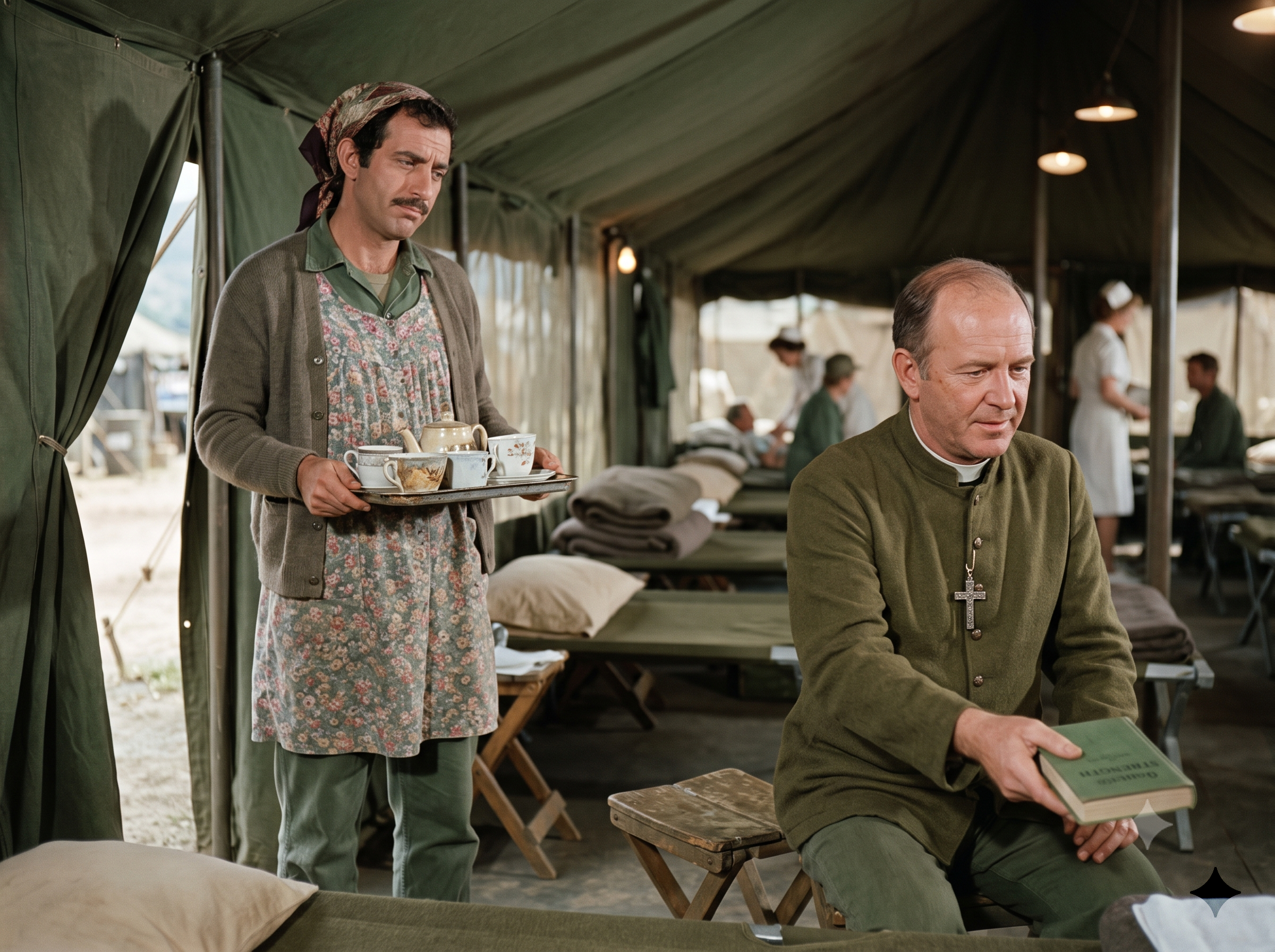
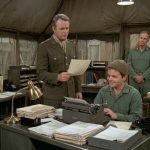
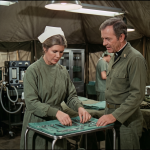
The air in the 4077th was always the same: a stale cocktail of surgical scrub, exhaustion, and dust. That quiet lull between the endless choppers and the inevitable next wave was often the hardest. Sometimes, just sitting still was heavier than lifting a scalpel. It was in one of these moments, captured in `g4_clean.jpg`, that a different kind of quiet settled on the post-op tent.
Father Mulcahy sat on a small stool, nursing a worn green book. His hands, usually so steady, gripped the covers as if they held the weight of the entire camp. Outwardly, he was the picture of gentle calm, but those close to him saw the shadow. His latest letters home were filled not with comforting scripture, but with the painful confusion of the young men he couldn’t seem to reach. He looked at the book, but his mind was somewhere far down that bumpy road.
Behind him, emerging silently from the glare of the Korean midday, was Klinger. He wasn’t looking for trouble today. The usual flamboyant dresses were tucked away, replaced by the humble armor of a floral apron and a knitted cardigan. It was a quieter rebellion, a performance of domestic comfort against the backdrop of a military hospital. In his hands, he balanced a silver tray loaded with mismatched ceramic cups and a chipped teapot.
The contrast was striking. The quiet, spiritual man grappling with an internal storm, and the theatrical supply corporal offering a fragile moment of home. Klinger saw the tension in the Padre’s shoulders. He knew that the kind of ache Mulcahy carried wasn’t one you could trade for a Section Eight.
With infinite care, Klinger advanced, closing the distance. His face, usually a mask of expressive exasperation, held a rare, silent concern. The Post-Op tent was unusually empty, making their small interaction feel like the center of the world. He reached out to gently set the tray on a bedside stool next to Mulcahy, the metal clinking softly.
The small sound cracked the silent reverie. Mulcahy blinked, looking up slowly from his book. As his eyes adjusted to the dimmer tent light and settled on Klinger and the steaming teapot, a look of profound, heavy sadness passed over his face. He didn’t immediately reach for a cup. He just looked from the floral apron to the small porcelain offerings, then back to the worn book in his hands, and let out a long, quiet sigh that seemed to deflate his very spirit.
“Klinger,” Mulcahy said, his voice barely a whisper, a sound that felt brittle in the close air of the tent.
Klinger froze, his hand still hovering over a ceramic cup. The rejection—or perhaps the immense burden of the tone—struck him harder than any order from Colonel Potter.
“Father,” Klinger replied, his own voice dropping, the usual bravado replaced by something tentative. “I… I made tea. It’s actual tea. I swapped a jeep carburetor to a supply sergeant from the 8063rd for it. He’s putting his daughter through medical school with my car parts.”
Mulcahy looked at the tray again. Mismatched cups: a delicate, flowered teacup from another life; a sturdy, chipped mug. A teapot that had clearly seen too much of the war. These were not just beverages; they were symbols of dignity.
“It’s not just the tea, Klinger,” Mulcahy sighed, his eyes fixed on the tray. “Your apron. Your kindness. This whole place. Sometimes…” His voice trailed off.
Klinger moved around to face him fully, his apron rustling. The performative nature of his attire vanished in the face of true despair.
“What is it, Father? You didn’t even look in that book today. You’ve been staring at the same page for forty minutes. Are you reading backwards?” Klinger tried a weak attempt at a joke, standard procedure when things got too serious.
Mulcahy managed a small smile, but it didn’t reach his eyes. “No, Klinger. I’m afraid I’m running out of words that make sense. Today, the words on these pages seem so far away. And the words I try to offer…”
He closed the green book with a decisive, painful snap. He didn’t look at it again.
“Sometimes, Klinger, the comfort we try to provide feels like trying to stop a hemorrhage with a postage stamp. Another soldier lost, and I have no answers. No prayers that can fix this. Just a man on a stool, and a pile of broken things.”
Klinger didn’t say anything for a long moment. He watched Mulcahy’s hands, still gripping the book tightly. He knew a soldier’s fatigue; he knew the unique fatigue of a doctor. This was different. This was the fatigue of belief being tested by reality.
Quietly, Klinger reached for one of the mismatched cups—a solid, chipped one—and filled it. The fragrant steam rose, catching the ambient light. He set it on the stool right in front of the Padre.
“This teapot, Father,” Klinger said, his voice surprisingly gentle and grounded. “It’s chipped. That silver tray is dented. This cup has a crack in it. The tea is lukewarm on a good day. It’s not beautiful. It’s not new. It’s just what we have.”
He paused, making sure Mulcahy was looking at him, not the tea.
“You aren’t trying to make us beautiful or new, Father. You are just here, when everything else is broken. You aren’t fixing us with prayers; you are just sitting with us while we’re chipped and cracked. You don’t need the answers. You just need to hold the book, even if you can’t read it.”
Mulcahy’s expression shifted, the tension in his face beginning to ease. He looked from Klinger’s earnest expression down to the chipped cup. He saw the genuine, human worry of a friend.
Klinger wasn’t offering salvation. He was offering comfort in the only way he knew how: with a strange floral apron, a warm beverage, and the stubborn persistence of a found family.
Slowly, and with a sense of immense weight being subtly shared, Father Mulcahy placed the worn green book on the stool behind him. His hand, no longer trembling, reached out and lifted the chipped cup.
“Thank you, Klinger,” he said, and this time, the smile that formed was small, weak, but present. It was a human light in the Post-Op gloom.
They sat together in the quiet. Klinger stood silently, waiting, a servant in floral armor. Mulcahy took a sip of the tea, not to evaluate its flavor, but to acknowledge the connection. The war was still outside the canvas walls. The pain was still in the adjacent beds. But for that single moment, the tea-time truce held, and the comfort of shared brokenness was enough to get them through to the next helicopter.
In the 4077th, hope wasn’t found in a perfect sermon, but in a chipped cup of tea offered in love.