A Thread of Silk in a Canvas World
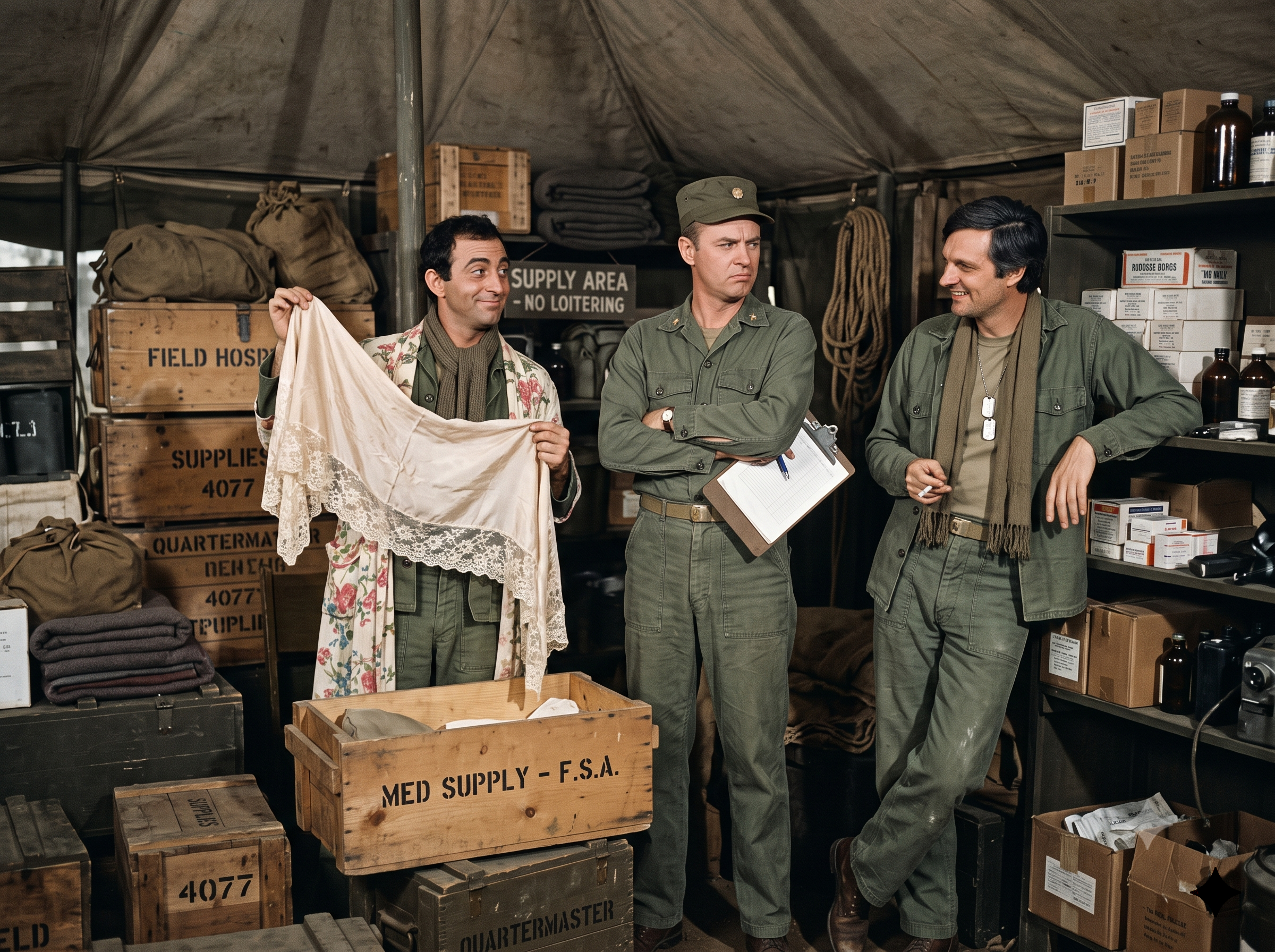
The supply tent of the 4077th Mobile Army Surgical Hospital was a dusty, canvas-draped museum of misplaced priorities. It smelled perpetually of damp wool, mothballs, and the stale dust of a war that had overstayed its welcome.
Most days, it was just a place to find itchy long johns or complain about the lack of surgical soap. But every so often, the United States Army’s chaotic shipping system produced a glitch.
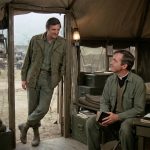
Captain Benjamin Franklin “Hawkeye” Pierce was currently using the tent as a sanctuary. He was leaning casually against a towering shelf of scratchy, folded blankets, hiding from a mountain of post-op paperwork.
Hawkeye wore a playfully mischievous smile, his sharp eyes dancing as he watched the afternoon’s entertainment unfold. The war was quiet today, leaving just enough room for the daily, desperate comedy of camp life to take center stage.
Standing a few feet away, looking utterly out of place amidst the practical clutter, was Major Charles Emerson Winchester III.
Charles stood as rigidly as a marble statue, his hands clasped behind his back. His face was a masterpiece of restrained irritation. He had been promised a newly arrived shipment of high-grade surgical talc. Instead, he was trapped in a performance.
The performer, as always, was Corporal Maxwell Klinger.
Klinger was practically diving into a large, freshly pried-open wooden crate. Wood shavings and faded paper labels fluttered to the dirt floor as he rummaged.
“I’m telling you, Major,” Klinger said, his voice muffled from inside the crate. “My contact in Seoul said this box was pure gold. An officer’s misplaced luxury luggage, auctioned off to the highest bidder.”
“Corporal, I am a surgeon, not a pawnbroker,” Charles sighed heavily, his eyebrow raised in aristocratic disdain. “If there is no talcum powder in that box of stolen refuse, I am returning to my cot.”
“Patience, Major,” Hawkeye quipped from his spot against the shelf. “You can’t rush high fashion. For all we know, Klinger’s about to pull out a matching set of rhinestone dog tags.”
Klinger suddenly gasped. He pulled his head out of the crate, a look of sly, theatrical hope spreading across his face.
Slowly, with the reverence of a priest handling a sacred relic, Klinger lifted a garment from the depths of the wooden box.
It was stunning. In the dim, olive-tinted light of the supply tent, the item seemed to glow. It was a heavy, pure silk dressing gown.
The silk was a deep, shimmering midnight blue, trimmed with intricate silver embroidery around the cuffs and lapels. It was a garment of absolute, undeniable elegance, completely alien to the dirt and blood of the 4077th.
Hawkeye let out a low whistle. “Well, I’ll be damned. The Army finally issued us something for cocktail hour.”
Charles stared at the gown. His raised eyebrow fell. His posture stiffened even further, but the irritation in his eyes was suddenly replaced by a sharp, calculating gleam.
“Look at this craftsmanship, gentlemen,” Klinger crooned, holding the gown up by the shoulders. “Feel the weight of it. This isn’t just a bathrobe. This is a ticket to a better tax bracket.”
Charles cleared his throat, trying to maintain his mask of utter indifference. “It is a garish rag, Corporal. Likely stitched together by some blind tailor in a back alley of Tokyo.”
“You think so, Major?” Klinger asked, a sly smirk creeping onto his face.
Klinger deliberately turned the collar of the magnificent blue silk gown inside out. He leaned closer to the dim light filtering through the tent flap, tracing his finger over the thick, elegant silver lettering sewn into the custom tailor’s label.
“That’s funny,” Klinger said softly, his eyes locking onto Winchester’s suddenly pale face. “Because according to this tag, this garish rag was custom tailored for a ‘Charles E. Winchester, Boston, Massachusetts.'”
The silence in the supply tent was thick enough to cut with a scalpel.
Hawkeye pushed himself off the blanket shelf, the playful smirk dropping from his face. He blinked, looking from Klinger’s triumphant grin to Charles’s stunned, motionless expression.
For a long moment, the war outside seemed to completely vanish. There was no hum of distant artillery, no rumble of jeeps. There was only the shimmering blue silk hanging in the dusty air.
Charles took a half-step forward, his eyes fixed on the embroidered letters of his own name. His hands twitched at his sides.
“Give that to me,” Charles said. His voice was dangerously low, stripped of all its usual pompous bluster. “That was lost in the mail six months ago. It is my property.”
Klinger took a strategic step backward, clutching the gown to his chest like a shield. His theatrical charm shifted instantly into the sharp survival instincts of a Toledo street kid.
“Now, hold on a minute, Major,” Klinger reasoned, though his voice wavered slightly. “By Army regulations, this crate was declared unclaimable salvage. I bought it fair and square with two cartons of cigarettes and a bottle of very convincing mouthwash. Technically, this beautiful piece of Boston real estate belongs to me.”
“Corporal,” Charles breathed, his jaw tightening. “I will not be extorted for my own haberdashery by a man who willingly wears a fruit basket on his head.”
“It’s not extortion, it’s commerce!” Klinger countered. “And since you appreciate the fine craftsmanship, I’m willing to offer you a very reasonable hometown discount.”
Hawkeye watched the exchange carefully. He saw the comedy in it, of course. The great Charles Winchester haggling over a bathrobe in a dusty tent was prime material.
But Hawkeye was a doctor, and he knew how to look at a man and see exactly where it hurt.
He looked at Charles. Beneath the anger and the aristocratic pride, Hawkeye saw something else. He saw a deep, gnawing exhaustion. He saw a man who was drowning in a sea of olive drab, holding onto his sanity by his fingernails.
That silk gown wasn’t just a piece of clothing to Charles. It was a lifeline. It was a tangible piece of the world he had been ripped away from. It smelled of home, of civilization, of a life where people didn’t bleed to death on wooden tables.
“Klinger,” Hawkeye said quietly, stepping between them.
Both men turned to look at him. The tent was still, the dust motes dancing in the heavy air.
“What’s the going rate for a miraculously resurrected piece of custom tailoring?” Hawkeye asked, his tone unusually gentle.
“Hawkeye, stay out of this,” Charles snapped, trying to preserve his dignity. “I do not need your charity, nor your interference.”
“Relax, Charles, I’m just browsing,” Hawkeye said with a soft, easy smile. He turned his attention back to Klinger. “Come on, Max. Name your price. But remember who you’re dealing with. The Major’s wallet is currently in a different time zone.”
Klinger narrowed his eyes, sizing up the situation. He looked at Charles, then at Hawkeye. Klinger might have been a hustler, but he was also part of this family. He knew when to push and when to fold.
“Three days,” Klinger said softly. “Three days of absolutely no officers barking at me. And… I want that tin of imported French biscuits you’ve been hiding in your footlocker, Major.”
Charles stared at Klinger. The price was absurdly low for a piece of clothing that had cost more than a jeep.
“Is that all?” Charles asked, his voice thick with a sudden, overwhelming emotion he was trying desperately to hide.
“It’s a buyer’s market, Major,” Klinger said with a gentle shrug.
Slowly, carefully, Klinger folded the heavy silk gown over his arm and extended it forward.
Charles reached out. His hands were usually so steady in the operating room, but as his fingers brushed the cool, smooth fabric, they trembled just a fraction of an inch.
He took the gown. He didn’t put it on. He simply held it against his chest, clutching the deep blue silk tightly over his rumpled, sweat-stained fatigue shirt.
Hawkeye leaned back against the shelf, crossing his arms. He didn’t say a word. He didn’t make a joke. He just let the moment breathe.
For a few seconds, the deep, permanent lines of fatigue around Winchester’s eyes seemed to soften. The harsh angles of his face relaxed. Standing in the middle of the cluttered, dirty supply tent, holding a piece of his old life, Charles looked like a man who had finally been allowed to exhale.
“The biscuits will be on your cot by nightfall, Corporal,” Charles said quietly. He didn’t look up. He didn’t need to.
“Pleasure doing business with you, Major,” Klinger replied softly, turning back to his crate with a quiet dignity of his own.
Charles turned and walked toward the tent flap. He moved differently now. The stiff, defensive posture was gone, replaced by a quiet, grounded calm. He pushed the canvas flap aside and stepped out into the bright, harsh glare of the Korean afternoon.
Hawkeye watched him go, a small, genuine smile touching his lips.
“You’re a good man, Klinger,” Hawkeye said softly into the dusty air.
Klinger pulled a dented canteen out of the crate and tossed it aside. “I don’t know what you’re talking about, Captain. I just wanted those biscuits.”
Hawkeye chuckled, pushing himself off the shelf. He walked out of the tent, heading back toward the swamp, the paperwork, and the war. The world was still a mess, but for one afternoon, a little piece of home had found its way through the dark.
In a place where everything was measured in blood and mud, sometimes survival was simply the feeling of silk against your skin.