A Splash of Color in the Khaki Dark
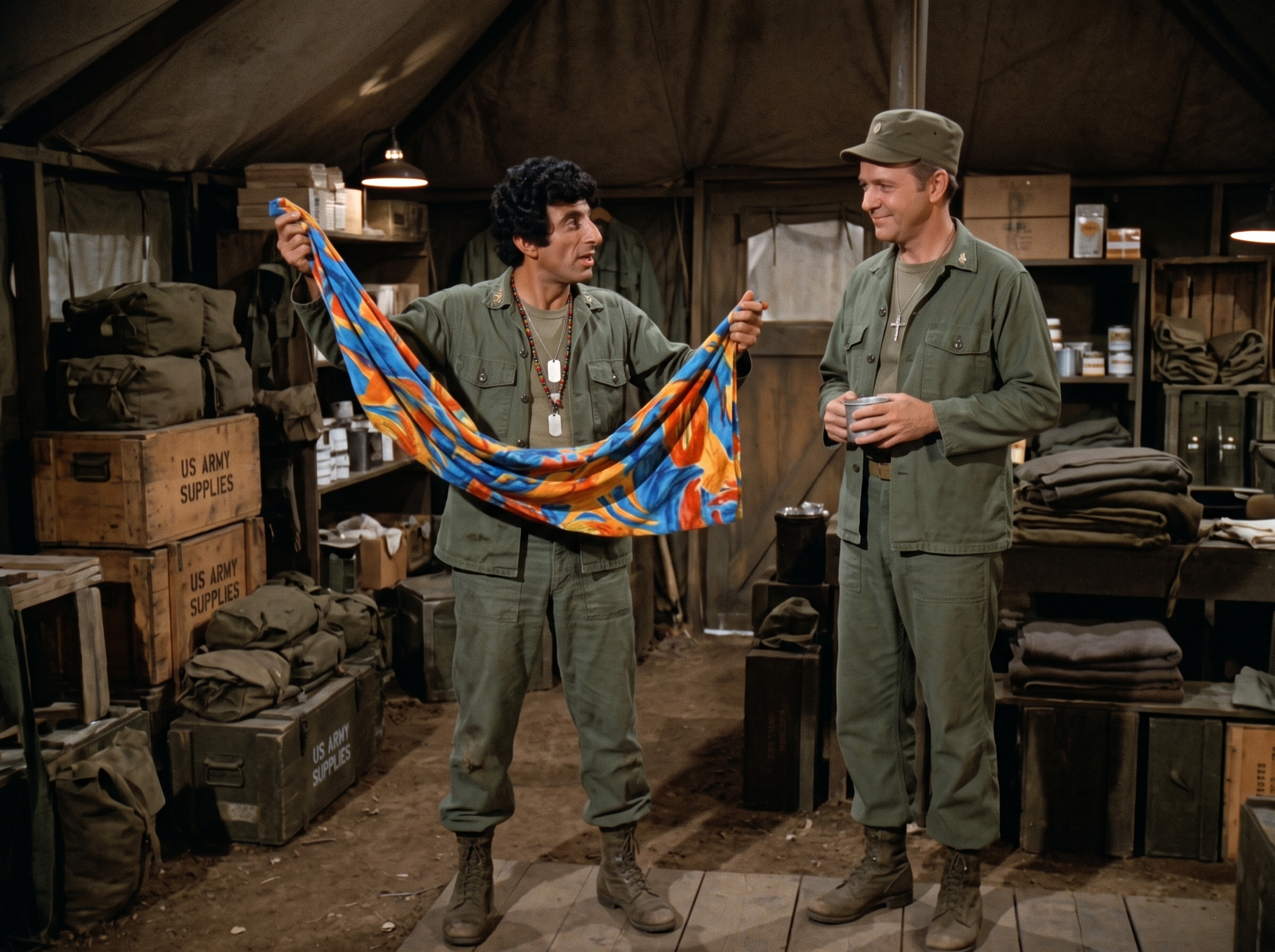
It was three in the morning, and the supply tent of the 4077th smelled like old canvas, damp wool, and exhaustion.
The rest of the camp was finally asleep, settling into a fragile silence after three days of back-to-back wounded.
Inside the supply area, the dim, warm light of a single bare bulb cast long, tired shadows across the uneven stacks of wooden crates.
Father Mulcahy stood quietly in the corner, seeking a rare moment of peace.
His hands were folded softly around a small, battered aluminum camp cup, letting the heat of the terrible mess tent coffee warm his cold fingers.
He was just about to close his eyes and say a quiet prayer for the sleeping camp when the tent flap flew open.
In walked Corporal Maxwell Klinger, carrying himself with the dramatic flair of a Shakespearean actor who had just been wronged by the critics.
Klinger wasn’t wearing a dress tonight, just his standard issue fatigues, but his energy was as loud as a marching band.
In his hands, he clutched a large, wildly eccentric piece of patterned fabric.
It was a chaotic, brilliant explosion of mustard yellows, deep purples, and vibrant magentas, covered in swirling paisley designs.
It was the loudest, most wonderfully absurd thing Mulcahy had seen in months.
Klinger stepped into the center of the tent, holding the fabric high by the corners, throwing his arms wide in a grand, theatrical gesture.
He didn’t look crazy. He looked deeply, profoundly insulted.
“Look at this, Father,” Klinger declared, his voice trembling with a mixture of wounded dignity and comic pride. “Just look at it!”
Mulcahy blinked, his soft smile faltering into mild confusion. “It’s… certainly very vibrant, Maxwell. Did you get a package from home?”
“Better,” Klinger said, tossing one end of the fabric over his shoulder like a regal cape. “I traded three cartons of Chesterfields, a slightly dented hubcap, and half a bottle of Hawkeye’s gin to a merchant down in Seoul for this masterpiece.”
He stroked the loud material with deep reverence. “It’s genuine imported silk, Father. Or at least, very convincing rayon. I was going to use it to create an evening gown that would make General MacArthur himself discharge me on the spot.”
Mulcahy smiled gently, taking a slow sip of his coffee. “It sounds like a foolproof plan, Corporal.”
“It was!” Klinger cried, pacing between the canvas bags and folded blankets. “Until I showed it to Major Winchester.”
Klinger stopped, dropping his arms, the theatrical bravado slipping away for just a moment.
“He looked at it, Father. He pinched it between his fingers like it was a dead rat, and he told me it looked like an explosion in a cheap upholstery factory.”
Klinger looked down at the bright fabric in his hands, his face suddenly falling into an expression of genuine, exhausted defeat.
“He said I wasn’t crazy,” Klinger whispered, his voice cracking in the quiet tent. “He said I was just… tacky.”
The heavy silence of the supply room rushed in, pressing against the absurd, beautiful splash of color in Klinger’s hands.
Mulcahy lowered his camp cup, his mild confusion instantly melting into deep, sincere concern.
He knew Klinger. He knew the dresses, the wild schemes, the oversized earrings, and the feathered hats.
But Mulcahy also knew that beneath the comedy, beneath the desperate attempts to get out of the army, there was a man trying to survive a nightmare.
The fabric wasn’t just a joke to Klinger; it was a shield.
It was a way to keep a piece of his humanity alive in a place that dealt only in olive drab, mud, and blood.
“Maxwell,” Mulcahy said softly, stepping away from the shadows of the wooden crates.
Klinger didn’t look up. He just stared at the paisley pattern, his shoulders slumped, looking smaller than he ever did in a corset and heels.
“I mean, what’s the point, Father?” Klinger sighed, rubbing his thumb over a bright yellow swirl. “If they don’t think I’m crazy, and they just think I’m a joke… then I’m just a guy stuck in Korea wearing bad clothes.”
He began to bundle the fabric together, the grand gestures gone, replaced by the tired movements of a homesick soldier.
“Maybe the Major is right. Maybe I should just fold it up. Put it away. Just be regular old Corporal Klinger.”
Mulcahy stepped into the center of the tent, standing directly under the warm, dim light.
“Don’t you dare,” Mulcahy said.
His voice wasn’t loud, but it carried the firm, absolute authority of a man who dealt in the matters of the soul.
Klinger stopped folding the fabric, looking up at the priest with wide, surprised eyes.
Mulcahy offered a gentle, reassuring smile, gesturing toward the bundled cloth. “May I?”
Klinger hesitated, then slowly handed a corner of the vibrant material to the chaplain.
Mulcahy held it up to the light, studying the chaotic clash of purple and magenta against the dreary canvas walls of the supply tent.
“Major Winchester is a man who appreciates the fine, orderly things in life, Maxwell,” Mulcahy said softly. “He likes Bach. He likes tailored suits. He likes things that make sense.”
Mulcahy looked over the top of the fabric, meeting Klinger’s weary eyes.
“But we do not live in a world that makes sense right now, do we?”
Klinger swallowed hard, shaking his head slightly. “No, Father. We sure don’t.”
“This place,” Mulcahy said, gesturing around the cluttered, dusty tent, “this war… it tries to drain the color out of everything. It tries to make us all uniform. It tries to make us forget that there is beauty, and absurdity, and joy left in the world.”
Mulcahy let go of his corner of the fabric, stepping back and taking a sip of his lukewarm coffee.
“When I look at this fabric, Maxwell, I do not see a cheap upholstery factory.”
Klinger blinked, his wounded dignity slowly beginning to heal. “You don’t?”
“No,” Mulcahy smiled, a warm, bright look in his tired eyes. “I see Toledo. I see neon signs, and crowded streets, and life. I see a man who refuses to let the darkness win.”
Klinger stood frozen for a long moment, the heavy silence of the night wrapping around them like a shared blanket.
Slowly, the familiar spark returned to Klinger’s eyes.
He stood up a little straighter, his chest puffing out with that old, resilient comic pride.
With a swift, dramatic flick of his wrists, Klinger unfurled the fabric again, draping it magnificently over his left arm.
“You know, Father,” Klinger said, his voice regaining its theatrical bounce. “With a sweetheart neckline and a tasteful velvet sash, I think this could really pop.”
“I have absolutely no doubt,” Mulcahy chuckled, wrapping his hands back around his tin cup.
“I might even make a matching handbag,” Klinger mused, admiring the drape of the rayon in the dim light. “Just to show the Major what true high fashion looks like.”
“You show him, Maxwell,” Mulcahy said gently.
Klinger smiled, a real, genuine smile that reached all the way to his tired eyes. “Thanks, Father.”
“Goodnight, Corporal.”
“Goodnight, Padre.”
Mulcahy watched as Klinger marched proudly out of the supply tent, carrying his wild, absurd splash of color out into the dark, cold Korean night.
The priest took one last sip of his terrible coffee, feeling warmer than he had all week.
He didn’t know if Klinger’s new dress would get him a Section 8, but he knew it would give the 4077th something to smile about tomorrow.
And in a place like this, a smile was its own kind of miracle.
Sometimes, the bravest thing a soldier can do is refuse to let the war wash away their colors.