The Quiet Side of the War
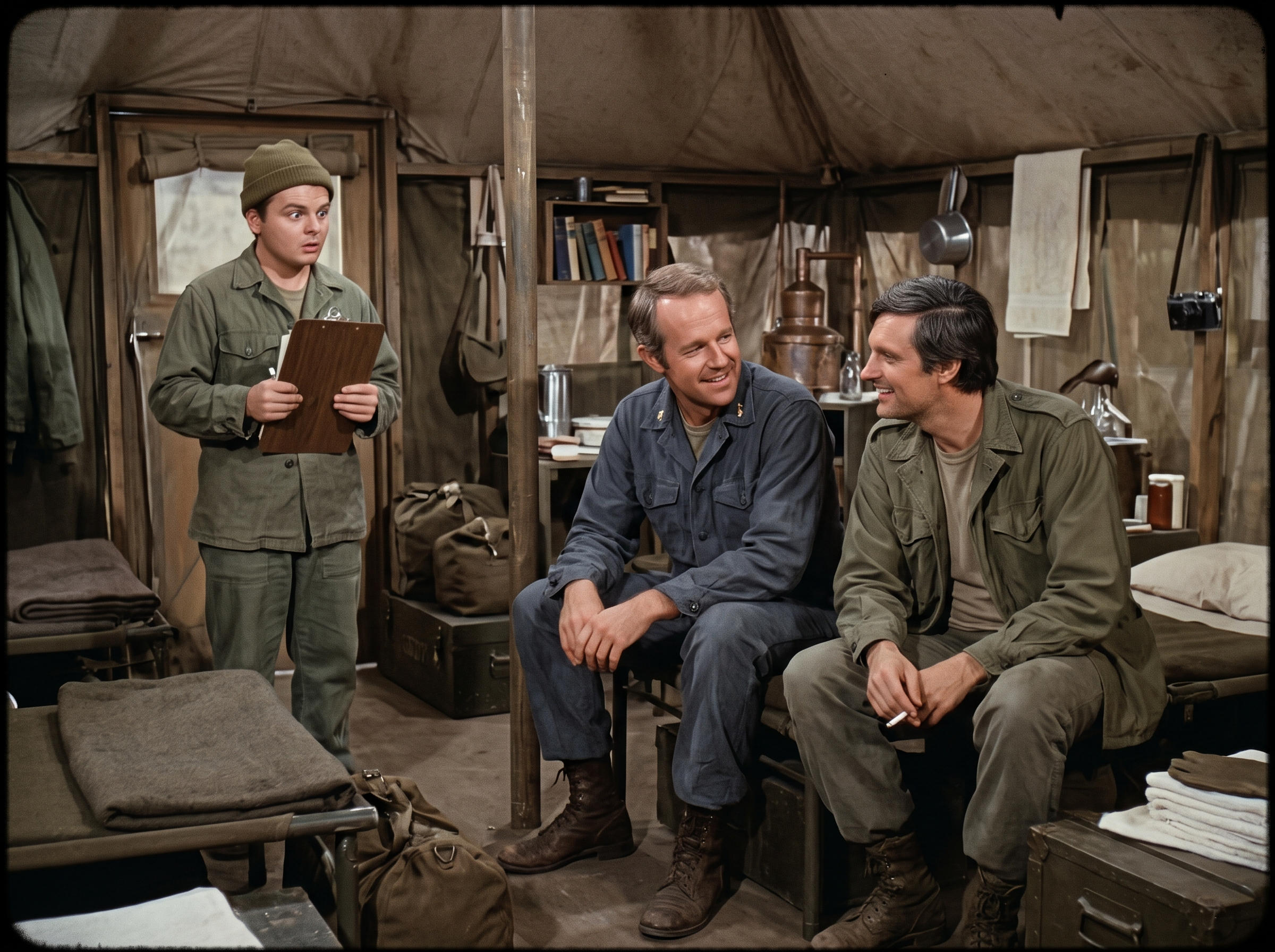
There was a very specific, heavy kind of silence that fell over the 4077th after a marathon session in the Operating Room.
It wasn’t the peaceful silence of a Sunday morning back home in Maine or Mill Valley. It was a bruised, hollow quiet. It was the sound of a hundred canvas tents breathing out all at once, carrying the lingering ghosts of iodine, copper, and damp earth.
Inside The Swamp, that silence was usually beaten back by the clinking of a makeshift martini glass or the frantic, desperate rhythm of a bad joke.
Today, it was a little bit of both.
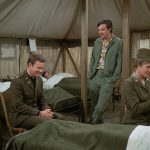
Hawkeye Pierce sat slumped on the edge of his cot, looking entirely boneless. He was still in his wrinkled green fatigues, a cigarette resting casually between his fingers.
For the first time in eighteen hours, his hands weren’t trembling. For the first time since the choppers had descended like a swarm of angry metal locusts, there was no blood on his boots.
He leaned back, letting the familiar, musty smell of the canvas tent wash over him. He offered a dry, clever observation about the army’s latest attempt at serving them something resembling meat in the mess tent.
It was a small, throwaway line. A tiny life raft of humor tossed out into the middle of the room.
Beside him, resting on a footlocker, B.J. Hunnicutt caught the joke and held onto it.
B.J. was leaning forward in his blue shirt, his shoulders relaxed, a warm and remarkably steady smile spreading across his exhausted face. He didn’t offer a loud, boisterous laugh. He didn’t need to.
His quiet, knowing smile was an anchor. It was a silent acknowledgment between two men who had just spent the better part of a day pulling young boys back from the brink of the abyss.
They had survived another wave. They were still here. They were still human.
Hawkeye caught B.J.’s eye, and a genuine, emotionally alert smile broke through his own exhaustion. For a beautiful, suspended second, the war was a million miles away from this cluttered, lived-in corner of Korea.
They were just two doctors, sharing a quiet moment of victory over the madness.
Then, the canvas flap of the tent rustled, letting in a shaft of harsh afternoon sunlight.
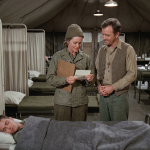
Radar O’Reilly stood in the doorway, frozen half-in and half-out.
He was wearing his oversized green jacket and his trademark knit cap, clutching a wooden clipboard to his chest like a piece of homemade armor. His round, youthful face was a picture of wide-eyed, innocent confusion.
He had clearly caught the tail end of the joke, but the punchline had sailed right over his head. Radar looked from Hawkeye’s relaxed grin to B.J.’s warm amusement, blinking like an owl caught in the high beams of a jeep.
The mood in The Swamp shifted instantly. It didn’t shatter, but it stretched tight.
Hawkeye’s smile didn’t vanish, but it hardened just a fraction around the edges. He took a slow drag from his cigarette, his eyes dropping to the clipboard in the corporal’s hands.
In this place, a clipboard in Radar’s hands was rarely a good thing.
It meant incoming wounded. It meant a casualty report from post-op. It meant a telegram from a grieving family, or another impossible directive from a general sitting comfortably in Tokyo.
The silence rushed back in, thicker this time.
Radar shifted his weight nervously, his boots shuffling against the dirt floor. He looked down at the paper clipped to the board, then back up at the doctors, completely unaware of the sudden, heavy dread he had just carried into the room.
Hawkeye let out a slow breath of smoke, bracing himself for whatever reality was about to drag them back to the war.
“Don’t just stand there, Radar,” Hawkeye said, his voice dropping into a gentle, teasing drawl that he used to mask his own anxiety. “You look like a kid who just accidentally walked into the wrong theater during a double feature.”
B.J. shifted his weight, his smile softening into something deeply empathetic. He could see the nervous twitch in the boy’s shoulders.
“Come on in, Radar,” B.J. offered quietly. “The still is resting, but we’re open for business. What’s the word from the outside world?”
Radar blinked, taking a small, tentative step into the cluttered space. He looked around at the footlockers, the unmade cots, and the complex glass tubing of the gin still sitting quietly in the background.
“Well, sirs,” Radar started, his voice cracking slightly as it always did when he was caught off guard. “I heard laughing. I didn’t mean to interrupt anything official.”
“The only thing official happening in here is a severe violation of military protocol regarding our sanity,” Hawkeye quipped. He flicked a tiny speck of ash onto the dirt floor. “Now, what is it? Did Command finally realize we’re a lost cause? Are they sending us to the French Riviera for mandatory psychological observation?”
Radar looked down at his clipboard, his brow furrowing in deep, earnest concentration.
“No, sir,” Radar replied, completely missing the sarcasm. “It’s a memo from General Headquarters.”
Hawkeye and B.J. exchanged a fleeting look. The tension in the room remained, hanging by a thread. Memos from GHQ were often absurd, but sometimes they carried the weight of impending offensives.
“Read it, Corporal,” Hawkeye said, his tone a little more grounded now. “Give it to us straight. We’re doctors, we can take it.”
Radar cleared his throat, holding the clipboard up to his nose.
“It’s an official directive, sir,” Radar read carefully. “Subject: Immediate and Mandatory Inventory of all Standard Issue Olive Drab Shoelaces, Length 36 Inches, for the purpose of reassessing quartermaster supply chain efficiencies.”
The silence that followed was absolute.
Hawkeye stared at the young corporal. B.J. stared at the tent floor.
Outside, the distant rumble of an artillery shell echoed off the mountains, a grim reminder of the very real, very bloody war raging just a few miles away.
Inside The Swamp, they were being asked to count shoelaces.
Hawkeye slowly reached up and pinched the bridge of his nose. He closed his eyes, his shoulders shaking in a silent, uncontrollable spasm.
For a terrifying second, Radar thought his favorite surgeon was crying. The boy took a panicked step forward, his hand reaching out.
“Captain Pierce? Sir? Are you okay?” Radar asked, his voice trembling with genuine concern.
B.J. let out a sudden, loud snort.
Radar spun his head toward the other doctor. B.J. was leaning over his knees, burying his face in his hands, his broad shoulders heaving.
It wasn’t a breakdown. It was laughter.
It was the deep, helpless, breathless laughter of men who had stared death in the face all morning and were now being threatened with the crushing, spectacular stupidity of army bureaucracy.
Hawkeye lifted his head, a massive, brilliant grin breaking across his face. He looked at B.J., and the two of them simply lost it. The tension that had coiled tight in their chests finally snapped, releasing a flood of exhausted relief.
“Shoelaces, Beej,” Hawkeye gasped, pointing a finger at the ceiling. “They want us to count the shoelaces! Because God forbid, if a man takes a piece of shrapnel in the chest, his shoes might fall off on the operating table!”
B.J. wiped a tear from the corner of his eye, shaking his head. “Efficiency, Hawk. We must maintain the supply chain. The whole war effort depends on those thirty-six inches of cotton.”
Radar stood in the center of the room, still clutching his clipboard. His wide-eyed confusion slowly melted away, replaced by a tentative, crooked smile.
He didn’t fully understand why it was so funny. He knew the army was crazy, but to him, it was just another piece of paper. Yet, seeing the two doctors laugh—really, truly laugh, without the bitter edge of the OR clinging to it—made his own chest feel lighter.
Hawkeye took a deep breath, calming himself down. He looked at the young kid standing there, realizing how much they relied on Radar’s innocent gravity to keep them tethered to the earth.
“Come here, Radar,” Hawkeye said softly, patting the edge of his cot.
Radar hesitated, then walked over and sat down stiffly on the edge of the canvas mattress.
“You put that clipboard away,” Hawkeye told him, his voice stripped of the sarcasm, leaving only a warm, older-brother tenderness. “You tell GHQ that the 4077th is entirely out of shoelaces. We are currently holding our boots together with surgical tape and sheer, unadulterated patriotism.”
B.J. leaned over, clapping a heavy, comforting hand on Radar’s shoulder.
“You did good, Radar,” B.J. said quietly. “You brought us exactly what we needed.”
Radar looked between the two men. He saw the dark circles under their eyes, the deep lines of fatigue etched into their faces, and the lingering dust on their collars. But he also saw the unmistakable warmth directed entirely at him.
They were tired, they were broken, and they were trapped in a nightmare. But right here, right now, sitting in the dusty clutter of The Swamp, they were safe.
Radar lowered the clipboard to his lap. His shoulders finally dropped, his posture relaxing into a comfortable slouch.
“Yes, sirs,” Radar said softly, the nervous edge entirely gone from his voice. “I’ll go draft a reply to Tokyo right away.”
“Tomorrow, Radar,” Hawkeye said, leaning back against the canvas wall and closing his eyes, a peaceful, contented smile resting on his lips. “We’ll save the world from tripping over its own feet tomorrow.”
The three of them sat in the quiet of the tent, the afternoon light turning golden and soft. The war raged on outside, but inside, they had built a fragile, beautiful barricade out of friendship, exhaustion, and a profoundly ridiculous joke.
In the heart of the madness, they didn’t just save lives; they kept each other alive, one small, quiet moment at a time.