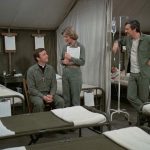
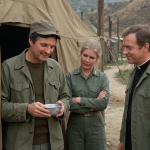
The Unofficial Diagnosis of the 4077th
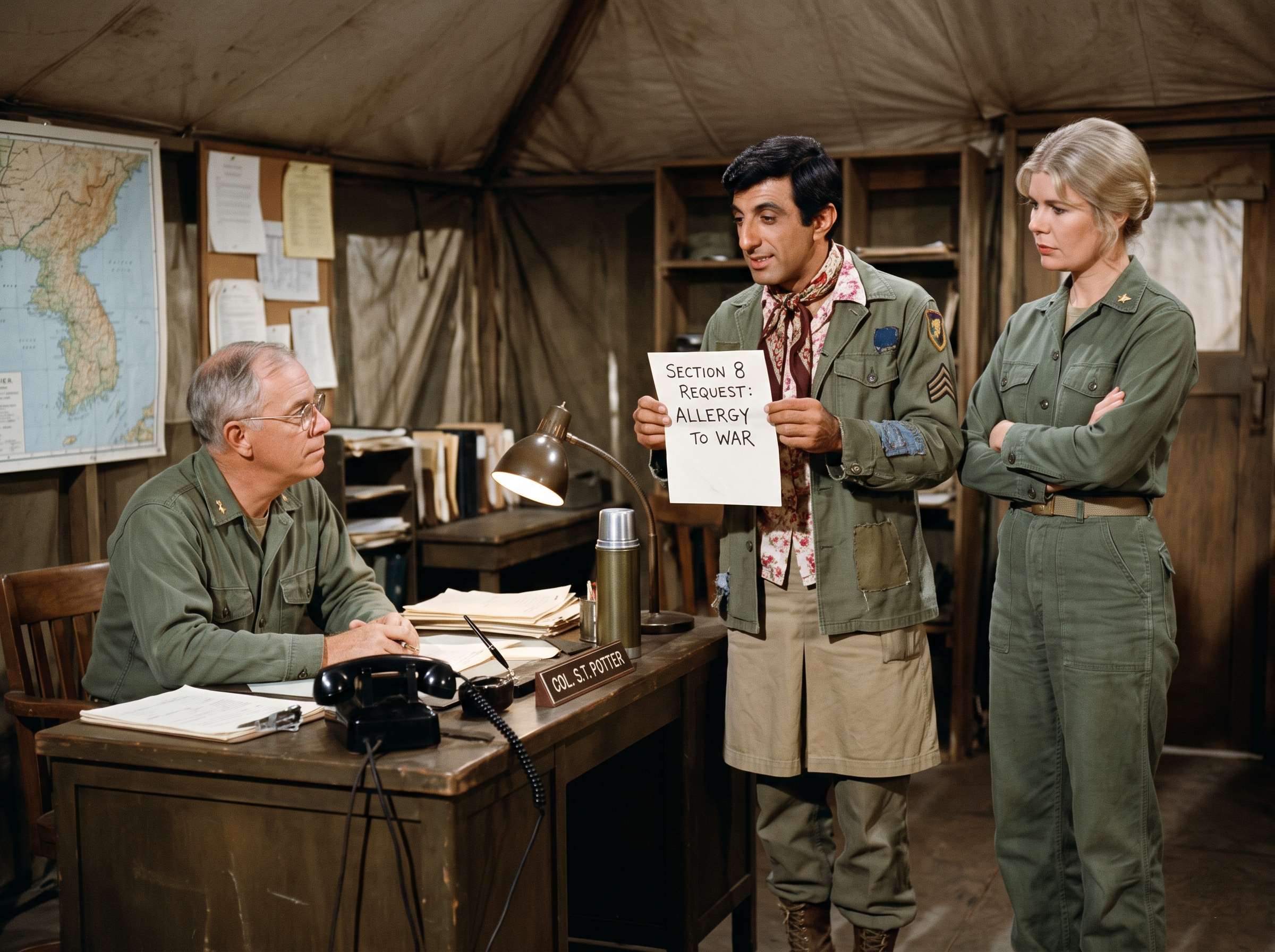
The office was a warm, tired cage of olive drab and endless paperwork. Colonel Potter’s old clock ticked with rhythmic exhaustion.
A shaft of pale Korean sunlight cut through the dusty tent canvas, landing directly on Corporal Klinger.
He was a striking composition, even for the 4077th. Klinger wore a patterned neckerchief and a skirt—perhaps a kilt, or a desperate approximation—over his uniform jacket.
But his attire wasn’t the point today. It was the paper he held with both hands.
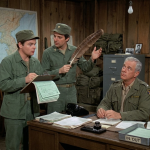
Colonel Potter sat at his desk, peering over his glasses. He looked weary, the kind of weary that comes from years of commanding men in a war without an ending.
Margaret Houlihan, arms crossed tight over her chest, was a silent pillar of professionalism, her stern face a carefully maintained mask.
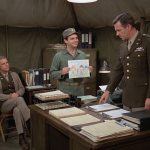
“Permission to speak, sir?” Klinger’s voice was earnest, lacking its usual performative flair. He was holding something he clearly believed was a masterpiece.
He presented the white sheet of paper like it was a sacred scroll. Typed clearly across the top was his official new request.
“Section 8 Request: Allergy to War.”
Potter didn’t speak immediately. He just stared at the text. He sighed, a sound that seemed to carry the weight of the entire camp.
“Allergy, Corporal?” Potter finally said, his voice quiet and dangerously calm.
“Yes, sir!” Klinger said, a flicker of renewed hope igniting in his expression. “Medical. Physiological. Proven by observation.”
Margaret let out a short, incredulous breath, shifting her weight.
“It’s not mental, Colonel. It’s physiological!” Klinger insisted, his hand gesturing towards the paper. “My body is physically rejecting the conflict.”
“List your symptoms, Maxwell,” Potter said, still incredibly still, but his eyes were sharp.
“Hives, Colonel! Right after the 0800 report. And an overwhelming, physical compulsion to wear taffeta,” Klinger stated, matching the seriousness of the situation. “Also, my heart does this strange, panicky tap-dance every time I hear a distant rumble that isn’t a delivery truck.”
Margaret’s eyebrows arched high. “Taffeta, Corporal? A direct physiological symptom?”
“It helps me cope, Major! It regulates my blood pressure!” Klinger argued, his face flushing with the intensity of his belief. “The paper is clear, sir. This allergy is real.”
Potter put his hand on his desk, his fingers tapping the nameplate that read ‘COL. S.T. POTTER’. He leaned back, the leather creaking, and fixed Klinger with a direct, complex stare. It wasn’t the look of someone dismissing a joke. It was the look of a man processing a desperate cry disguised as a legal form.
He was just about to speak, about to address the earnest absurdity of it all, when something broke the warm silence.
It was a distant rumble, soft at first, but unmistakable. The unmistakable, terrible sound of incoming helicopters.
Potter’s weary gaze snapped from the paper to the entrance of the tent.
The silent understanding passed between everyone in the room. The real world was always louder. The phone on his desk gave its sharp, jarring ring, shattering the small bubble of human drama they were in.
Potter picked up the receiver. “Potter here.” He paused, listening.
Then his eyes, so weary just a moment before, turned into hard, focused command centers. He stared at the two officers in front of him. “How many?” He listened for a second more.
“Understood. We’re on it.”
Potter slowly placed the receiver back in its cradle, his gaze moving first to Margaret and then, finally, to the still-hopeful Klinger, whose arms were still extended with his “Allergy to War” request.
The moment stretched. The tension in the small tent was unbearable.
“Potter here. … Understood. Six choppers. Five ambulances on the way. Houlihan!”
Colonel Potter stood up, his voice cutting through the space, instantly erasing the quiet. “Get the surgical teams assembled. Full mobilization.”
The transformation was immediate. Margaret, already in motion, answered with a sharp “Yes, sir!” before turning and exiting the tent with practiced efficiency, her stern mask giving way to operational focus.
Potter turned back to Klinger. The Corporal still stood there, the paper held in his hands, his face a complex tapestry of lingering hope, profound guilt, and the crushing reality of what was coming. The theatricality was gone.
He knew his “diagnosis” was just interrupted by a wave of undeniable human suffering. He looked at the paper, and then he looked at the door. He didn’t drop his request, but he didn’t present it again either. He stood in the crossroads of his desire to leave and the absolute necessity of staying.
Potter looked at Klinger, his fatherly, weary eyes holding the younger man’s gaze. He reached out and gently took the paper from Klinger’s outstretched hand.
He didn’t read it again. He didn’t mock it. He just held it.
“Corporal,” Potter said, his voice quieter but with a weight that made the paper feel heavier than iron. “We’ve got people coming who are *really* allergic to this place. Really allergic to metal. To fire.”
Potter’s gaze moved to the desk, the maps, the symbols of command. “Go get ready, Maxwell. We need every hand. Every heart.”
He didn’t need to say more. Klinger nodded once, a brief, silent admission. He didn’t salute. There was no time. He turned and ran out of the office, his kilt fluttering, already shedding the performance, ready to be a medic again.
He was gone, but the paper remained in Potter’s hand.
Later that long, grueling night, the operating tent was silent. The red light above the door was off. The only sound was the drip of water and the quiet, heavy breathing of exhaustion.
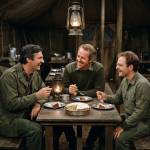
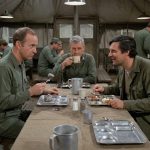
Everyone was gathered in the mess tent. A collective silence, the silence of survivors. Klinger was there, in a uniform that was torn and dusty, the kilt long gone. His patterned neckerchief was the only piece of personality left. He was nursing a mug of coffee, staring into it as if it held all the answers.
Hawkeye Pierce, a bandage on his own wrist and dark circles under his eyes that looked like war paint, sat across from him. “Hell of an allergy you’ve got there, Klinger.”
Klinger didn’t look up. He just stirred his cold coffee.
“It was a joke, right? The paper?” Hawkeye pressed, but his wit lacked its usual bite. It was soft, a cushion for the reality they had all just touched.
“I don’t know, Doc,” Klinger whispered, finally looking up. “I think the hives were real.”
Potter walked into the mess tent, his own fatigue evident in every muscle. He saw Klinger and walked over, silent. He sat down opposite him.
He reached into his pocket and pulled out the wrinkled paper. “Allergy to War.”
Potter smoothed it out on the scratched wooden table. He didn’t smile, but his eyes were incredibly gentle. He wasn’t looking at a subordinate. He was looking at another human being living through the same nightmare.
“We’re all reacting, Klinger,” Potter said softly, his voice a low rumble in the quiet tent. “Everyone in this camp is reacting to this madness. Some of us hide it behind bad jokes, some behind silence, some behind… taffeta.”
He laid his hand, rough and warm, over Klinger’s arm. It was a single, simple gesture that contained a thousand words of shared pain, mutual respect, and the profound, unshakeable bond of people trapped in a world they didn’t choose.
“I’m filing this, Corporal,” Potter said, his voice steady. “But not in the ‘insane’ file. It’s going in the ‘Humanity’ folder. It’s real enough for me.”
He didn’t approve the request. He didn’t give Klinger a ticket home. He gave him something better. He gave him understanding.
He handed the paper back to Klinger. It was wrinkled, stained, and rejected by the official system. But it felt validated. Acknowledged. Not as a successful ploy, but as a genuine echo of a shared human heart.
Potter gave his shoulder a final, fatherly pat and stood up, a single, understanding nod between them.
Hawkeye and B.J. Hunnicutt, who had arrived silently and was now leaning against the pole, both watched the interaction. Neither said a word. The silence in the tent shifted. It was no longer the silence of simple exhaustion. It was the deep, shared peace of people who recognized their own humanity reflected in each other.
Klinger looked down at the wrinkled paper. He didn’t try to hide it. He folded it carefully, not as a legal document, but as a memento. He put it in his pocket, close to his heart. It was a badge of honour, of their shared allergy. The “normal” they all fought to keep alive inside the madness.
Potter turned and walked back out into the cool, dark Korean night, his back straight, the silhouette of a steady man, the only center of gravity in a world that spun without control. He knew the war wasn’t over. Not today. But in that small office, with that absurd request, they had all been seen. And that was enough.
In the end, we all had our own unofficial diagnosis.