THE GOURMET GOSPEL AND CHARLIE’S SLAW
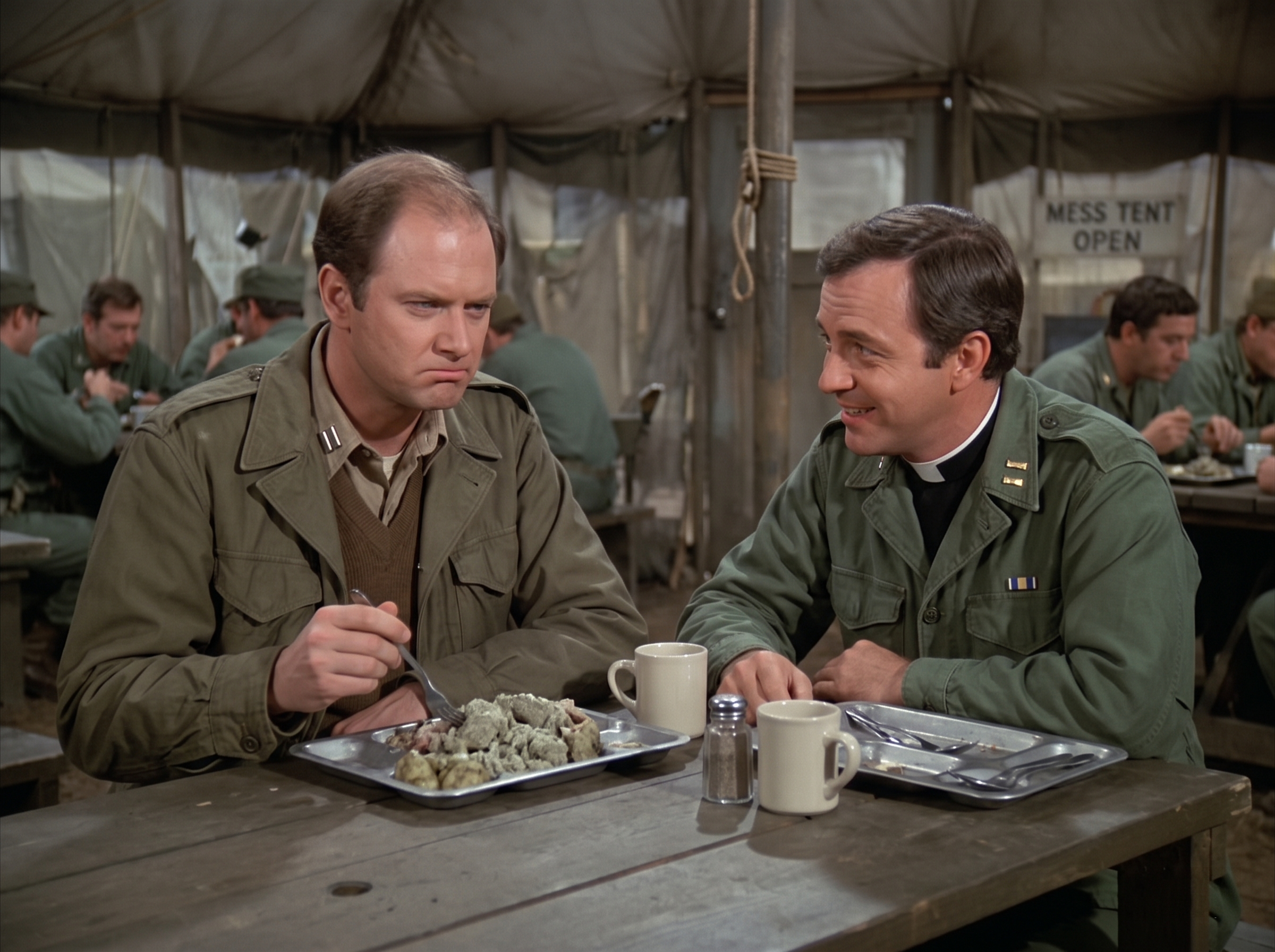
If life at the 4077th had a recurring melody, it wasn’t just the mortar fire; it was the slow-motion tragedy that took place every lunchtime. Major Charles Emerson Winchester III, a man whose palate was tuned for caviar and refined soufflés, had spent the last twenty minutes in a silent battle with a specific pile of what the Army labeled ‘corned beef.’
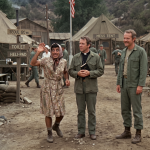
As the file image_0.png perfectly captures, Charles’s face was frozen in an expression that could curdle fresh milk.
His refined nostrils were pinched. His lips were set in a tight, offended line. In his hand, a fork poked at a large, gray lump on his metal tray, attempting to determine if it was organic matter or a geological specimen.
Across the worn picnic table sat the 4077th’s quiet anchor, Father Mulcahy.
The contrast, as seen in image_0.png, was priceless. The Father had long since adopted a policy of eating what was set before him with quiet, practiced dignity, viewing it as another test of faith. Where Charles saw an affront to civilization, Mulcahy saw… well, nutrition.
Mulcahy leaned in slightly, his smile soft and patient, watching the Major perform a surgical autopsy on his lunch. “Not quite a gourmet experience today, Charles?” he asked, his voice a calm counterpoint to the unspoken thunder on Winchester’s face.
Charles offered a sniff that was itself a form of punctuation.
“Father, comparing this to a ‘gourmet experience’ is like comparing a mud puddle to the Charles River,” Charles replied, his gaze still fixed on the grey-green mass. “This is not cuisine. This is a crime against cattle. A felony of forgotten seasoning.”
B.J. Hunnicutt, seated nearby, paused his own meal. “Easy, Charles,” he grinned. “You have to approach Army corned beef like a first date. Don’t ask too many questions. Just focus on getting through it.”
“If my first date required a tetanus shot and a prayer for intervention,” Charles snapped back, finally looking up, “I would reconsider my romantic priorities.”
Around them, the mess tent hummed with the noise of tired people trying to eat quickly. Other soldiers, their backs to the conversation, focused on clearing their trays. The ‘MESS TENT OPEN’ sign hung in the background, offering entry but promising nothing.
For Charles, however, the real tragedy was deeper than flavor. He missed the simple, effortless dignity of a decent meal. He missed the grace of civilized living. Every meal here felt like an admission of defeat.
He looked at Mulcahy, who was gently stirring his coffee, completely at peace. The sight seemed to offend Charles more than the food. “Father, I simply do not know how you endure this constant assault upon decency.”
Mulcahy smiled. “Well, Charles, sometimes decency isn’t about what we *have*. It’s about what we share.” He paused, then adding a playful glint to his eye, “Though I must admit, I wouldn’t mind a spot of good cheddar myself.”
Suddenly, a loud crash echoed from the kitchen area. The clatter of falling trays was followed by Klinger shouting, “I didn’t do it! It was the force of gravity! Colonel Potter, I swear!” Everyone paused, eyes turning toward the noise.
Except Charles. He took that moment to look again at his gray lunch. And right there, centered among the gray, was the one thing he had genuinely been saving—a tiny, single portion of mustard he had miraculously secured days ago.
As he looked back down, his fork inadvertently nudged the gray lump, which rolled just enough to completely crush his tiny paper cup of mustard. The precious gold paste, his last civilized hope, disappeared beneath the tide of gray.
A silence far more dramatic than the one B.J. had broken now descended over that section of the picnic table. It was a silence filled with tragic inevitability.
Major Winchester’s face in image_0.png went from mere disdain to a profound, internalized defeat. It was the face of a king watching his last bastion of civilization crumble, over a mustard packet.
He didn’t make a sound. He didn’t dramatically throw his fork down. He just stared at the gray disaster. His jaw worked silently for a moment, and his eyes seemed to see right through the metal tray, back across the ocean to a mahogany table that was definitely not a picnic bench.
It was the look that Hawkeye often saw right before Charles started quoting Shakespeare at a wounded private, or B.J. saw before Charles took up some incredibly pretentious, and annoying, hobby to distract himself.
“Oh,” Mulcahy said, his gentle voice dropping to a near whisper. He had witnessed the mustard tragedy and understood its significance to a man like Charles. “Oh, my. That is… unfortunate.”
Charles finally took a slow, deep breath, maintaining his posture seen in image_0.png, but letting his fork drop to the tray with a soft *clack*. “It was a tiny light, Father. A beacon of civilization in a sea of gray. And it has been extinguished. Simply… *poof*.”
B.J., recognizing the moment was no longer purely about humor, spoke up with real sympathy. “Sorry, Charles. That stuff is liquid gold out here. We’ll secure you another one. Maybe I can trade something with Supply for a whole bottle.”
Charles waved a dismissive hand, attempting to summon his usual defensive arrogance, but succeeding only in sounding genuinely weary. “Do not bother, Captain. I shall adapt. Like the native primitives, I shall find ways to survive on raw misery and unadorned mystery meat.”
Mulcahy looked between Charles’s defeated face and B.J.’s sincere concern. This wasn’t just about condiments. It was about morale. It was about maintaining a flicker of humanity when everything around them felt designed to strip it away.
He set down his coffee mug, which was empty, and stood up quietly.
“Charles,” Father Mulcahy said, his tone commanding enough to make Charles actually look at him. “Wait here just one moment.” He patted Charles on the arm and strode with purpose toward the kitchen entrance, ignoring the chaos still erupting around Klinger and Potter.
Charles arched an eyebrow. “Is he going to pray for its resurrection?”
Five minutes later, Father Mulcahy returned, carrying something wrapped carefully in a slightly grease-stained cloth napkin. He resumed his seat with a slight smile and placed the package on the table between them, in the open space right next to the salt shaker.
“I happened to recall,” Mulcahy began, speaking softly so only those at the table could hear, “a rather generous care package sent by my cousin in Syracuse. A gentleman by the name of Charlie.”
Mulcahy carefully unwrapped the napkin. Inside, nestled like a small, precious artifact, was not a bottle of champagne or a box of fine chocolates, but a single, carefully saved half-pint jar.
It contained a small, vibrant mound of homemade *cole slaw*.
“Charlie was famous in our neighborhood for his ‘Slaw of Salvation,’” Mulcahy explained with affectionate nostalgia. “Cabbage, a touch of vinegar, caraway seeds… and actual, non-governmental, Dijon mustard.”
The aroma, sharp and authentic, momentarily overpowered the kitchen smells. Charles, still looking much like he does in image_0.png, was frozen, but this time, in genuine surprise.
B.J. leaned in, his eyes widening. “You were holding out on us, Padre!”
Mulcahy’s smile was warm and earnest. “I was saving it for a rainy day. And Major Winchester looked remarkably damp.”
Mulcahy picked up his empty coffee mug, filled it a third of the way with a spooned helping of the slaw, and offered it across the table to Charles.
Charles looked from the mug, to Mulcahy’s smiling face, to B.J., and finally back down at his original gray mess. He slowly reached out and took the coffee mug.
“Father,” Charles said, his voice unusually soft, “I am… exceedingly grateful.”
He didn’t use any grand words. He didn’t boast about its quality before trying it. He just scooped a small amount of the sharp slaw onto his fork and ate it.
A look of pure, unadulterated pleasure swept across his features. For ten seconds, he wasn’t in a tent in Korea; he was… elsewhere. The expression of defeat in image_0.png completely vanished.
“The… caraway is precise,” Charles murmured, closing his eyes for another second.
Mulcahy laughed quietly. “It’s a simple pleasure, but sometimes, simple is exactly what the soul requires.”
Charles sat up straighter, the dignity returning, but this time, it was authentic and earned. He ate another forkful. He didn’t just eat; he was experiencing civilization again.
Suddenly, looking across at B.J.’s own plain tray, and then at Father Mulcahy’s, who was back to drinking his coffee, Charles paused.
“Captain,” Charles said, gesturing with his spoon, “Father Mulcahy has provided a surplus. Please.” He nodded toward B.J.’s side of the table.
B.J. raised an eyebrow, genuinely shocked. “You’re offering to *share*?”
Charles gave a brief, haughty sniff that was far warmer than his previous ones. “I simply cannot allow a whole mug to go to waste. Consider it a scientific observation on how your crude palate reacts to actual flavor.”
B.J. grinned and accepted a helping. “Thanks, Charles. And thanks, Father. For the slaw… and the salvation.”
As they sat, three exhausted officers eating shared, unexpected slaw in a dusty mess tent, the noise around them seemed less intrusive. The clatter of trays, Klinger’s loud arguments, and the smell of the kitchen were all still there. But for a few minutes, focused on that small, precious gift, they were just men.
Charles finished his portion and leaned back, his posture relaxed, a ghost of a smile on his lips. He looked at Father Mulcahy, who raised his own empty coffee cup in a silent, warm toast.
The food was still gray. The location was still wretched. But in that moment, in that connection, they had won a small victory for decency, friendship, and the enduring power of a shared comfort in a place designed to break them all.
In a war defined by chaos, they fought for every moment of grace.