A Tactical Emergency in Hannibal
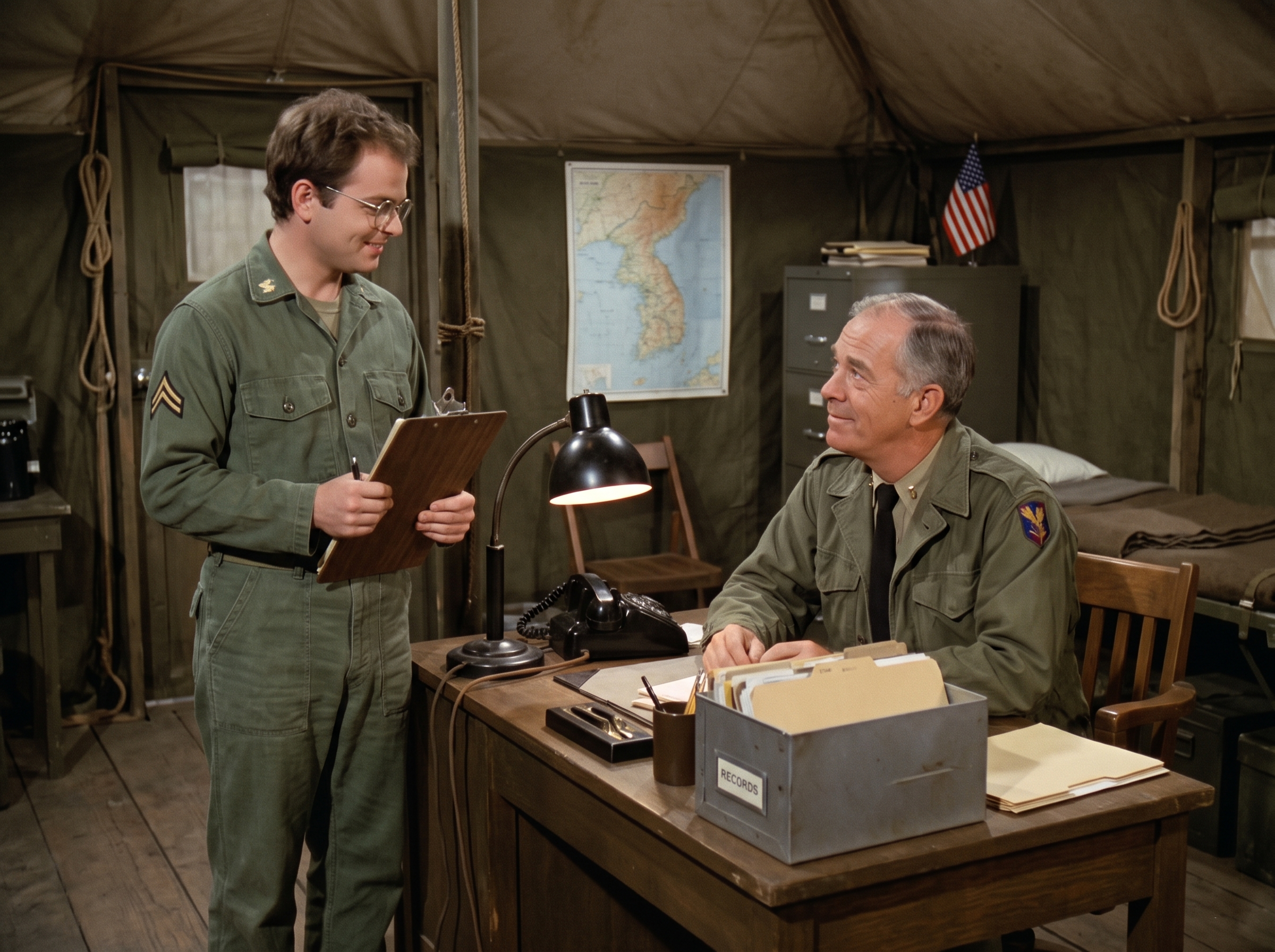
The war did not always announce itself with the frantic scream of incoming choppers or the panicked shouts echoing from the surgical compound.
Sometimes, the war was simply the heavy, suffocating silence of a slow Tuesday afternoon inside a canvas tent.
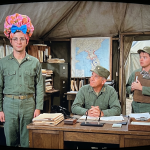
Colonel Sherman T. Potter sat behind his heavy wooden desk, staring at a stack of requisition forms that seemed to multiply every time he blinked.
The olive-drab walls of his office felt closer today, the heat of the Korean summer pressing against the fabric.
Behind him, the map of the peninsula hung on the canvas, looking less like a geographical chart and more like a permanent, spreading stain on their lives.
It was a quiet day at the 4077th Mobile Army Surgical Hospital, which only meant the exhaustion had time to settle deep into their bones.
Potter rubbed his eyes, feeling the familiar ache of too many miles, too much loss, and entirely too much paperwork.
He rested his arms on the warm brown wood of his desk, his gaze drifting over the familiar clutter of his command.
The practical desk lamp was switched on, casting a soft, warm pool of light over a gray filing box plainly stenciled with the word “RECORDS.”
Next to it sat the black field phone, sitting silent and heavy like a sleeping gargoyle that usually only woke up to deliver bad news from I Corps.
Today was a difficult day for the Colonel.
It was his and Mildred’s anniversary, and for the first time in his long military career, the mail had failed them both.
A massive monsoon off the coast had grounded the choppers and blown out the switchboards in Seoul, cutting off all non-essential communication lines to the States.
He was entirely, utterly cut off from Hannibal, Missouri, left only with the ghosts of memory and the smell of stale coffee.
The tent flap rustled softly, and Corporal Walter “Radar” O’Reilly slipped into the office.
Radar did not march; he simply materialized, bringing a quiet, comforting shift in the room’s air pressure with him.
He stood politely at attention in front of the desk, dressed in his practical, worn-in fatigues that looked perfectly natural to the harsh reality of the camp.
There was nothing glossy or heroic about the boy’s appearance, just the modest, lived-in olive drab cotton, his corporal stripes, and a clipboard clutched securely in his hands.
“Afternoon, Colonel,” Radar said, his voice soft, earnest, and slightly hesitant.
Potter looked up from his desk, leaning slightly forward with a posture of calm authority.
The soft office lighting caught the natural film grain of the boy’s youth, highlighting the contrast between the harshness of the army and the innocence of the clerk.
“What have you got for me, son?” Potter asked, his voice rough but laced with a customary, fatherly patience. “More complaints from General Clayton wanting to know why we use so many bandages at a hospital?”
“Uh, no sir,” Radar said, shifting his weight slightly and adjusting his round glasses.
He did not hand the clipboard over immediately, which was unusual.
Instead, he just stood there in a candid, mid-conversation beat, looking down at his paperwork and then back up at Potter.
Radar wore an earnest, intense focus, but the corners of his mouth were twitching into a small, shy smile.
It was a sweet, secretive smile that did not quite belong in a war zone, and it immediately caught the Colonel’s attention.
Potter looked at Radar with a mix of weary wisdom and gentle, protective pride.
He knew this boy better than he knew most of his own commanding officers.
He knew that when Radar got that specific, nervous-but-proud look in his eye, something completely impossible was about to happen.
“Spit it out, Radar,” Potter said gently, his tone dropping its gruff edge. “You look like a canary that just swallowed a very large, very classified cat.”
Radar gripped the clipboard tighter, his knuckles turning slightly pale against the brown pressed wood.
“Well, sir… I’ve been working on the daily requisitions,” Radar started, his voice wavering just a fraction of an inch.
“And?” Potter prompted, watching the boy’s shoulders tense.
“And… I had to make some trades, sir,” Radar confessed, looking everywhere but at Potter’s eyes. “I had to trade two cases of powdered eggs, a jeep distributor cap, three favors from a guy in the Signal Corps, and… well, I had to forge your signature on a priority-one tactical clearance form.”
Potter sat up straight, his paternal warmth suddenly spiked with a sharp jolt of administrative alarm.
“You forged my signature on a tactical clearance?” Potter asked, his voice dropping into a dangerous, commanding register.
“Yes, sir,” Radar said, the shy smile fading into a look of sheer, earnest panic. “And if anyone asks, I think I technically just committed high treason against the entire Eighth Army.”
The quiet tent suddenly felt incredibly small, and the silence stretched out, thick and unresolved between them.
Potter stared at the young corporal, the heavy silence stretching so long that the buzzing of a distant jeep engine outside felt deafening.
He looked at the boy’s worn uniform, the corporal stripes that always seemed a little too heavy for his young shoulders, and that earnest, terrified face.
“Treason, Radar?” Potter asked slowly, keeping his voice deadpan and terrifyingly calm. “That is a hanging offense. Or at the very least, a one-way ticket to a very stern talking-to from a court-martial board.”
“I know, sir,” Radar swallowed hard, his Adam’s apple bobbing nervously. “But I had to do it. It was a dire emergency.”
Potter frowned, his brow furrowing as his gaze dropped to the clipboard still clutched in Radar’s hands.
“What kind of dire emergency requires my powdered eggs and my forged signature?” Potter demanded.
Radar took a deep breath, stepping slightly closer to the worn wooden desk.
He extended the clipboard forward, but he did not let go of it.
Instead of a standard medical requisition form, Potter saw a hand-drawn routing map, completely covered in red pencil lines.
The lines connected a dizzying web of locations: Seoul, Tokyo, a naval ship in the Pacific, Hawaii, San Francisco, and finally, a small dot in the Midwest.
“The lines to Seoul aren’t completely down, sir,” Radar said quietly, his voice dropping to a conspiratorial whisper. “They’re just restricted to priority-one tactical emergencies for the brass.”
Potter’s eyes widened slightly as the sheer audacity of the boy’s plan began to dawn on him.
“So,” Radar continued, pointing to the red lines on the paper, “I declared a tactical emergency. Code name: ‘Operation Mildred’.”
Potter stopped breathing for a fraction of a second.
He looked up from the clipboard, his eyes meeting Radar’s across the cluttered desk.
The boy’s shy, proud smile had returned, illuminating his face under the warm, practical glow of the desk lamp.
“Sparky in Seoul owes me from that time I managed to requisition the penicillin for his commanding officer’s prize hound,” Radar explained, speaking quickly now to get the confession over with.
“He managed to patch a line through to a naval cruiser in the Pacific, who bounced it to a relay station in Frisco, who somehow connected it to the civilian switchboard in Hannibal.”
Radar pointed a trembling, ink-stained finger at the black field phone sitting next to the records box.
“Sir… Mrs. Potter is on the line. Right now.”
Potter stared at the heavy black plastic handset as if it had suddenly transformed into solid gold.
For a long, suspended moment, the veteran cavalryman could not find his voice.
The suffocating weight of the war, the endless stream of wounded boys, the miles of dark ocean separating him from his entire life—it all seemed to evaporate in the warm light of the office.
He looked back up at Radar.
In that candid, quiet moment, Potter did not just see a company clerk or an enlisted man.
He saw a son.
He saw a boy who had moved heaven, earth, and the rigid United States military bureaucracy just to give an old soldier a tiny sliver of his home.
Potter leaned forward again, the stern, weary authority melting completely away from his face.
It was replaced by a deep, profound, and overwhelmingly paternal gratitude.
“Radar…” Potter’s voice was thick, fighting a losing battle against the lump forming in his throat. “You risked a court-martial for my anniversary?”
“You are family, sir,” Radar said simply, his tone modest and entirely factual, as if it were the most obvious thing in the world. “Families are supposed to be together today.”
Potter swallowed hard, blinking back the sudden sting of moisture in his eyes.
He reached across the desk and gently pulled the clipboard from Radar’s hands, setting it down carefully next to the filing box.
“You are a wonder, Walter,” Potter said softly, using the boy’s first name like a blessing.
Radar blushed furiously, shifting his weight from one foot to the other and ducking his head.
“We only have about five minutes, sir, before General Clayton’s staff sweeps the trunk lines and realizes ‘Operation Mildred’ isn’t an artillery strike,” Radar whispered. “You better pick up.”
Potter reached for the receiver, his weathered hand shaking just a fraction of an inch as his fingers brushed the cold plastic.
He pulled the heavy handset to his ear.
“Mildred?” he said into the mouthpiece, his voice barely above a whisper.
A tinny, staticky, infinitely beautiful voice drifted out of the earpiece, cutting through the thousands of miles of ocean and war.
“Sherman? Is that you, you old horse thief?”
A massive, radiant smile broke across Colonel Potter’s face, washing away years of fatigue in an instant.
Radar took a respectful step back, sensing the deep intimacy of the moment and knowing his mission was complete.
“I’ll, uh… I’ll just go wait outside, sir,” Radar whispered, his shy smile blooming into full, genuine happiness. “I’ll make sure nobody interrupts the tactical emergency.”
“Thank you, son,” Potter mouthed silently, covering the receiver with his hand and giving the boy a look of absolute, pure love.
Radar gave a crisp, completely sincere salute, spun on his heel, and slipped quietly out of the tent, leaving the Colonel alone in the warm light.
Potter leaned back in his chair, the solid wood of the desk grounding him as the harsh sounds of the camp faded into nothingness.
For the next five minutes, there was no Korea, no 4077th, no blood, and no fear.
There was only the crackling, static-filled sound of the woman he loved, a miracle delivered by the most unlikely, wonderful angel in the United States Army.
Even in the darkest corners of the world, family always finds a way to cut through the static.