The Quiet After the Storm
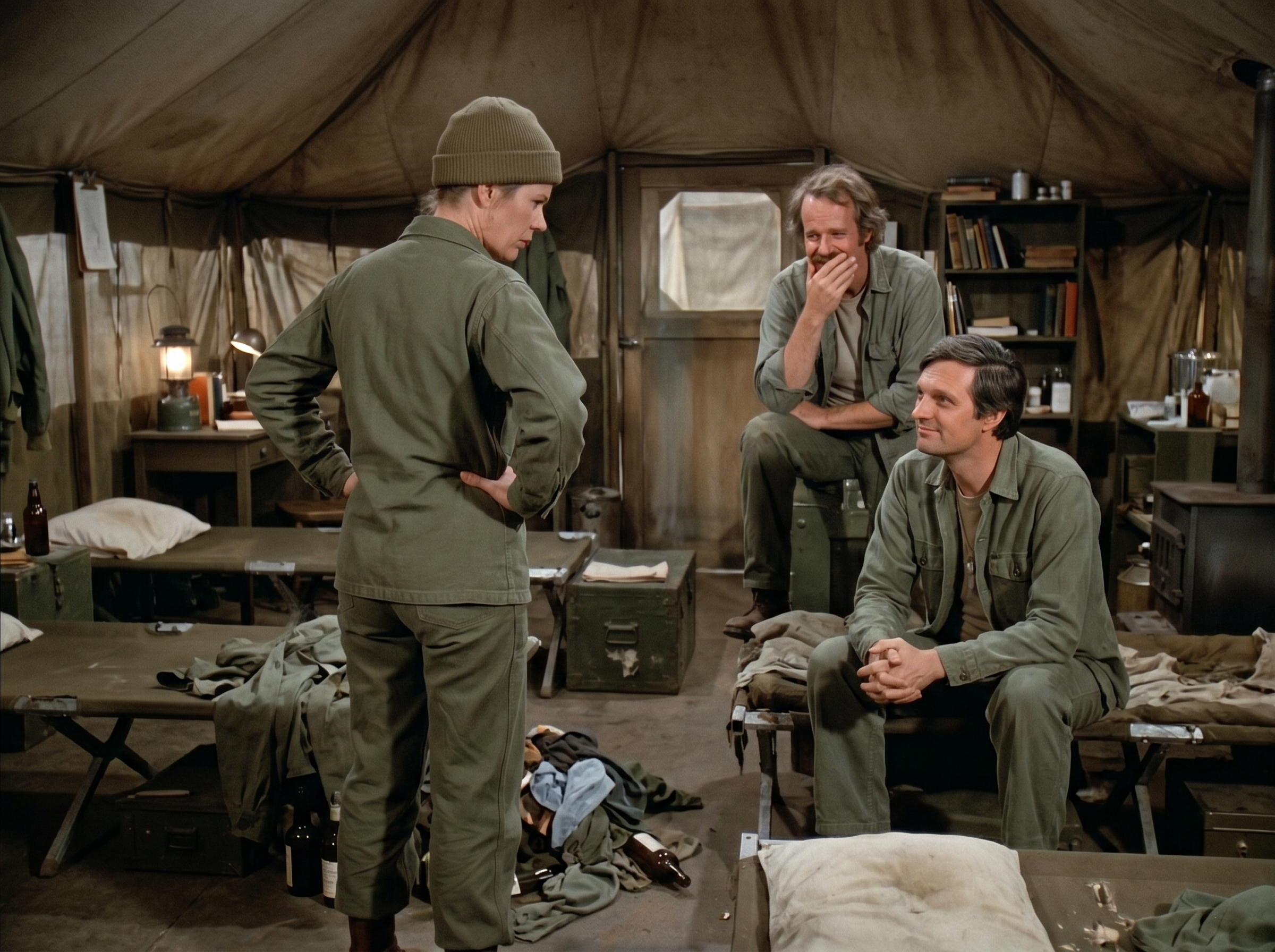
The dust of the day seemed to hang suspended in the air of the Swamp, a permanent fixture of our lives that no amount of sweeping could ever truly banish. It was late—that strange, hollow hour when the choppers had finally stopped their rhythmic thumping, leaving behind a silence that felt heavier than the noise.
Margaret stood in the center of the tent, her hands planted firmly on her hips, her combat beanie pulled low. She looked exhausted, her posture rigid as if she were holding her entire world together by sheer force of will.
B.J. sat on the edge of his cot, leaning forward with his elbows on his knees, his expression one of weary amusement. He was watching Hawkeye, who sat opposite him, looking far too calm for a man who had spent the last twelve hours surrounded by the relentless chaos of the O.R.
There was a half-empty bottle on the floor near Margaret’s boots, and a pile of laundry that seemed to have a life of its own. It was a scene of perfect, messy domesticity that we had all come to know better than our own homes.
“I didn’t come here to argue about protocol, Margaret,” Hawkeye said, his voice quiet, lacking its usual sharp, manic edge. He was looking up at her, his eyes searching hers, looking past the nursing supervisor and seeing the woman beneath.
“And I didn’t come here to be lectured on patience, Pierce,” she fired back, though the venom was absent. Her voice cracked, just once, betraying a fragility she usually kept under lock and key.
The air in the tent suddenly shifted, moving from the comfortable banter of roommates to something sharp and terrifyingly raw. Margaret turned toward the door, her shoulders trembling, the weight of the day finally threatening to pull her under.
She didn’t leave, though. She stopped, her back to them, clutching her elbows as if she were cold despite the suffocating warmth of the Korean night.
B.J. caught Hawkeye’s eye. It was that silent language they had perfected over months of shared grief and shared gin—a look that said, *tread lightly, she’s reached the edge.*
B.J. stood up slowly, moving with the unhurried grace of a man who knew exactly when to offer a drink and when to offer space. He didn’t approach her directly. Instead, he went to the small shelf, rummaged around, and pulled out two clean tin cups.
“You know,” B.J. said to the room at large, pouring a modest amount of their precious stash, “I think we’ve forgotten the most important rule of the 4077th. If you can’t laugh at the absurdity of it, you might as well start memorizing the dictionary.”
Hawkeye stood up to join him. He walked over to where Margaret stood and gently placed a hand on her shoulder. She stiffened for a second, then let out a long, shuddering breath, her head dropping forward.
“I just wanted them to be okay, Hawk,” she whispered, the professional veneer finally dissolving. “Just for once, I wanted to feel like we were actually winning instead of just holding the line.”
“We are holding the line, Maggie,” Hawkeye said softly, using the name only when the masks were off. “And that is a victory. It’s the only one that matters tonight.”
He handed her the tin cup. She took it, her fingers brushing against his, and for a long moment, the three of them just stood there. The tent, with its peeling canvas and scattered memories, didn’t feel like a barracks anymore. It felt like a sanctuary.
B.J. raised his own cup in a slow, solemn salute. “To the ones who made it back. And to us, for being crazy enough to keep showing up.”
Margaret turned, a sad, weary smile finally touching her lips. She took a sip, the bite of the alcohol doing little to warm her, but the company doing everything. She moved to the edge of the cot and sat down, letting her guard drop completely as she leaned her head against the wooden post of her bunk.
The humor wasn’t forced, and the pain wasn’t hidden behind jokes. It was just three tired people in a tent in the middle of nowhere, finding the exact amount of grace they needed to survive until the sun came up.
We didn’t solve the war that night. We didn’t solve our own exhaustion, or the ghosts that hovered just outside the tent flap. But as the low murmur of conversation drifted into the night, filled with half-forgotten stories and the gentle clinking of metal against metal, the world felt a little less lonely.
In the 4077th, you didn’t have to be perfect, and you didn’t have to be strong all the time. You just had to be there, and you had to be willing to let someone else be there with you.
That was the secret, the thing that kept us human when everything else was designed to strip that humanity away.
We were a family of circumstance, holding onto each other in the dark until the dawn brought a new day.