The Refined Reprieve
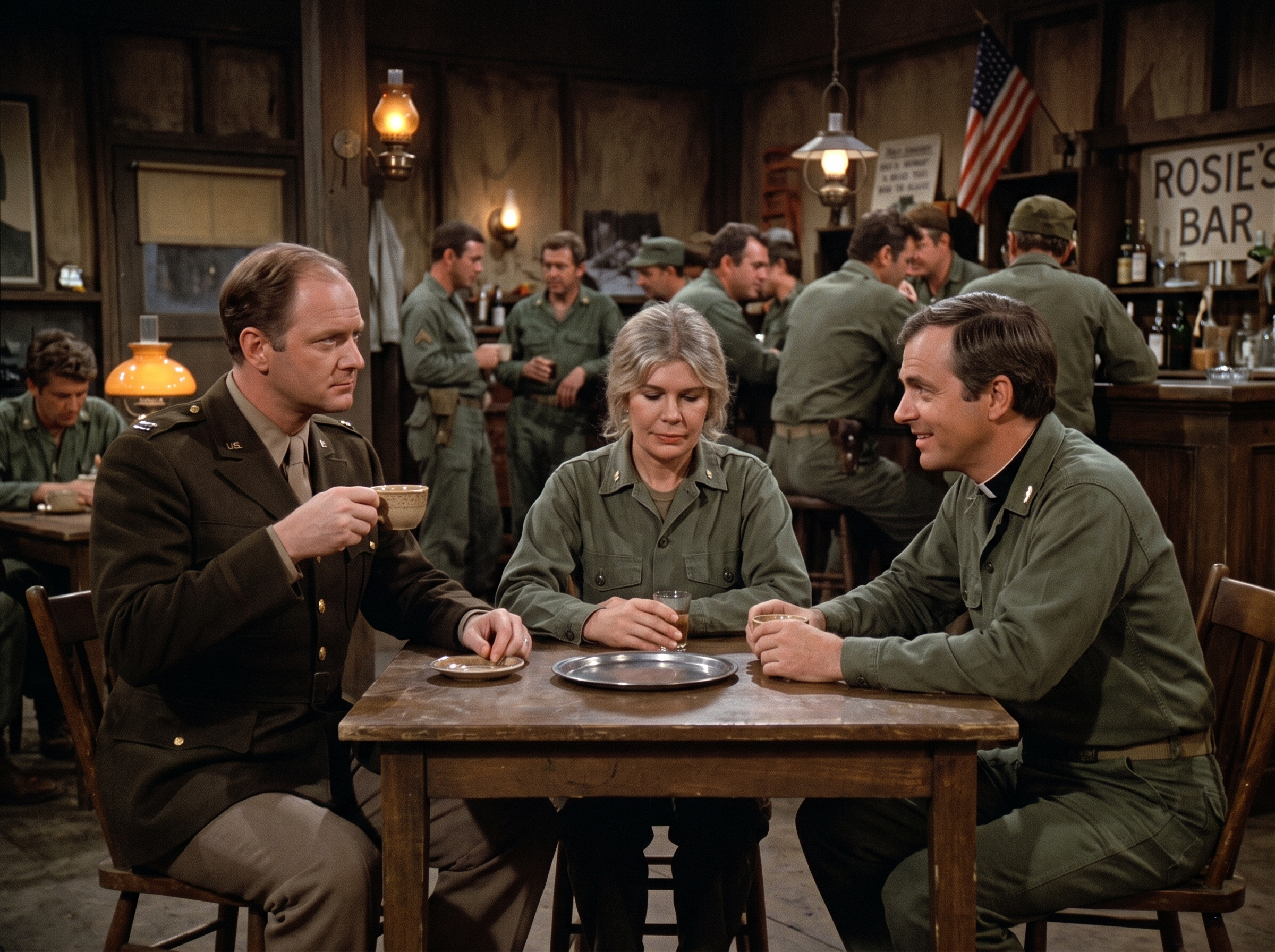
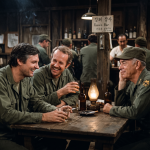
Rosie’s Bar was the only place in Uijeongbu where the mud didn’t seem quite so oppressive.
Inside, the warm light of the lanterns made the smoky air feel like a cozy, worn blanket.
Peeling posters shared wall space with an American flag and a handwritten sign, the visual furniture of a found family trying to make a home in a forgotten corner of the world.
Tonight, the quiet hum of a hundred weary soldiers drinking the memories of the day away was interrupted by a distinct, delicate click.
At the small, scarred wooden table by the window, Major Charles Emerson Winchester III sat with an posture that would make a West Point instructor weep with pride.
He was the only man in the entire bar—perhaps the entire Korean peninsula—still wearing his pristine Class-A uniform.
His expression was a masterpiece of refined misery, a delicate balance of aristocratic disdain for his surroundings and a bone-deep fatigue that he would never, ever admit to.
He was carefully lifting a tiny, ceramic tea cup with precise, dainty gestures, as if he were taking high tea at a Boston hotel rather than sipping lukewarm brew in a plywood shack.
Beside him sat Major Margaret Houlihan.
She wore her simple olive-drab fatigue shirt, the standard attire of the 4077th, but she held herself with a quiet, powerful grace that transcended the canvas.
Her eyes were fixed on the small glass in her hand, her mouth set in a guarded line that hid the exhaustion of a hundred difficult surgeries.
Between them sat Father Mulcahy.
He was the anchor in their small, tattered canoe.
His fatigue shirt looked soft and worn, much like his patience, and he smiled a gentle, hopeful smile towards Margaret, trying to offer comfort without breaking the delicate silence that hung over the table like a foggy dawn.
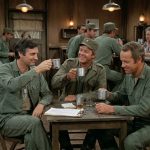
The table itself was a landscape of their shared experience: a few worn cups, a metal plate waiting for something from Rosie’s grill, and three weary hearts.
Outside, the war continued its terrible rhythm, but here, they had carved out a temporary peace.
But the silence was about to shatter.
They had all seen too much that day, and the quiet was becoming too heavy to hold.
The last shift in the O.R. had been brutal, a cascade of tragedy that left even the strongest of them hollowed out.
Charles daintily placed his cup back down, his expression hardening.
Margaret clutched her glass, the gin inside a fragile shield.
Father Mulcahy’s gentle smile wavered for the briefest second, a silent request to the heavens.
The moment was taut, a rubber band pulled to its breaking point, and any sudden move or word would snap it, revealing the raw pain hidden behind their careful composure.
The tension was broken by the smallest sound—the distant, hollow thump of artillery.
It was too far to be a threat, but too near to be forgotten.
The three of them seemed to exhale simultaneously, a shared acknowledgment that the world outside was still there.
Margaret downed her shot in a single, fluid motion.
She didn’t wince.
She didn’t smile.
She simply placed the glass back on the table with a firm, decisive thunk.
Charles stared at his cup, the refined geometry of his face suddenly cracking.
A small tremor in his hand, barely noticeable, betrayed him.
Thedainty pinky finger uncurled and he slumped forward, just an inch, allowing his rigid shoulders to drop.
It was the first time Margaret had ever seen him so visibly vulnerable outside of an operating room.
“It’s a failure, Father,” Charles murmured, his voice velvety even when thick with despair.
“Boston Fellowship,” he continued, still staring at the cup. “Rejected.“
“They claim my skills… my dedication… are not suitable for their prestigious institution.“
He looked up at Margaret and Mulcahy, his refined facade replaced by a raw, naked hurt.
“They have no idea what it is to be a surgeon in this mud. They think we are butchers.“
He finally let go of the cup, placing both hands flat on the scarred table.
“I wore the Class-As to read the letter,” he added, a wry, sarcastic note creeping back in.
“To give the moment the appropriate gravity. It seems I only succeeded in looking ridiculous in a bar that doesn’t know the difference.“
Margaret looked at him, truly looked at him, not as a superior or a rival, but as a colleague drowning in the same sea.
She pushed her empty glass towards the metal plate.
“They’re fools, Charles,” she said, her voice unusually soft.
“Any fellow would be lucky to have you. We are lucky to have you.“
She wasn’t used to offering comfort to him, and her words were direct and unadorned, but sincere.
Father Mulcahy nodded gently. “Sometimes, Charles, the greatest recognition doesn’t come in an envelope. It comes in the quiet moments after we’ve done our best.“
He picked up the metal plate and placed it in the center of the table.
“Perhaps we should bless this empty space instead,” Mulcahy said, a small chuckle escaping.
“It has held so much silence tonight. Sometimes, the most meaningful prayers are the ones we don’t speak.“
His gentle smile found Charles and held his gaze. “You provided life today, Charles. The fellowship provided a pieces of paper. I know which I value more.“
Charles looked from Mulcahy to Margaret.
The silence was different now.
It wasn’t heavy or tense.
It was found family.
It was three weary people from different worlds, united by circumstance, finding a small shelter from the storm.
Charles finally managed a weak, appreciative smile.
He reached out and picked up his small tea cup again.
He held it, this time, with his hand.
He didn’t make a dainty gesture.
He simply held it, feeling the warmth.
“You know, Margaret,” Charles said, his refined voice returning, but with a new edge of genuine warmth. “I believe your shot of gin might be a more fitting tribute to my rejection than this tea. Although,” he sniffed, “it does not have the correct bouquet.“
Margaret laughed, a short, dry, beautiful sound.
She looked at Rosie, who was bustling behind the bar.
“Rosie! Another round for the fellowship!“
Rosie didn’t understand the joke, but she understood the laughter.
She raised a glass from behind the counter in a silent salute.
For another hour, they sat there, three souls from the 4077th, found in a plywood haven.
They shared no other words about the war or fellowships, just small, tender, tired human connection.
The photo was taken at the tail end of that shared peace.
Looking at it now, you can still feel the profound fatigue and the secret, unspoken strength of found family that defined the 4077th.
They were weary, wounded, and wise beyond their years, finding home in the middle of a war-torn nowhere.
The mud might stain the uniforms, but never the spirit of the family we found there.