The Clipboard Crusade and the Box of Hope
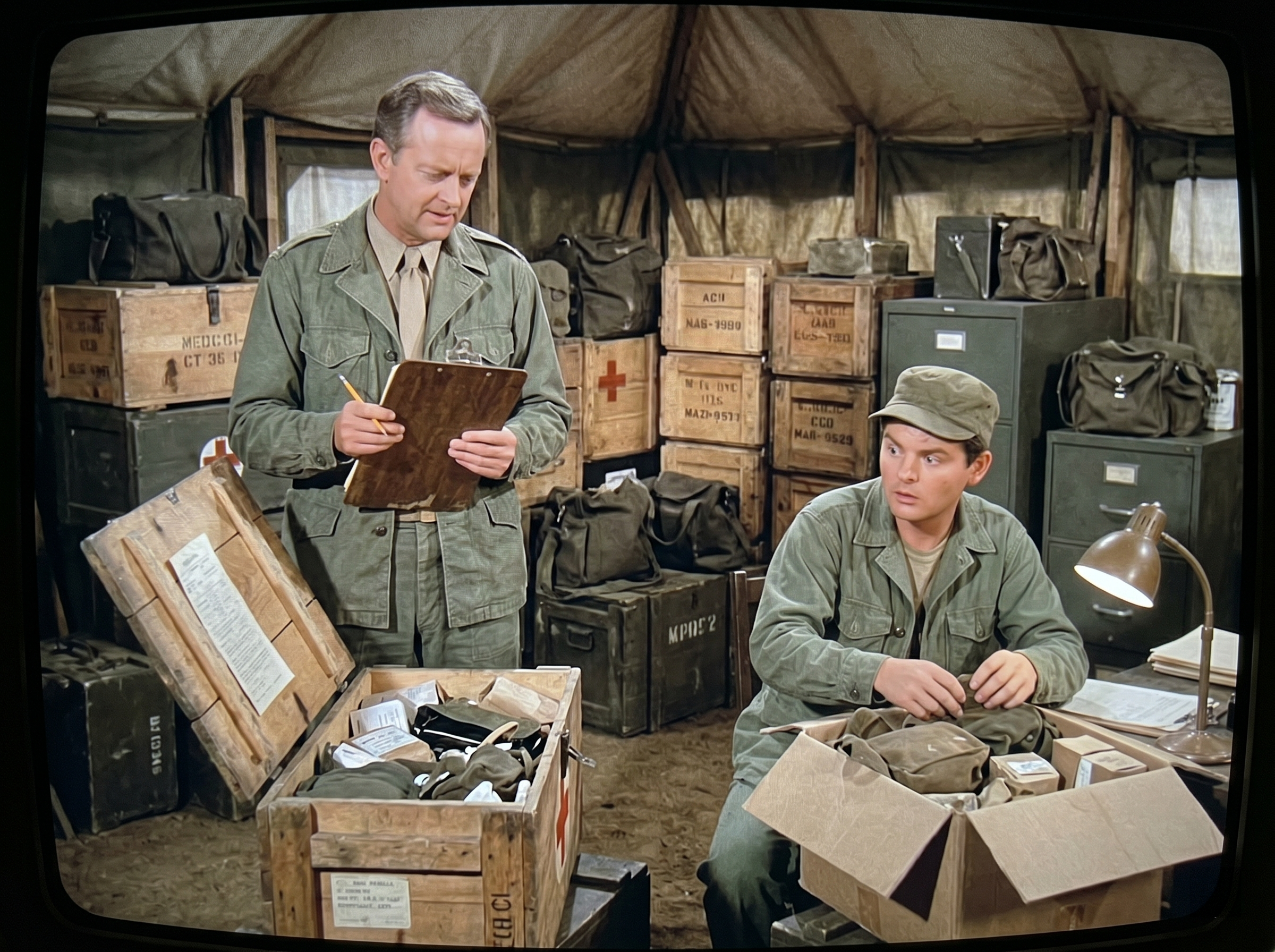
You know the feeling, that 4077th fatigue. It’s the kind that settles in your bones and makes the simple sound of supply crates shuffling feel heavier than a Jeep engine. Today, that shuffling echoed in the Supply Tent, a small, cluttered haven of order and chaos rolled into one. Colonel Potter, bless his pragmatic soul, was on the march, his clipboard acting as both shield and spear against the rising tide of administrative dread. He had the kind of furrowed brow that suggested he was mentally rearranging the universe, and it started right here, with this shipment of… well, of everything.
Radar, that sweet, perceptive anchor, was sitting cross-legged by a growing collection of cardboard, his hands delicately navigating a sea of tiny bottles and bandages. He was like a surgeon working with miniatures, his brow mirrored the Colonel’s, but with a different kind of intensity. He was searching, not for an error in accounting, but for something that wasn’t there, a small, personal absence in a landscape of sterile necessity.
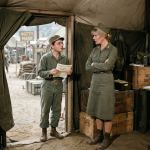
The Supply Tent itself was a mosaic of war-era utility: olive drab fabric walls clinging to the cold ground, filing cabinets that had seen more grease than some of the operating tables, and wooden crates stacked higher than hope sometimes feels. It was the background music to their lives, the quiet rhythm of logistics in a world that often made no sense.
Potter’s pencil scratched a symphony of checks and X’s across his clipboard, his voice a dry, reliable constant. “Twenty-four field dressings, check. Twelve packs of plasma, check. And… three bottles of whiskey. What happened to the request for five? Did O’Reilly eat them?”
Radar didn’t even look up, his fingers still methodically unpacking a particularly stubborn little box. “No sir. It wasn’t the whiskey.” He said it quietly, almost a whisper, his voice colored with a tired certainty that made Potter pause. The Colonel looked over the edge of his spectacles, his gaze shifting from the list to the boy surrounded by cardboard.
“Well, Radar, spill it. What was it? You’ve been brooding for an hour, and it’s making my clipboard itch.” Potter’s tone was gruff, but there was a thread of worry in it, a small ripple of genuine concern for his company clerk. He didn’t just run the camp; he minded its soul, and he knew when a crack was showing.
Radar hesitated, his fingers still tracing the outline of a small glass vial. “The cookies, sir. The ones my Ma sent in that last care package. The batch with the white chocolate. I can’t find the tin. They must have missed the shipment.” He looked up, and for a fleeting second, the tired clerk was gone, replaced by a young man yearning for a taste of home. His eyes were wide, and in that small, shadowed supply tent, the weight of a thousand miles and a hundred lost things felt centered in his gaze.
The silence that followed was heavy, a quiet vacuum of understanding. It wasn’t about the cookies. It never was. It was about what they represented: a connection to something safe, something warm, something that didn’t smell like antiseptic and mud. Potter’s pencil hovered, a single checkmark left incomplete. Radar’s eyes, fixed on the Colonel, were filled with a desperate, unspoken plea for a miracle, for a piece of his lost mother’s kitchen to miraculously appear among the gauze and iodine. And in that moment, in the gentle, tired light of the Supply Tent, a single, unfinished checkmark suddenly felt like the most important thing in the entire war.
Potter lowered the clipboard. He looked from Radar’s face to the chaotic inventory list, his dry, military practicalities hitting a wall of simple human longing. He saw not a logistical issue, but a homesick kid, and he knew that sometimes, morale wasn’t built with supply lines, but with kindness. He didn’t offer platitudes or easy reassurances. He simply lowered the clipboard onto a stacking of crates with a solid, definitive thud.
“All right, Radar, enough of this administrative ballet,” Potter said, his voice softer now, with a quiet, paternal command. He began to unbutton the top button of his jacket. “We’re going on a search party. And it’s not on my clipboard.” Radar watched, his eyes widening in confusion as the Colonel started rolling up his sleeves.
“Sir?” Radar asked, his voice cracking slightly. He was accustomed to the Colonel’s strict adherence to rules and procedures, to the rigid order of camp life. Seeing him discard the official list was like watching a river flow upstream.
“We are going to find those white chocolate cookies,” Potter stated, a determined glint in his eye. “We’re going to search every box, every crate, and every single bag in this tent, if we have to. Nobody messes with a soldier’s mail, especially not when it comes from his mother.”
He moved past Radar and began aggressively shifting a stack of wooden crates, his previously neat organization collapsing into a purposeful, messy excavation. “Start over there,” Potter directed, pointing toward the back, past the filing cabinets. “The mail often gets buried under the heavier medical gear.”
For a few seconds, Radar just sat there, stunned by the sheer, surprising humanity of the gesture. Then, a smile, small but genuine, finally broke across his face. He didn’t just smile; his entire posture relaxed, the tension draining out of his shoulders. He scrambled up, his typical earnestness replaced by a sense of hopeful adventure. “Yes, sir!” he chirped, moving with a speed that suggested the cookie search was the single most vital mission in Korea.
And so they dug. Colonel Potter, the steady commanding officer, and Radar, the nervous, capable clerk, became a two-man supply chain of hopeful excavation. They turned the orderly tent into a temporary, magnificent disaster area, upending bags, searching empty crates, and even checking the spaces behind the filing cabinets. The air grew dusty, and their fingers got dirty, but the shared purpose created a warm, unlikely connection.
There was a moment, around hour two, when they both stopped, surrounded by piles of discarded canvas and empty boxes. Potter looked at his watch, a sigh escaping his lips. “It’s getting late, Radar. This might be a lost cause.”
Radar’s face fell, the hope dimming. “I guess you’re right, sir. Ma’s packages don’t always make it.” He started to pick up a stray bundle of gauze.
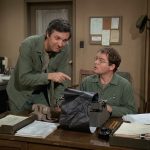
But Potter wasn’t finished. He looked at the disorganized piles and then back at the small, cluttered desk near the lamp. He saw a brown leather satchel that hadn’t been searched yet. He walked over and gently unbuckled it. It was Hawkeye’s bag, a messy sanctuary of stethoscopes, medical notes, and half-empty packets of crackers.
And right there, sandwiched between a medical text and a stained notebook, was a simple tin box. Potter carefully lifted it. The writing on the top, in precise, familiar script, read: ‘For Walter, from Ma. White Chocolate Cookies – do not share!’
“Well, look at this,” Potter said, a quiet triumph in his voice. “Seems Captain Pierce has been doing some supply work of his own.”
He walked over to Radar and placed the tin gently in his hands. It was like he was giving him a tiny, tangible piece of home.
Radar’s hands trembled as he took the tin. His eyes glistened, but this time, not with loss. He couldn’t speak. He just looked at the tin, then up at Colonel Potter, a look of profound, silent gratitude. He opened the lid, and the scent of sweet, home-baked white chocolate cookies flooded the small, dusty Supply Tent, a scent that was better than all the supplies in the world.
“They’re just as I remembered,” Radar whispered, his voice thick with emotion. He didn’t share right away. He just savored the moment, the simple, profound comfort of having that tin in his hands. He knew the war was still happening outside, but for now, in that small, messy sanctuary of supplies, there was kindness, friendship, and the sweet, lingering scent of a mother’s love.
And as Colonel Potter watched the young man find his footing again, he let out a long, slow breath. The checkmark on the clipboard could wait. The supply list could be re-ordered. But this, this moment of restored hope, this simple, vital piece of humanity… this was the most important thing he’d check off his list all day. The cookies tasted like white chocolate, but in that Supply Tent, they tasted of home, of family, and of the quiet, enduring grace of simply caring for one another.
And the Supply Tent was filled with the only currency that really mattered: the sweet taste of home and the comforting certainty of being seen.