The Mystery of the Monday Mess Hall Stew
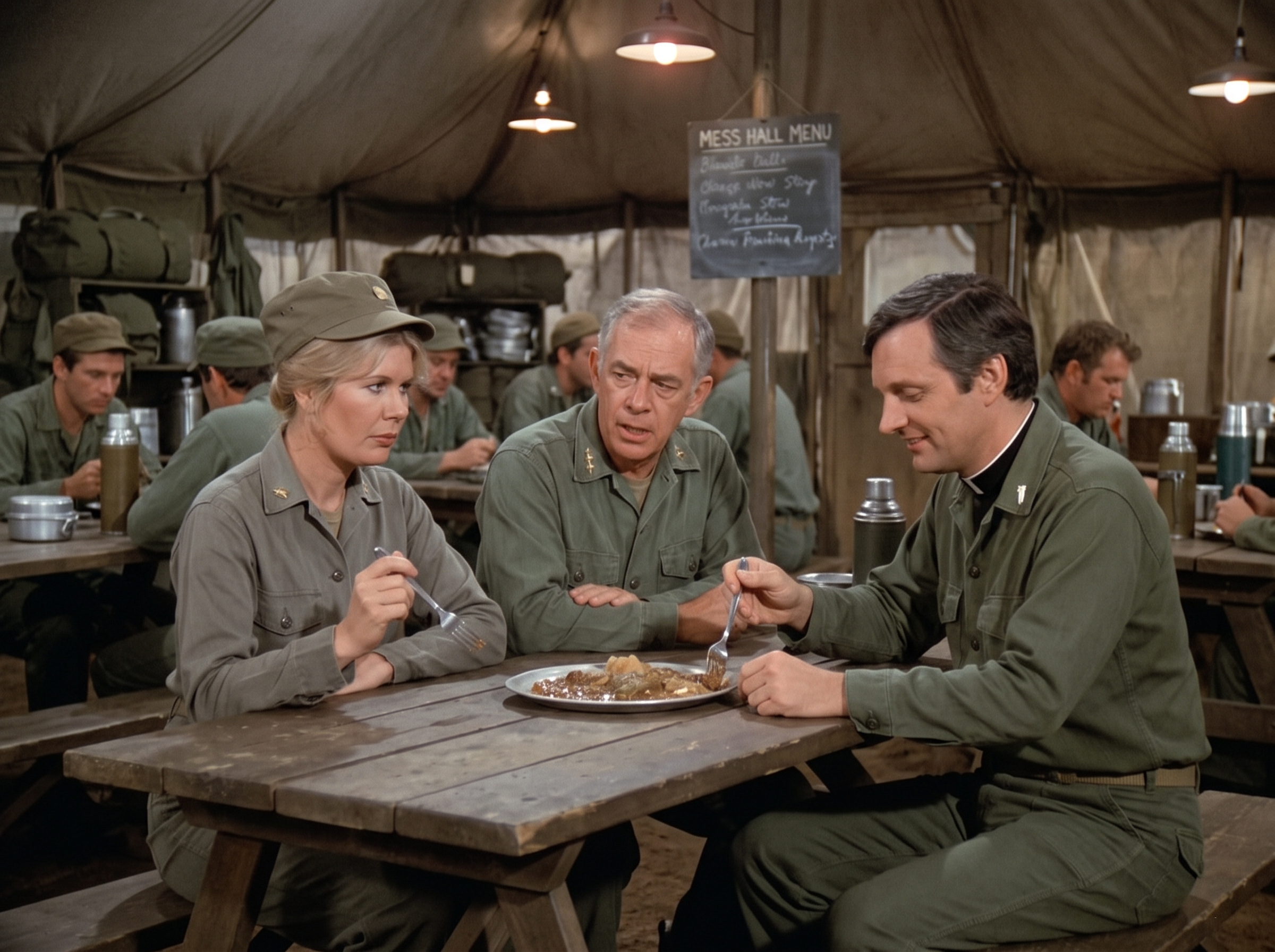
The fluorescent lights in the mess tent flickered with that familiar, rhythmic buzz that seemed to be the unofficial soundtrack of our lives. It was another Monday, which meant the kitchen crew had once again decided to test the limits of human digestion with something that looked suspiciously like industrial lubricant masquerading as a hearty beef stew.
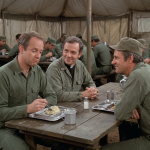
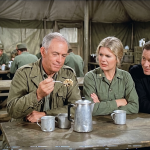
Colonel Potter sat at the center of the wooden table, his forehead creased with the kind of focus he usually reserved for reviewing casualty reports or negotiating for spare parts. Across from him sat Margaret, her posture immaculate even after a twelve-hour shift in Post-Op, her eyes darting between the steaming plate in front of her and the blackboard menu behind her.
To their right, Father Mulcahy was gamely poking at his serving with a fork, his expression one of polite, holy resignation. He had spent the morning counseling a young corporal and was clearly in need of sustenance, yet he seemed to be treating his dinner like a delicate theological puzzle he wasn’t quite ready to solve.
“I’ve seen better looking things come out of the septic tank, Father,” Colonel Potter muttered, not looking up from his plate. “I’m not entirely sure if this is meant to be eaten or used to patch a hole in the jeep’s radiator.”
Margaret let out a sharp, weary sigh, the kind that reminded us all that she was the backbone of this camp. “It’s protein, Colonel. At least, I think that’s what the lab report would say if we bothered to send a sample.”
I watched them from a few feet away, feeling that familiar, heavy blanket of fatigue that settled over the 4077th like dust after a convoy passed. It wasn’t just the hunger; it was the sheer, relentless absurdity of it all. We were thousands of miles from home, eating mystery meat in a canvas box, trying to find a reason to laugh.
Suddenly, Father Mulcahy leaned forward, his fork hovering mid-air. He looked at the Colonel, then at Margaret, his eyes twinkling with a sudden, uncharacteristic spark of mischief. He gently pried apart a particularly grey-looking chunk of the stew, revealing something buried deep within the broth.
“Colonel,” he whispered, his voice trembling slightly with suppressed laughter. “I think you might want to hold off on your critique. I believe… I believe this might be the first miracle of the week.”
The entire table went deathly silent. Colonel Potter squinted, leaning in so close his nose nearly touched the gravy. Margaret dropped her guard, her shoulders sagging as she peered into the mess. The tension in the air shifted from weary annoyance to something sharp, frantic, and entirely bizarre.
“What in the name of horse sense is that?” Potter barked, his voice hushed but demanding.
Mulcahy carefully extracted the object with his fork, balancing it on the edge of his tray. It was a small, perfectly preserved plastic toy soldier, covered in brown gravy, standing at rigid attention in the middle of a pool of starch.
Margaret let out a startled, undignified bark of laughter that she immediately tried to swallow with her hand. The Colonel’s eyes went wide, then narrow, and then, slowly, the corners of his mouth began to twitch.
“I suppose that’s one way to ensure we stay disciplined,” I added, stepping closer to join them, unable to help myself. “At least we know someone in the mess tent is paying attention to the war effort.”
The absurdity of the moment broke the spell of the long, gray day. Father Mulcahy started to chuckle, a soft, bubbling sound that grew until he was shaking with mirth. The Colonel finally broke, letting out a wheezing, old-man belly laugh that made the mess tent benches creak. Even Margaret, usually so steadfast and serious, was wiping tears from her eyes, her shoulders shaking uncontrollably.
We weren’t laughing at the war. We were laughing because the world had stopped making sense a long time ago, and here we were, sitting in a canvas tent, being served a toy soldier in our stew. It was ridiculous, it was pathetic, and it was absolutely perfect.
For a few minutes, nobody talked about the wounded. Nobody talked about the mud, the cold, or the letters from home that were still sitting in our lockers. We were just a group of friends, tired and hungry, finding a moment of genuine, human joy in the middle of a place where joy was supposed to be a luxury we couldn’t afford.
As the laughter died down, the Colonel picked up his fork and nudged the little soldier, setting it back upright. “Well,” he sighed, patting Mulcahy on the shoulder with a rare, genuine tenderness. “I guess we’re eating with the infantry tonight, boys and girls.”
The food didn’t taste any better, but it went down easier. We finished our meal in a quiet, companionable silence, the kind that only exists between people who have seen too much and have decided to hold onto each other anyway. As we stood up to leave, I looked back at the table. The little plastic man was still standing there, a tiny, brave sentinel in a sea of gray gravy, keeping guard over our small, precious corner of peace.
We walked out into the cool evening air, the distant sound of a helicopter fading away, feeling a little less heavy than we had an hour ago. We were the 4077th, and if we could survive the stew, we could survive anything.
In the heart of the madness, it’s the smallest things that keep us whole.