The Day Klinger Held His Breath
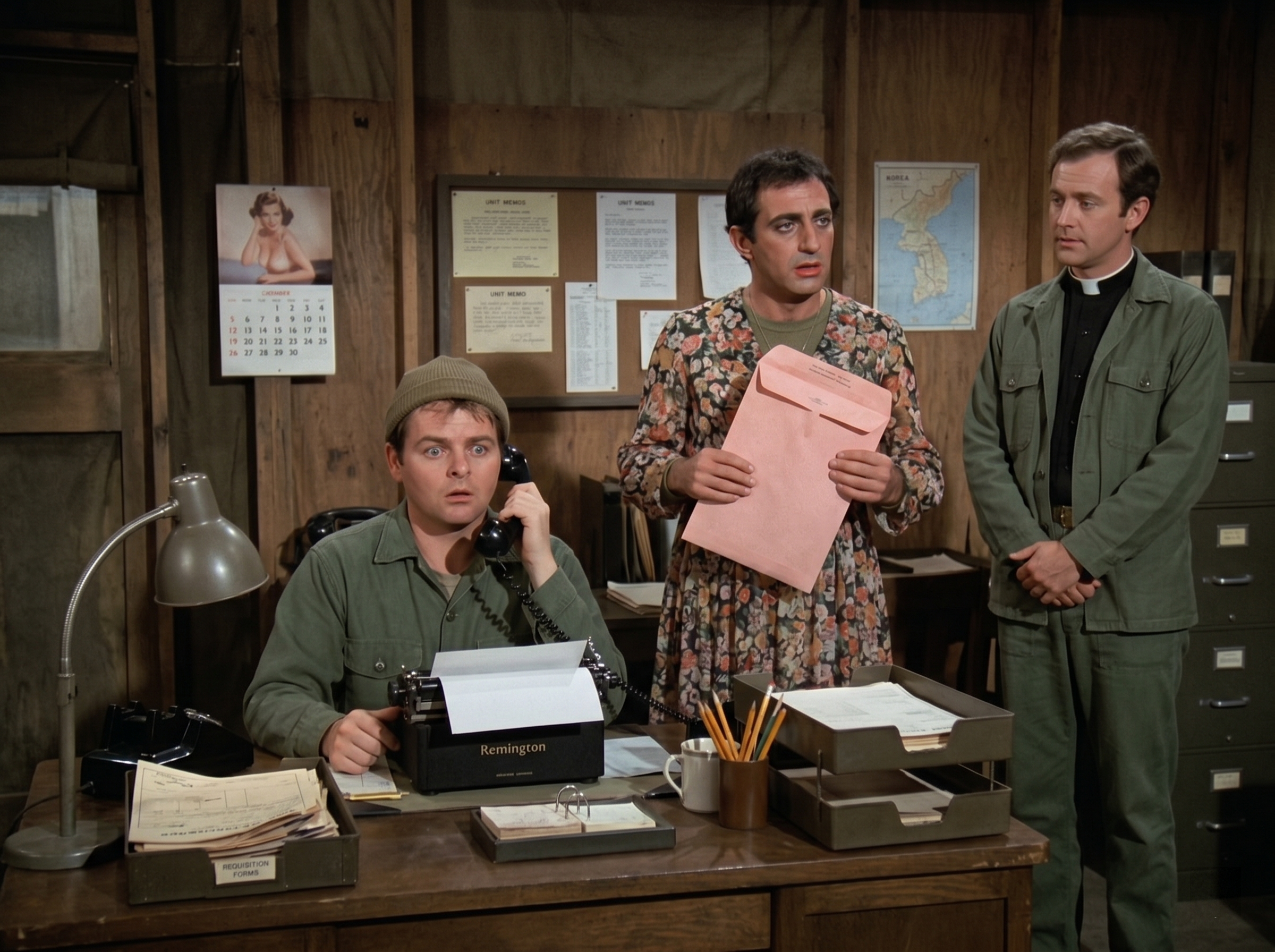
Do you remember that specific, quiet kind of chaos that settled over the 4077th right after a long casualty run?
It wasn’t the screaming panic of the operating room; it was the exhausted, hollow stillness that follows, when the only sound is the rhythmic *clack-clack-clack* of Radar’s typewriter, meticulously documenting another round of saved lives and lost causes.
This particular Tuesday was different.
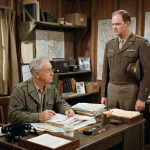
In the drab wooden heart of Headquarters, the normal, tired rhythms were frozen.
Radar O’Reilly sat at his desk, the “Remington” typewriter idle, its last sheet of paper half-typed.
He wasn’t moving.
His beanie-clad head was tipped back slightly, the black telephone receiver pressed tightly to his ear.
And his eyes—usually watchful but soft—were wide with a kind of blank, processing horror.
If Radar looked like that, something *really* bad had just happened, and it hadn’t come from a shell-casing or a bullet wound.
Standing right behind him, frozen in his own kind of flamboyant anxiety, was Corporal Max Klinger.
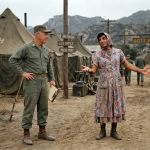
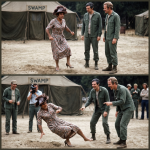
This morning, Klinger was in his “Floral Afternoon” ensemble—a busy, patterned, long-sleeved dress that somehow clashed perfectly with the dull green walls of the camp.
He clutched a large, heavy, pink mailing envelope with both hands, gripping it so hard his knuckles were white against the dress material.
His dark eyes were fixed on Radar, full of a terrified, hopeful energy that matched the silent scream in the room.
And rounding out this frozen trio was Father Mulcahy, the only stabilizing force of quiet dignity, standing with his hands clasped, offering a silent prayer for whatever news Radar was receiving.
He had simply walked in to drop off an inventory form and had been caught in the emotional snapshot.
What Klinger had *thought* was a harmless plea to the base commander’s wife was unfolding into a potential disaster.
The only noise in the room was the heavy, wet click as Radar finally swallowed.
“I… I see, sir. Yes, Commander,” Radar stammered, his voice so quiet it barely registered.
Klinger squeezed the pink envelope tighter. He looked ready to break into tears of either relief or total catastrophe.
Radar’s eyes, normally focused, were currently pointed at nothing, staring past the 1953 pinup calendar on the wall.
He looked up at Klinger, and then beyond him to Father Mulcahy.
“It’s about the… special delivery,” Radar whispered, his voice cracking.
The phone was silent. Radar held it to his ear for three more agonizing seconds, then slowly, deliberately, lowered it into the cradle.
The simple sound of the plastic resting against its receiver was the loudest noise in Korea.
“What? What is it, son?” Klinger pressed, his voice high-pitched and strained. He was vibrating in his dress.
“He didn’t even mention the dress. He didn’t mention Section Eight. He didn’t even mention the commander’s wife,” Radar said, his voice flat with disbelief.
Father Mulcahy stepped forward. “Then what, Walter? The news seems grave.”
Radar finally met Klinger’s desperate eyes.
“He said, ‘Tell Corporal Klinger, if he values his stripes, he will personally deliver a very specific item… and not *until* I order it.’”
Klinger’s face crumpled slightly. “What item?”
“Wait,” Radar said, “and then he said, ‘But before that, O’Reilly, what’s this about a request for… *pantyhose*?’”
The air in the room seemed to vacate. Klinger gasped, his pink envelope now held to his chest like a floral shield.
Father Mulcahy looked between them, a gentle flush rising to his own face. “Pantyhose? Oh dear.”
“He has the list,” Radar groaned, running a hand under his beanie. “The supply list you slipped in, Max! He said the word ‘pantyhose’ with… an unsettling amount of curiosity.”
For Klinger, this was a moment where several parallel universes of shame and victory collided. He wanted to go home. He wanted this specific woman’s garment to win him a ticket. And now the base commander was *personally* aware of his list.
“But he didn’t court-martial me?” Klinger asked, a tiny kernel of hope sparking.
“No,” Radar said. “He wants you to bring him the… *specific item*… the envelope. Right now.”
Klinger looked at the large, heavy pink envelope as if it contained plutonium.
He hesitated, then slowly extended the pink envelope over the desk, handing it not to Radar, but to Father Mulcahy.
“What is in this, Maxwell?” Mulcahy asked gently, holding the heavy weight.
“My hope, Father,” Klinger said, his expression one of tragic resignation. “My ultimate plea. A 20-page dissertation on why a dress—no matter how tasteful—is incompatible with a combat zone. It’s a work of art.”
Mulcahy smiled compassionately. “Ah. Art. I think I see.”
Radar looked back and forth. “Max, you have to take it. He specified you.”
“I can’t. Not like this! I’m in floral!” Klinger gestured helplessly to his outfit. “The commander will never respect my argument for insanity if I look this… put together!”
Father Mulcahy placed a comforting hand on Klinger’s shoulder. “I believe, Maxwell, that you already have his full attention. The pantyhose list ensures that.”
The tent door opened, and a tired Colonel Potter stepped in, a rare moment of respite written on his face. He stopped, taking in the scene: Radar staring, Klinger in a dress clutching his arms, Mulcahy holding a large pink envelope.
Potter’s eyes narrowed slightly. He looked between them, the silence hanging heavy with weary affection and quiet endurance.
“Anyone want to explain why O’Reilly looks like he’s seen a ghost and Klinger is vibrating in a bedsheet?”
No one answered immediately.
The moment stretched, a fragile snapshot of the absurd and the tender human heart that beat at the core of the 4077th. In that quiet office, surrounded by filing cabinets and maps of a foreign land, they were just men trying to survive the quiet war.
Klinger finally found his voice, high and quiet. “Just a… delivery, Colonel.”
Potter smiled a dry, affectionate smile. “Carry on, Corporal. Just keep the pantyhose inventory low.”
The small moment of human comedy, the shared fatigue, the quiet loyalty—this is what bound them together. They would all still be here tomorrow.
They all kept breathing, one absurd, exhausting, and hopeful moment at a time.