A Quiet Cup at Rosie’s
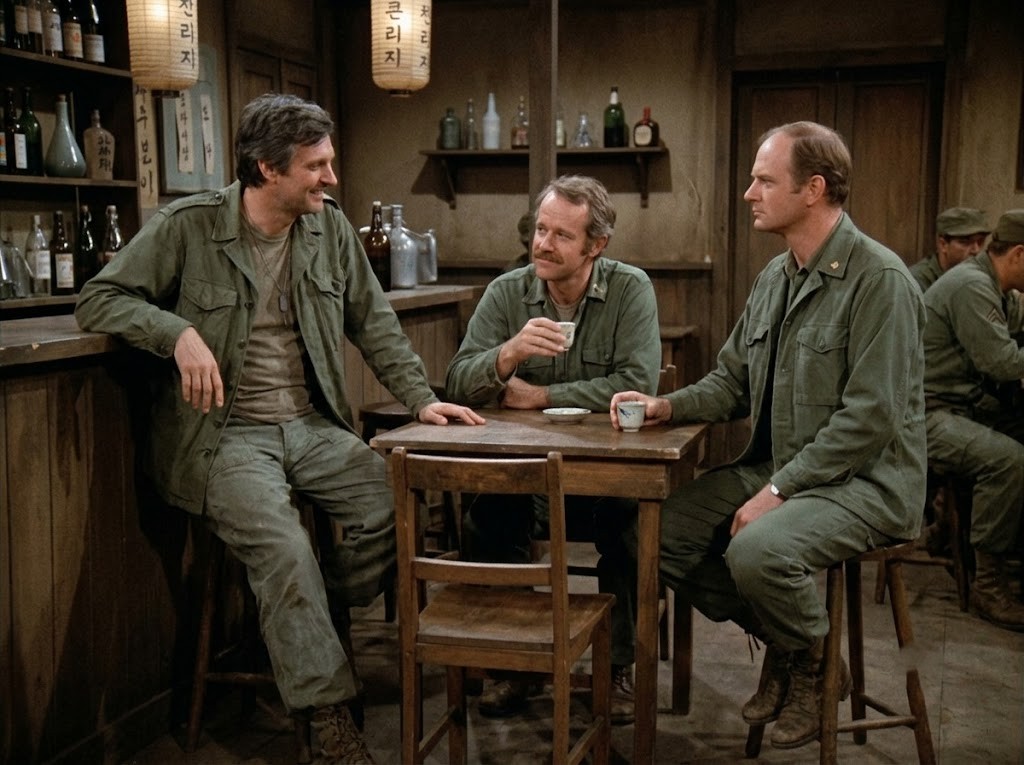
Some days, the war doesn’t come at you with the roar of incoming choppers or the frantic, metallic snap of hemostats under the blinding lights of the O.R.
Sometimes, it just seeps into your bones like the damp Korean winter, slow and heavy, until even your jokes feel like they weigh a hundred pounds.
That was the kind of Tuesday we were having at the 4077th.
After a grueling thirty-six-hour shift that left everyone smelling of antiseptic and exhaustion, the operating room had finally gone dark, leaving behind a silence so thick you could almost hear it.
Hawkeye, B.J., and Charles didn’t even bother changing out of their faded, sweat-stained fatigue jackets before wandering down the muddy path to Rosie’s Bar.
They just needed to be anywhere that didn’t smell like ether.
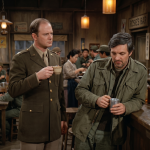
Rosie’s was quiet, save for the low murmur of a couple of enlisted men in the corner and the soft glow of the paper lanterns hanging from the rafters.
Hawkeye leaned heavily against the wooden bar, his long frame propped up by sheer willpower, a faint, tired smile playing on his lips as he looked over at his companions.
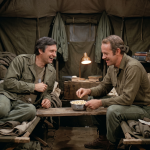
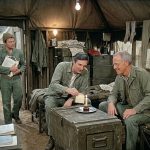
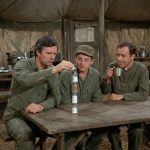
B.J. sat at the small, battered wooden table, his fingers curled around a tiny ceramic cup of Rosie’s questionable rice wine.
His mustache was slightly droopy from the humidity, but his eyes held that familiar, steady warmth that usually kept the rest of them anchored.
Across from him sat Charles, looking entirely out of place as usual, yet somehow completely rooted to his wooden stool.
Charles held his own tiny cup with the rigid precision of a man attending a high tea in Boston, his jaw set, his eyes staring blankly at the grain of the wood.
“You know,” Hawkeye said, his voice a gravelly whisper, breaking the silence like a stone dropped in a still pond, “if we stay here long enough, I think the wood grain on this bar might actually start making sense.”
B.J. let out a soft huff of a laugh, swirling the clear liquid in his cup. “Careful, Hawk. That’s the first sign of camp fever. The second sign is finding Charles’s conversation stimulating.”
Charles didn’t immediately snap back with his usual aristocratic venom.
He simply exhaled, a long, deflating sound that seemed to come from the very bottom of his wingtipped soul.
“If I had the energy to insult you, Captain Hunnicutt, I assure you it would be devastating,” Charles muttered, his voice devoid of its usual booming theatricality. “But presently, I am entirely bankrupt.”
Hawkeye watched them both, the humor fading slightly from his face to reveal the deep lines of fatigue etched around his eyes.
He leaned a bit closer to the table, his hand resting on the edge.
There was a bond here, unexpressed and buried under layers of sarcasm and stubborn pride, but as real as the mud outside.
Then, the small bell above Rosie’s door jingled.
It wasn’t a loud sound, but in the quiet of the bar, it made all three men tense up instantly—a reflex conditioned by months of mortar fire and sudden alerts.
Radar stepped inside, his oversized cap pulled low, holding a single, crumpled piece of paper in his hand.
He didn’t look at the bar; his eyes went straight to the table where the three doctors sat, and his face was entirely pale.
Hawkeye’s heart did a familiar, unpleasant flip in his chest.
“Radar,” Hawkeye said, his voice losing every trace of its previous banter. “Tell me that’s a Sears catalog order and not another shift.”
Radar swallowed hard, clutching the paper tightly. “No, sir. No incoming. The Colonel sent me to find Major Winchester.”
Charles didn’t move, but his shoulders went visibly rigid beneath his olive-drab jacket.
He slowly turned his head to look at the young corporal, his expression guarded, masked by the defensive wall of his Boston upbringing.
“What is it, Corporal?” Charles asked, his tone returning to a semblance of its formal, clipped authority, though a slight tremor betrayed him. “Has my sister Honoria sent another recorded message? Or has the mail carrier finally realized that Boston correspondence deserves priority over these… local circulars?”
Radar stepped closer to the table, looking incredibly small. “It’s a telegram, Major. From your father’s attorneys. It came through Tokyo.”
The silence in Rosie’s Bar suddenly felt freezing.
B.J. set his small cup down on the table with a tiny, delicate click.
Hawkeye straightened up from the bar, his casual posture vanishing as he stepped over to stand just behind B.J., his eyes fixed on Radar, then on Charles.
Charles reached out a hand, his fingers surprisingly steady despite the tension in the room, and took the paper from Radar. “Thank you, Corporal. You may return to your duties.”
Radar lingered for a second, looking anxiously between the three officers, before nodding quietly and slipping back out into the damp Korean evening, the bell jingling softly behind him.
Charles unfolded the paper.
The light from the paper lantern above cast long shadows across his face as he read the brief lines typed on the page.
For a long moment, nobody spoke.
The only sound was the distant, rhythmic thumping of a generator somewhere across the compound.
Hawkeye and B.J. exchanged a brief, worried glance.
They had seen Charles angry, they had seen him arrogant, and they had seen him profoundly annoyed, but they had rarely seen him completely still.
Finally, Charles folded the paper back up, very neatly, creasing the edges with his thumb until they were perfectly sharp.
He didn’t look up.
“My uncle,” Charles said, his voice surprisingly quiet, lacking any of its usual oratorical grandeur. “Julian Winchester. He passed away peacefully on Sunday at his estate in Beacon Hill.”
B.J. leaned forward, his face softening with immediate, genuine sympathy. “Charles… I’m so sorry.”
“He was an extraordinary man,” Charles continued, staring at his folded hands on the table. “He was the one who bought me my first cello. He told my father that a Winchester should not merely master the bank account, but also the arts. He was… the only one who didn’t look at my passion for medicine as a bourgeois eccentricity.”
Hawkeye stepped closer, placing a hand on the back of the empty wooden chair next to Charles.
The sarcastic quips that usually tumbled out of Hawkeye’s mouth vanished completely, replaced by the deep, protective empathy of a man who knew exactly what it felt like to love a family member from ten thousand miles away.
“Did you get to see him before you were shipped out?” Hawkeye asked softly.
Charles shook his head once, a minimal, tightly controlled gesture. “No. We had an argument about a recording of Brahms. A ridiculous, pedantic argument. And then the army called.”
He reached for his tiny cup of rice wine, his hand shaking just enough for the clear liquid to ripple against the ceramic rim.
He raised it slightly, looking at the cheap, unrefined spirits that were a world away from the crystal snifters of Boston.
“To Uncle Julian,” Charles murmured, his voice thick. “Who believed that music could cure the soul, long before I discovered that a scalpel could only patch the body.”
B.J. immediately raised his cup, his eyes locked onto Charles with total, unyielding support. “To Uncle Julian.”
Hawkeye didn’t have a cup, so he reached out, reached across the small table, and picked up B.J.’s bottle of rice wine, raising it in a silent, respectful salute before taking a small swig.
Charles looked up then, meeting the eyes of the two men he spent every day bickering with, the two men who drove him absolutely insane with their practical jokes, their unmade bunks, and their relentless defiance of authority.
And in that shared look, beneath the faded green uniforms and the exhaustion of a war that seemed to have no end, the walls crumbled.
There were no captains or majors in Rosie’s Bar right then.
There were just three tired doctors holding onto each other’s humanity in the middle of nowhere.
Charles drank his wine, a single, sharp swallow, and set the cup down.
He looked at Hawkeye, then at B.J., a faint, genuinely touched smile breaking through his grief.
“Thank you, gentlemen,” Charles said softly, his voice steadying. “Your comfort is… remarkably unrefined, but strangely effective.”
Hawkeye smiled back, leaning his arm on the back of Charles’s chair, the warmth returning to the room. “Hey, we do what we can, Charles. But don’t get used to it. Tomorrow, I’m fully planning on stealing your classical records again.”
“If you touch my Mozart, Pierce,” Charles replied, the familiar, comforting haughtiness returning to his eyes, “I will perform a tonsillectomy on you with a rusty butter knife.”
“Now that’s the Winchester we know and tolerate,” B.J. laughed gently, refilling Charles’s tiny cup.
They sat together as the lanterns flickered, the weight of the world just a little bit lighter because they were carrying it together.
In the quiet corners of the 4077th, the greatest medicine they ever offered was simply being there for one another.